[pageLogInLogOut]

#Weaving

DORNIER initiates mask development with the German Institutes for Textile and Fibre Research (DITF)
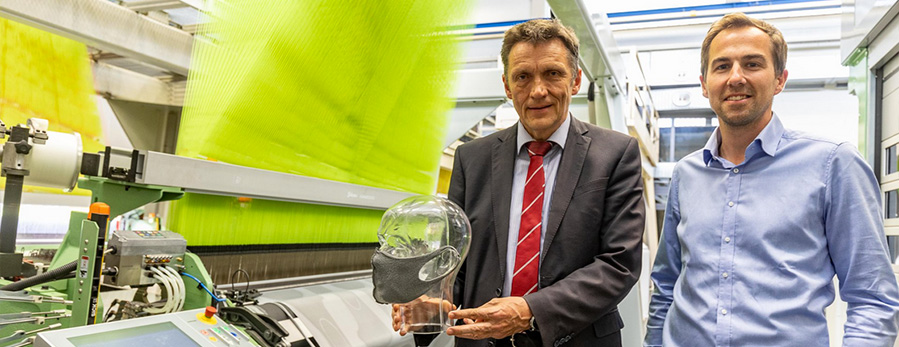
© 2020 Lindauer DORNIER
Initiated by weaving machine manufacturer Lindauer DORNIER, the DITF are launching a project to develop reusable medical face masks based on high-precision air-jet weaving technology.

This initiative creates the prerequesites for setting up the development, testing, approval, start-up production and cleaning service for reusable medical face masks within 4-6 months together with well-known industrial partners from the region and the Hohenstein Test Institute. The project, together with two other outstanding corona projects, was selected from 120 applications submitted nationwide and is supported by the Ministry of Economy, Labour and Housing with 195TEuro.

The supply situation for medical face masks has now stabilized; there is no longer an acute emergency situation as at the beginning of the Corona pandemic. Nevertheless, face masks are still a scarce commodity. The supply situation for protective equipment is extremely tense due to global demand. In order to avoid supply bottlenecks in the future, pragmatic solutions are being sought which, in cooperation with regional textile machinery manufacturers and textile producers, guarantee a secure supply in Baden-Wuerttemberg and make the state independent of supplies from Asia.

At the same time, it is important to further improve the wearing comfort and protective function when developing new masks. For the most complete protection possible, the masks must fit comfortably and tightly in the cheek area. There is currently still considerable potential for optimisation. In addition, conflicting requirements regarding air permeability and microbial filtration efficiency must be met. Last but not least, ecological aspects that speak against the use of disposable products must be taken into account.

The project that has now been approved by the DITF under the direction of Dr. Hans Jürgen Bauder, head of the weaving technologies division at the DITF, addresses these requirements with a completely new manufacturing approach: while the common protective masks are made of non-woven fabric and thrown away after having been used only once, the Denkendorf researchers are focusing on "ready-to-wear" one-piece masks. These are made of high-performance precision fabric woven in Jacquard weaving technique and, in addition, create the prerequisite for multiple use in order to save waste and avoid delivery bottlenecks.


An innovative manufacturing concept is realised for flexibly adaptable masks with significantly improved wearing comfort and thus higher protective function. According to initial calculations, the manufacturing costs are 6-8 cents/mask and thus provide a realistic basis for mass production.

For this ambitioned project, DITF are using the latest technology from associated textile machine manufacturers and textile producers: Lindauer DORNIER is providing the necessary air-jet weaving machines, Stäubli AG is the project partner for the Jacquard weaving technology.

Global Safety Textiles has agreed to support the project regarding the complex warp beam production and the drawing-in of the warp threads. The company TWD Fibres supplies antimicrobial filament yarns and textured yarns for the prototypes and the start-up production. At the same time, split fibres from the DITF technical centers are used which favour an increased filtration efficiency and are almost as fine as the fibres for masks made of meltblown non-woven fabric.

The medical face masks do not have to be sterile, but must imperatively be low in germs (disinfected). A project partner is therefore also the cleaning company Textilpflege Mayer, which takes on this task and cooperates with the Ortenau Clinic in Offenburg to evaluate the masks. The testing of the masks according to the specifications of EN 14683 is carried out by the Hohenstein Test Institute.

The project focuses on the technical design of the woven face mask, which is to be made available for production to the 15 textile companies in Europe which operate a total of more than 200 Jacquard weaving machines. The production settings of the masks developed at the DITF can be immediately transferred to existing production facilities. This would enable the 15 weaving mills to jointly produce over 2 million masks per day at short notice – a significant contribution to further stabilising the supply situation for protective masks.
More News from Lindauer DORNIER GmbH

#Weaving

Lindauer Dornier announces leadership transition in weaving machine business

After more than ten successful years at Lindauer DORNIER GmbH, Mr Wolfgang Schöffl will leave the family-owned company at the end of the year to enter well-deserved retirement.

#ITMA Asia + CITME Singapore 2025

DORNIER celebrates its anniversary at ITMA Asia + CITME

To mark its 75th anniversary, machine and plant manufacturer Lindauer DORNIER will be presenting the latest developments in its rapier and air-jet weaving machines at ITMA Asia + CITME in Singapore (Hall 2, Stand B401) from 28 to 31 October 2025. The focus will be on energy-efficient weaving technologies, new IoT solutions for networked textile production and systems for the series production of modern fibre composite components.

#Weaving

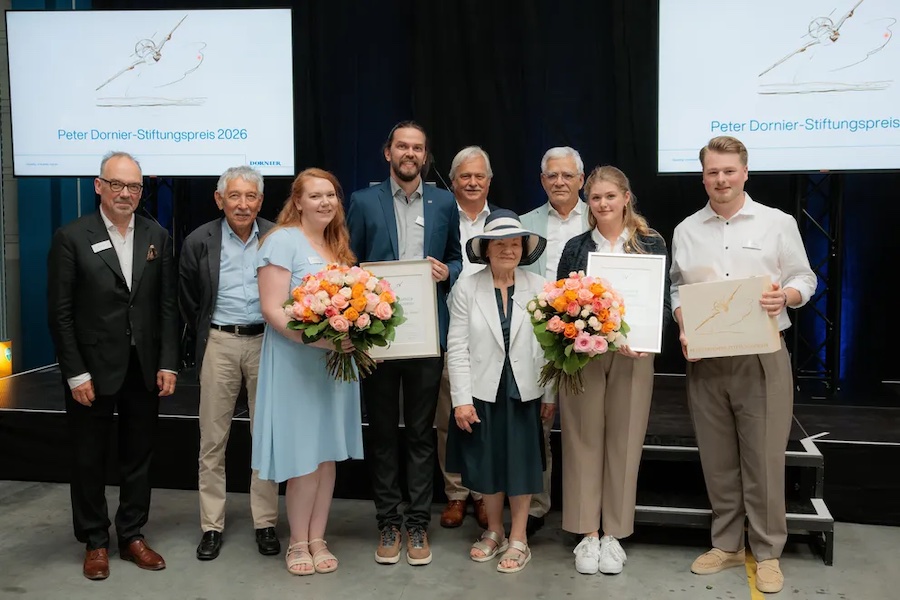
From the Venus flytrap to foldable aircraft wings: Peter Dornier Foundation Prize 2025 honours bionic research on 3D weaving technology

Long wings with foldable tips have the potential to reduce aircraft fuel consumption and make aviation more sustainable. An interdisciplinary research team has now developed a new solution based on the Venus flytrap: Freely movable wingtips made of fibre composites which are produced using innovative 3D weaving technology. For this pioneering combination of textile technology, aviation and bionics, researchers Patrick Meyer (TU Braunschweig) and Michael Vorhof (TU Dresden) were awarded the Peter Dornier Foundation Prize 2025 in mid-July.

#Weaving

Pattern-controlled “pic-a-pic” setting of rapier release timing on right-hand side

DORNIER PIRO enables the operator to set the timing of the rapier release on the right-hand side of the machine “pic-a-pic” and pattern-controlled. For applications with weft yarns of different fineness or elasticity, the optimum timing can be set for each weft channel. This offers great potential for reducing weft waste on the right-hand side.

More News on Weaving

#Research & Development

More safety and comfort for protective clothing thanks to auxetic fabrics

When everyday materials are pulled, they stretch or elongate in the direction of the pull and become narrower in cross-section. We can also observe this property in two-dimensional textiles. Auxetic structures behave differently here. They have the striking property of not changing under tensile stress or even increasing their width or thickness. These properties are advantageous, for example, in protective textiles or textile filter media. The DITF are researching auxetic fabrics for various applications.

#Weaving

Itema announces strategic partnership with Ivy Decarb to accelerate decarbonization in weaving process

Itema is pleased to announce the strategic partnership with Ivy Decarb, the digital platform helping textile companies measure and reduce their carbon footprint.

#Exhibitions & Events

Groz-Beckert showcases textile innovation at ShanghaiTex 2025

From December 16 to 19, 2025, the global textile industry will gather at ShanghaiTex at the Shanghai New International Expo Center (SNIEC), where Groz-Beckert will present its latest highlights and innovations across its five product areas – Knitting, Weaving, Nonwovens, Sewing, and Spinning – at Hall N3, Booth A05.

#Weaving

Vandewiele Group: Innovation across the textile value chain at ICFE Istanbul 2026

At the 2026 Istanbul Carpet & Flooring Expo (ICFE), Vandewiele Group presents its latest advancements spanning the entire textile value chain. From spinning and weaving to tufting, carpet manufacturing and digital finishing, the Group demonstrates how integrated innovation can boost performance, efficiency and sustainability across all stages of production. As a global technology leader, Vandewiele continues to develop solutions that strengthen processes, enhance product quality and enable smarter, greener manufacturing.

Latest News

#Dyeing, Drying, Finishing

Orthopac RVMC-20 plus: German Engineering for Smarter Weft Straightening

In times of rising cost pressure and growing quality demands, textile producers worldwide are searching for solutions that combine precision, efficiency, and sustainability. With its latest innovation, the Orthopac RVMC-20 plus, Mahlo once again demonstrates the strength of German engineering: improving proven technology to meet today’s challenges.

#Knitting & Hosiery

KARL MAYER and Lenzing partner to advance warp knitting with scalable cellulose fiber solutions

The Lenzing Group, a leading supplier of regenerated cellulosic fibers for the textile and nonwovens industries, together with KARL MAYER, the global market leader in warp knitting machines and warp preparation systems, debut a joint innovation project during Premiere Vision, Paris.

#Textile chemistry

RUDOLF gets the exclusive global distribution rights for Sanitized® textile technologies

With effect from today, RUDOLF officially assumes exclusive global distribution rights for Sanitized® textile technologies from SANITIZED AG. This is the next milestone in the strategic collaboration announced in 2025, with the partnership between the two companies now fully implemented and expanded worldwide.

#Europe

ICAC to support European Commission on pending PEF legislation

The International Cotton Advisory Committee (ICAC) is proud to announce that it has been included as a member of the European Commission’s Technical Advisory Board (TAB) on the Product Environmental Footprint methodology. The Commission developed the Product Environmental Footprint (PEF) to assess and communicate the life cycle environmental performance of products and organizations.

TOP