[pageLogInLogOut]

#Textiles & Apparel / Garment

The VF Foundation is bridging the gender gap in garment sector automation
(c) 2024 VF Foundation
Garment workers globally face potential widespread displacement due to the increase in automation. According to the International Labour Organization, sewing automation alone could displace 65 million workers globally.

With women making up 75 percent of the global garment workforce, the bulk of the loss of jobs will be roles held by women. Additionally, women in the garment industry often work in lower-tier roles, such as helpers and sewing machine operators, making them particularly vulnerable to displacement. When looking to find new jobs, women face challenges due to traditional gender roles and limited access to higher education acting as barriers for entry to higher-paying jobs within the garment sector and beyond.

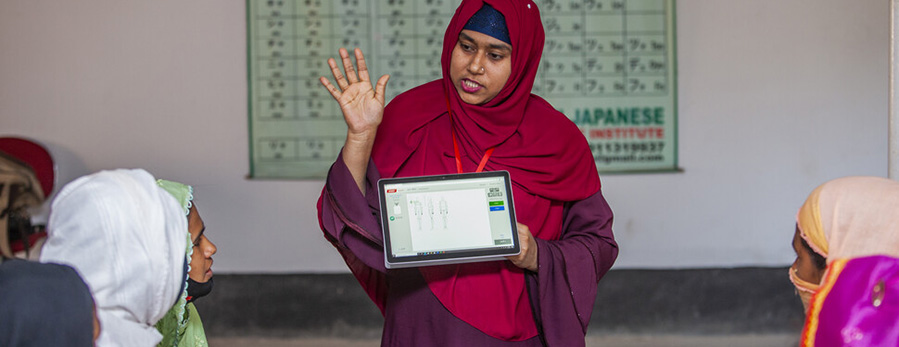
To address this challenge, Shimmy Technologies, a women-owned social enterprise, was founded in 2016 to prepare women working in apparel supply chains for the future of work through upskilling and reskilling via digital, mobile and tablet-based trainings. Shimmy’s mobile-first training approach is more flexible than traditional, paper-based training curriculum, the latter which inadequately addresses the rapid changes in the market.

Shimmy’s focus on this technical training component acts as a key unlock to assist workers in developing skills and gradually increasing their income. The majority female-led Shimmy team serves as role models to empower female workers to enter advanced operator roles. Their approach aims to reshape the workforce from the ground up, challenging the current status quo.

In 2022, The VF Foundation supported Shimmy’s pilot program across Bangladesh to reach unemployed women and assess the effectiveness of new training solutions to upskill and reskill women to provide them with the opportunity to enter the ready-made garment (RMG) industry. The program identified technical training centers in different cities across Bangladesh, including Dhaka, and located near garment factories in the area.

In addition, Shimmy carried out its research project called the Apparel Automation Pulse to identify current and future machines used in factories. This information helped Shimmy create a demand curve for machine-based skills, which in turn, informed the content of the training programs to align with the specific needs of employers.

The pilot yielded positive results. Of the 500 people who went through the training, 452 were women, and over 55% were employed in the RMG supply chain within six months. Of those without jobs in the RMG industry, only 23.19% were looking for work after six months. The remaining trainees opted to stay home as homemakers, continue with other studies, or enter another industry.

As a result of the success of the pilot, The VF Foundation recently announced Shimmy as a 2024 grantee to expand the upskilling of 500 more workers through mobile phone-based training and an additional 800 within physical training centers. This growing partnership with Shimmy exemplifies the power of collaboration, that complements VF’s work to empower women in its supply chain, and drives forward a shared vision to ensure a more sustainable and equitable future for women in the apparel industry.


More News from TEXDATA International

#Recycling / Circular Economy

textile.4U publishes special edition “Top 100 Textile Recycling Companies 2025”

With a comprehensive 176-page special edition, textile.4U is dedicating its latest issue entirely to one of the most dynamic and influential topics in today’s textile industry: textile recycling. The new issue, published exclusively in high-quality print, presents the Top 100 textile recycling companies researched and selected by TexData – organizations that already play a key role in the transition to circular textiles or are expected to have a significant impact in the near future.

#Recycling / Circular Economy

Responsible Textile Recovery Act of 2024 signed by Governor

Senator Josh Newman (D-Fullerton) is proud to announce that Senate Bill 707 (SB 707), the Responsible Textile Recovery Act of 2024, has been signed into law by the Governor of California, Gavin Newsom. This groundbreaking legislation establishes the country’s first Extended Producer Responsibility (EPR) textile recycling program, marking a significant step forward in the state’s efforts to combat waste and promote sustainability.

#Textiles & Apparel / Garment

Modtissimo promotes sustainability with 28 coordinates in the Green Circle

Modtissimo is proving more and more to be a textile and clothing show that delivers the latest innovations in the area of sustainability, with the iTechStyle Green Circle being the main showcase for companies' creations. In this 60+4 edition, taking place on 12 and 13 September, 28 coordinates will be exhibited in a section organised by CITEVE and curated by Paulo Gomes.

#Europe

The EU and Egypt team up to mobilise private sector investments at Investment Conference and sign a Memorandum of Understanding underpinning €1 billion in macro-financial assistance for Egypt

At the EU-Egypt Investment Conference, co-organised by the EU and the Government of Egypt on 29-30 June, the EU and Egypt are teaming up to intensify private sector investments in Egypt. They are also signing a Memorandum of Understanding (MoU) for the disbursement to Egypt of up to €1 billion in Macro-Financial Assistance.

More News on Textiles & Apparel / Garment

#Europe

Antwerp Declaration community urges EU leaders to deliver emergency measures as Europe’s competitiveness crisis deepens

EURATEX, representing the European textile and fashion industry, joins the Antwerp Declaration Community’s call on EU Heads of State and Government to adopt emergency measures that restore industrial competitiveness and deliver tangible results for Europe’s manufacturing base in 2026.

#Textiles & Apparel / Garment

Pets in fashion: functional and sustainable textiles find new market at Intertextile Apparel

China’s pet economy is booming, especially amongst younger generations, and pet apparel – from designer outfits to functional garments – was a RMB 3.5 billion (over USD 500 million) market in 2024, growing more than 20% annually¹. To help exhibitors harness this trend, Intertextile Shanghai Apparel Fabrics – Spring Edition 2026 will launch the Pet Boutique, presenting a range of innovative, sustainable materials that prioritise both functionality and comfort for pets.

#Sustainability

VAUDE eliminates PFAS from all products

PFAS (per- and polyfluoroalkyl substances) are now detectable worldwide – in drinking water, soil and the human body. These so-called “forever chemicals” are considered hazardous to health and potentially carcinogenic, as they do not break down and remain in the environment permanently. Despite these risks, PFAS are still used in a wide range of products. More than 15 years ago, VAUDE made a strategic decision to gradually eliminate PFAS from all product categories.

#Textiles & Apparel / Garment

IFCO 2026 has started today: Istanbul’s fashion expertise as a global business platform linking design, production, and trade

Around 450 exhibitors from all segments of the fashion industry are presenting their latest collections to more than 30,000 trade visitors from over 125 countries—ranging from womenswear, menswear, kidswear, eveningwear, lingerie, underwear, denim, shoes and accessories to homewear.

Latest News

#ITM 2026

The hub of smart and sustainable transformation in yarn technologies: ITM 2026

With global fiber production projected to reach 169 million tons by 2030, yarn manufacturing is becoming one of the most strategic fields within the textile machinery industry. Located in Halls 6, 7, and 10, the Yarn Hall at ITM 2026 is set to bring together industry professionals with innovative solutions developed around automation, energy efficiency, digitalization, and circular production.

#Research & Development

New DIN SPEC assesses environmental impact of textile fragments in soil

Textile products made from synthetic fibres, finished fabrics or dyed materials release fibre fragments into the environment at every stage of their life cycle. With the new DIN SPEC 19296, Hohenstein has developed a standardised testing method to analyse how these fragments behave in soil under natural conditions. Until now, little was known about their environmental behaviour or potential ecological effects once released.

#Research & Development

Solid Air Dynamics wins second place at RWTH Innovation Award

On 30 January, RWTH spin-off Solid Air Dynamics was awarded second place in the RWTH Innovation Awards for its research in the field of aerogel fibres. Manufactured from renewable raw materials, aerogel fibres offer outstanding thermal insulation, are extremely lightweight and completely biodegradable, and can consist of over 90 per cent air.

#Recycled_Fibers

Advancing the future of stretch: Fashion for Good launches new project to validate bio-based and recycled elastane

Launched today, Stretching Circularity is a collaborative project initiated by Fashion for Good dedicated to accelerating the adoption of lower-impact elastane alternatives that are compatible with circular textile systems. By validating bio-based and recycled elastane solutions through pilot-scale testing and demonstrator garments, the initiative aims to remove one of the most significant technical barriers to a circular textile economy.

TOP