[pageLogInLogOut]

#Textiles & Apparel / Garment

Borealis and paper republic unite in sustainable face mask initiative
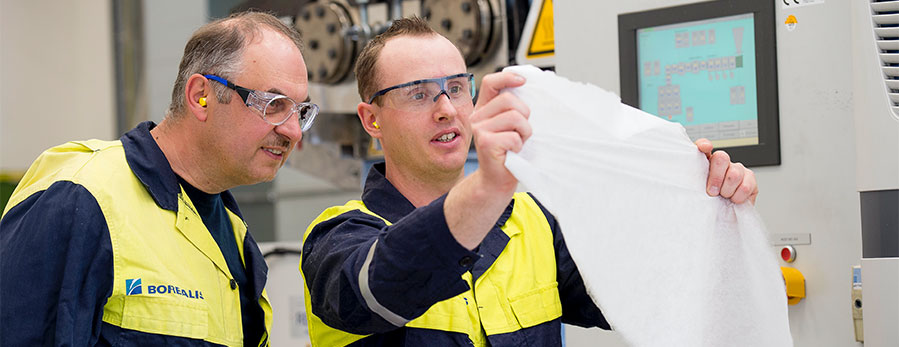
Meltblown fibres produced at Borealis’ pilot line in Linz, Austria Photo: © Borealis
Borealis, a leading provider of innovative plastics solution, and paper republic, a Vienna-based stationery brand, have teamed up in a social business initiative, named mask republic, for the production of sustainable, and reusable face masks.
  • mask republic collaboration offers high-quality reusable face masks assembled in Austria
  • The face masks feature a proprietary polypropylene resin from Borealis provided to this initiative through the Borealis Social Fund
  • Design, manufacturing and sales is organised by Vienna-based stationery brand paper republic
  • The face masks deliver up to four times better filtration than conventional hand-sewn alternatives

mask republic, which has been launched amid the COVID-19 pandemic, will supply face masks across Austria thanks to a reliable network of value chain partners, local and regional government organisations, and NGOs. Testing at Borealis laboratory facilities shows that the mask republic face masks provide up to four times more effective filtration than conventional hand-sewn face masks. Since washing the masks does not impact filtration effectiveness, they are perfectly washable and reusable without losing their filtration performance and therefore help to counter waste.

The mask republic partnership sees Borealis provide filtration media fabrics made using their new polypropylene (PP) resin for meltblown applications: Borealis HL912FB. Face mask design, manufacture and sales are being organised by paper republic. The initiative involves providing local and regional tailors, who would otherwise be unemployed or underemployed due to the coronavirus pandemic, with a custom-designed kit to assemble these masks from a light cotton fabric.

mask republic demonstrates how unlikely partners can come together to contribute to the communities in which they operate. “Some months ago it quickly became clear that Austria, like many other countries around the world, was facing one of the biggest health and safety challenges in nearly a century,” says Jérôme Bacquias, founder and Managing Director of paper republic. “We immediately knew that we had a mission to help the communities around us. These difficult times have brought us together with Borealis, in an extraordinary partnership that we are certain will benefit many.”

Demand for effective face masks has increased significantly amid the COVID-19 pandemic. Solutions are required that provide protection against the novel coronavirus, while at the same time enabling wearers to breathe easily. The need for face masks is expected to remain strong as European countries begin to loosen lockdowns and some introduce the mandatory wearing of face masks in public spaces.
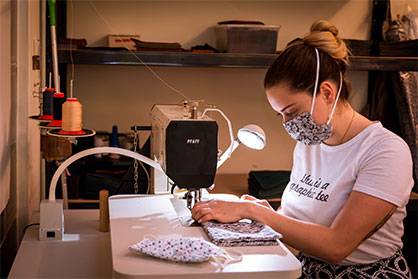
Seamstress sewing mask republic face mask Photo: © paper republic


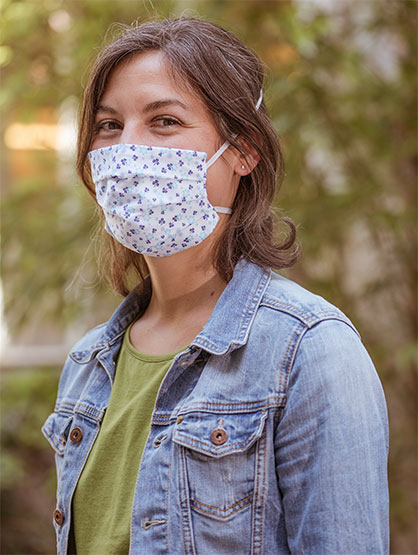
Woman wearing a mask republic face mask Photo: © paper republic

Borealis is the clear European market leader in PP resins for meltblown applications. These materials are particularly effective in hygiene applications, such as diapers and face masks, where micro- and nanofibre materials are required for barrier purposes. Due to the growing demand for face masks, Borealis recently converted a meltblown pilot line at its Linz, Austria, Innovation Headquarters for the small-scale production of fine fibre fabrics for these applications. The newly developed Borealis grade HL912FB is already being used on this line to produce meltblown fabrics for customised inlays in cotton-based mouth-nose masks, conventional mouth-nose masks, and possibly later on also for high-end face masks worn by medical professionals (FFP2, FFP3 and N95).

“We are very excited to be a part of an initiative through Borealis Social Fund, that benefits Austrian communities, while enabling us to provide our expertise and material solutions to improve people’s health, and safety, while being resource efficient and preventing waste,” explains Dorothea Wiplinger, Borealis Sustainability & Project STOP Manager. “The innovative Borealis material makes the masks more effective, while the design is not only fashionable but also sustainable, and safely reusable. Furthermore, we are also stimulating local employment. Borealis and paper republic demonstrate what reinventing for more sustainable living looks like.”

For more information: watch this and visit:

https://www.youtube.com/watch?v=EMpYZZ6-e0Q&feature=youtu.be

https://www.mask-republic.eu/

 

More News from TEXDATA International

#ITM 2026

ITM 2026: The new geography of textile production

New production hubs are emerging across North Africa and Central Asia, while Türkiye is accelerating its transformation toward higher-value, technology-driven and more sustainable textile manufacturing.

#Research & Development

“Production is a product”

From technical textiles and AI-driven robotics to the limitations of textile circularity: Professor Dr Thomas Gries looks back on more than two decades of development at ITA Aachen. In the interview, he explains why production technology remains a decisive success factor, discusses international collaborations and innovation ecosystems, and shares his views on the transformation of production landscapes and the challenges facing an increasingly regulated industry.

#Knitting & Hosiery

“We need to move away from the price trap and return to a value-driven mindset.”

With its new Textile Innovation Center, KARL MAYER is sending a strong signal for innovation, collaboration, and the future of textile applications. In this interview, Karl Josef Mayer discusses new opportunities in warp knitting, the processing of staple fibres, recycling, the changing role of machinery manufacturers, and why the textile industry must once again focus more strongly on the value of textiles. by Oliver Schmidt

#Associations

“Innovation, resilience and international experience remain the great strengths of the Swiss textile machinery industry”

Geopolitical uncertainty, growing competitive pressure from China, new free trade agreements and the shift towards a circular economy are currently reshaping the global textile industry. In this interview, Cornelia Buchwalder discusses the current mood within the Swiss textile machinery sector, the industry’s distinctive innovative strength, new market opportunities in India and Asia, and the technological trends that could shape the upcoming trade fair cycle leading up to ITMA 2027.

More News on Textiles & Apparel / Garment

#Man-Made Fibers

The LYCRA Company expands its co-creation vision through an immersive Lifestyle District at Intertextile Shanghai.

The LYCRA Company, a global leader in fiber and technology solutions for the apparel industry, is reimagining the trade show experience at Intertextile Shanghai Apparel Fabrics Autumn Edition, which opened today in China. Building on the success of last year's ALL IN concept, the company has expanded its co-creation vision into a 356-square-meter Lifestyle District featuring partners Jingzili New Material, JYT Textile, Lianxingfa Knitting, and Trend Textile. The district is part of a larger 895-square-meter pavilion showcasing a total of 19 co-exhibitors. Together, they demonstrate how innovations in fiber, fabric, and garments can be combined to create compelling solutions for both work and play.

#Textiles & Apparel / Garment

Hong Kong strengthens position as Asia's leading sustainable fashion hub

Hong Kong's position as one of Asia's most prominent sustainable fashion hubs has been further strengthened, with the HKTDC ESG Index 2026 released by the Hong Kong Trade Development Council (HKTDC) for the fashion industry rising to 65.5 in 2026, up 2.3 percentage points from 2025. The increase reflects growing industry confidence in Hong Kong as a premier platform for sustainable fashion development and ESG-related business opportunities.

#Textiles & Apparel / Garment

Première Vision Paris expands innovation focus across fashion and beauty

From September 1–3, 2026, Première Vision Paris will bring together more than 900 exhibitors from across the global fashion value chain. This year's edition places a strong emphasis on Innovation-Tech, highlighting technologies and materials that are reshaping product development, manufacturing and sustainability.

#Textiles & Apparel / Garment

Intertextile Apparel opens next week with strengthened focus on performance, sustainability, and innovation

Opening 25 August at the National Exhibition and Convention Center (Shanghai), Intertextile Shanghai Apparel Fabrics – Autumn Edition 2026 prepares to welcome thousands of global industry players for three days of sourcing, networking, and trend forecasting. Spanning 240,000 sqm, this edition will feature over 3,500 exhibitors from 30 countries and regions, providing a comprehensive platform for fairgoers to explore new products, market directions, and business opportunities across the entire apparel textile value chain – with high-potential segments noticeably magnified.

Latest News

#Raw Materials

Brazil sets new cotton export record and consolidates global leadership

Brazil ended the 2025/26 commercial year with a new record, consolidating its position as the world’s largest cotton exporter. Between August 2025 and July 2026, the country shipped 3,373,941 tonnes of the fiber, 19% more than in the previous cycle, and reached record revenue of US$5.3 billion. The result represents a milestone in Brazil’s expansion in the international market and reinforces the country’s role as a strategic supplier to the global textile industry.

#Raw Materials

Better Cotton Initiative partners with Avalo in AI plant breeding for climate-resilient cotton

The Better Cotton Initiative (BCI) has partnered with agriculture solutions company Avalo, whose platform accelerates the speed at which plants with key resiliency traits may be developed.

#Natural Fibers

Plastic-free stretch technologies drive new direction for denim innovation

As the denim industry looks for ways to reduce its reliance on synthetic fibres, plastic-free stretch technologies are gaining momentum. Developments based on mechanical fabric construction and natural rubber are demonstrating that comfort and stretch can be achieved without conventional elastane, supporting both recyclability and circular product design.

#Man-Made Fibers

Bemberg and Anita Dongre collaborate once again to launch “BREATH” collection

BembergTM and Anita Dongre present BREATH, a ready to wear collection of 18 key silhouettes, shaped by a common belief that true beauty is inseparable from caring for the environment.

TOP