[pageLogInLogOut]

#Textiles & Apparel / Garment

Getzner Textil is taking innovative measures to protect its employees from coronavirus
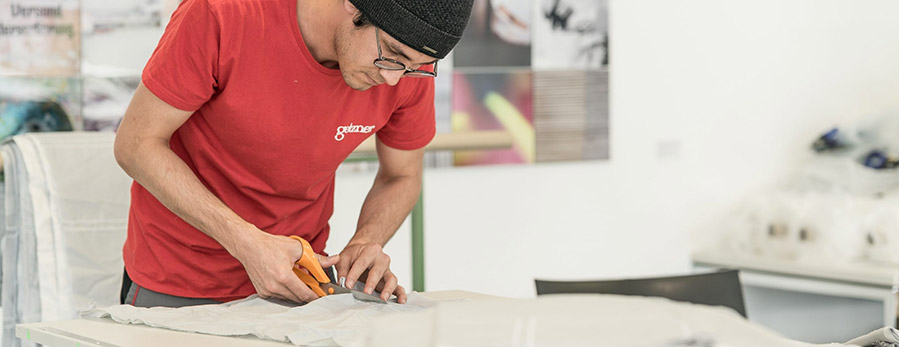
The vocational trainees are also passionately committed to the production of face masks for their colleagues.(Image: GTAG)
In over more than 200 years of company history, Getzner Textil AG has already faced a few crises head on. However, the overriding motto has always been to not only overcome any seemingly insurmountable obstacles, but to also think outside the box and to create a fertile breeding ground for creative thinking and/or innovations. During the corona crisis, we also managed to mobilise resources and implement important measures in a very short time to protect the workforce and pre-emptively safeguard the business.

"We are willing to keep on learning"

“The health of our employees is our top priority. We therefore introduced efficient hygiene and protective measures at an early stage and also made every effort to successfully implement and adhere to them. The current situation is new for all of us and doubtlessly contributes to the general uncertainty. However, we are willing to keep on learning, to adjust our strategies accordingly and to do everything we can to jointly master this crisis,” says Getzner Textil AG CEO Roland Comploj. The Bludenz-based family business is therefore passionately committed to its membership of a Vorarlberg consortium dedicated to the manufacture of tested and certified surgical face masks for medical use and the healthcare sector. The high-quality and durable fabric required to produce these in large quantities is made by Getzner Textil. As a preventative measure, the company has also made face masks that cover the mouth and nose available to its own workforce as soon as possible. To guarantee their availability, Getzner has set up a dedicated sewing shop equipped with several industrial sewing machines that are manned on a three shift basis.

The high-quality and durable fabric for the surgical face masks is made by Getzner Textil. (Image: GTAG)


Disinfectants made in-house

The development of solutions to guarantee the best-possible protection for the workforce and the company premises was actively addressed at a very early stage. In order to prevent a shortage of disinfectants on the premises, they were simply manufactured on site by the experienced professionals in the Getzner Textil AG in-house laboratory. The skilled craftspeople in the in-house joinery and in the metalworking department also came up with the idea of designing practical stands for disinfectant dispensers, for example, which they also made available to all subsidiaries in Germany, Austria and Switzerland. The dispensers are currently refilled twice a day by designated employees. Around 120 litres of disinfectant are therefore needed and used at the Bludenz site every week. The extensive package of measures that was implemented as soon as possible also includes touchscreen styluses for operating the machines, physical distancing rules, a group meeting and contact ban as well as the provision of disposable or cotton gloves for the production workforce.
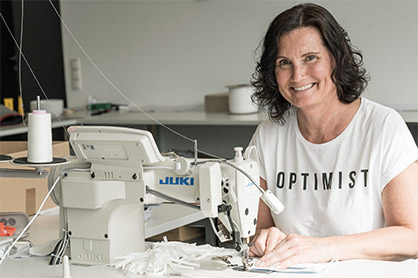

Getzner Textil AG employees from various different departments hard at work for the sake of occupational health and safety in the sewing shop set up exclusively for this purpose. (Image: GTAG)


More News from TEXDATA International

#ITM 2026

ITM 2026: The new geography of textile production

New production hubs are emerging across North Africa and Central Asia, while Türkiye is accelerating its transformation toward higher-value, technology-driven and more sustainable textile manufacturing.

#Research & Development

“Production is a product”

From technical textiles and AI-driven robotics to the limitations of textile circularity: Professor Dr Thomas Gries looks back on more than two decades of development at ITA Aachen. In the interview, he explains why production technology remains a decisive success factor, discusses international collaborations and innovation ecosystems, and shares his views on the transformation of production landscapes and the challenges facing an increasingly regulated industry.

#Knitting & Hosiery

“We need to move away from the price trap and return to a value-driven mindset.”

With its new Textile Innovation Center, KARL MAYER is sending a strong signal for innovation, collaboration, and the future of textile applications. In this interview, Karl Josef Mayer discusses new opportunities in warp knitting, the processing of staple fibres, recycling, the changing role of machinery manufacturers, and why the textile industry must once again focus more strongly on the value of textiles. by Oliver Schmidt

#Associations

“Innovation, resilience and international experience remain the great strengths of the Swiss textile machinery industry”

Geopolitical uncertainty, growing competitive pressure from China, new free trade agreements and the shift towards a circular economy are currently reshaping the global textile industry. In this interview, Cornelia Buchwalder discusses the current mood within the Swiss textile machinery sector, the industry’s distinctive innovative strength, new market opportunities in India and Asia, and the technological trends that could shape the upcoming trade fair cycle leading up to ITMA 2027.

More News on Textiles & Apparel / Garment

#Textiles & Apparel / Garment

Catalyst Club launches in Florence: Where conversations become catalysts for change

The first chapter of Catalyst Club debuted in Florence, bringing together creative directors, entrepreneurs, manufacturers, journalists and innovators from across the fashion and textile industry for an evening of dialogue, exchange and connection.

#Associations

Mario Jorge Machado re-elected President of EURATEX

The EURATEX General Assembly has re-elected Mario Jorge Machado as President of EURATEX, renewing its confidence in his leadership at a crucial moment for the European textile and clothing industry. The sector is facing rising costs, global competitive pressure and an increasingly challenging transition towards sustainability and digitalisation.

#Textiles & Apparel / Garment

Autopsy, the new trend book by Texworld Apparel Sourcing Paris, deciphers the fractures of our time through 12 creative signals

Presented during Texworld Apparel Sourcing Paris, from August 31 to September 2, 2026, at the Paris-Le Bourget Exhibition Center, Autopsy offers a reinterpretation of the contours of fashion in a world undergoing profound transformation, balancing radical introspection and sensitive renewal.

#Yarn & Fiber

Next week’s focus: Intertextile Shenzhen & Yarn Expo Shenzhen fuse textile tradition with sustainable, digital trends

Fashion will not be left behind in one of the world’s undisputed tech and manufacturing capitals. Which is why next week, at Intertextile Shenzhen Apparel Fabrics and Yarn Expo Shenzhen 2026, the organisers have made special efforts to integrate textile topics such as materials innovation, holistic sustainability, digitalisation and AI. Yet, from 9 – 11 June at the Shenzhen Convention and Exhibition Center, the platform also includes timeless tradition and heritage-inspired evolution in equal measure. Across both shows, over 600 exhibitors from 11 countries and regions are set to showcase everything from Peruvian alpaca wool fabrics to tea-derived fibres, while their fringe programmes will explore diverse solutions along the entire value chain.

Latest News

#Recycling / Circular Economy

Reju opens its first R&D Center in the U.S. in Conshohocken, Pennsylvania

Reju, the company specializing in textile regeneration, today announced the opening of a Research and Development (R&D) Center in Conshohocken, Pennsylvania, the company's first proprietary research center in North America. Located within Technip Energies' existing Advanced Materials and Catalysts research center, the lab will allow Reju to accelerate the rollout of its recycling technologies and develop its next-generation circular solutions.

#Weaving

Itema reaffirms its commitment to the Syrian textile industry at NasTex 2026

From July 18th to 21st, Itema will exhibit at NasTex at the Damascus Fairground (Hall 11 – Stand C02), marking its return to one of the Middle East’s historically significant textile markets. Itema will showcase advanced weaving technology designed to support the competitiveness and technological evolution of Syrian manufacturers and announces a new partnership with Growfast Agency as the sole agent of Itema in Syria.

#Knitting & Hosiery

KARL MAYER's HKS 2-SE Expands Possibilities for Premium Stretch WARP KNITS

Warp knitted fabrics with a woven look are more in demand than ever in the fashion and apparel industries. Stretch WARP KNITS, in particular, impress with their freedom of movement, breathability, and virtually wrinkle-free wear – thereby opening up new style worlds such as smart casual or business casual. When it comes to the highly efficient production of premium-quality stretch WARP KNITS, the HKS 2-SE has long been the machine of choice. KARL MAYER’s best-selling tricot machine produces standard elastic fabrics characterized by high gauges, smooth, delicate surfaces, and a soft hand feel.

#Recycling / Circular Economy

Textiles Recycling Expo 2026 builds on successful debut with record attendance, global participation and expanded industry collaboration

The second edition of Textiles Recycling Expo concluded on 24–25 June at Brussels Expo, reinforcing its position as Europe's leading exhibition and conference dedicated exclusively to textile recycling and circularity.

TOP