[pageLogInLogOut]
Texprocess 21.4.-24.4.2026 FRANKFURT/MAIN From idea to tangible results.

#Textile processing

Coloreel receives financing from Nefco – Swedish innovation furthers circularity in the textile industry
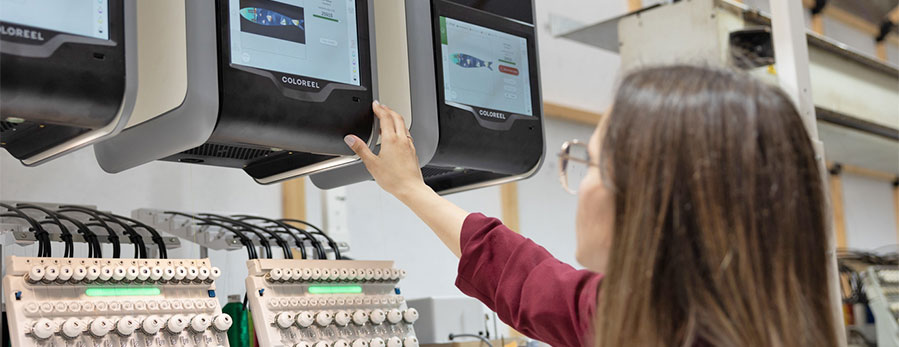
© 2022 Coloreel
On-demand thread colouring and fully recycled materials reduce the environmental impact of embroidery and make Coloreel a unique partner for sustainable clothing companies.

Nefco, the Nordic Green Bank, has signed a loan agreement with Coloreel Group AB to support its growth and expansion on global markets. The technology developed by Coloreel will lead to positive environmental effects within the textile industry by minimising thread waste, use of chemicals and wastewater.

All known embroidery machines on the market today rely on individual pre-coloured reels of thread for each colour used in the embroidery process. The Swedish company Coloreel’s unique, patented technology addresses this issue by using a single recycled polyester thread as input, thereby eliminating the need for pre-coloured threads, which are a significant cause of wastewater pollution. Coloreel’s on demand solution will also reduce the amount of wasted thread in the embroidery process.

“We are excited to provide this financing for Coloreel because the company has the potential to make embroidery and clothing production far more sustainable than it is today and enable a major step towards circularity in the textile industry,” said Fredrik Larsson, Investment Adviser, Nefco.


Coloreel’s innovation was driven by the significant environmental impact of the textile industry and the challenges posed by traditional methods of handling threads, which require many hundreds of thread reels to be stocked while still not ensuring the right colours are available to complete subsequent production orders. Based in Jönköping, southern Sweden, Coloreel is primarily looking to grow on global markets.

“The Nefco financing will go a long way in supporting our international expansion. It is also a strong acknowledgement of the sustainability benefits we can offer the textile industry,” said Torbjörn Bäck, CEO, Coloreel.

Using 100% recycled polyester threads, Coloreel offers the design freedom of digital print, including unlimited colours and effects, while delivering quality embroidery.


More News from Coloreel

More News on Textile processing

#Textile processing

Jeanologia showcases the future of product development

Jeanologia is showcasing how software is transforming product development in the fashion industry at PI Apparel Europe: The Fashion Technology Show, taking place on March 30–31 in London.

#Techtextil 2026

Groz-Beckert showcases cross-segment innovations for technical textiles in Frankfurt

From April 21 to 24, 2026, Groz-Beckert will present its latest innovations and solutions across the product areas of knitting, weaving, nonwovens and sewing at Techtextil 2026 in Frankfurt (Hall 12, Booth B90).

#Textile processing

Major expansion for ACG Kinna follows record year

In response to growing demand for its full textile and finished product line automation services, ACG Kinna – a member of TMAS, the Swedish textile machinery association – has inaugurated a 1,000-square-metre expansion at its headquarters in Skene, Sweden.

#Texprocess 2026

Texprocess 2026: Automation, digitalisation and AI reshape textile processing

Investment decisions in textile processing have become increasingly complex. Rising energy prices, labour shortages and geopolitical uncertainties are forcing companies to prioritise technologies that deliver measurable improvements in efficiency and process stability. This applies not only to apparel production, but also to the processing of technical textiles and high-performance materials. Modernisation projects are therefore being evaluated more selectively – but the pressure to upgrade production systems continues to grow. Texprocess 2026 reflects this tension between cautious investment behaviour and increasing technological demand.

Latest News

#Composites

KARL MAYER strengthens partnerships in the composites industry at JEC World 2026

KARL MAYER further strengthened its role as a reliable and competent partner to the composites industry at JEC World 2026. The global market leader in textile machinery manufacturing used the trade show to meet key customers, establish numerous new contacts, and engage in in-depth technical discussions.

#Recycling / Circular Economy

ABB and Syre partner to explore technologies for industrial-scale textile recycling

ABB has signed a Memorandum of Understanding (MoU) with Swedish textile impact company Syre to jointly explore technologies to support the development of Syre’s first textile-to-textile recycling plant in Vietnam. The agreement establishes a framework for collaboration to investigate how ABB’s automation, electrification and digital technologies could contribute to safe, efficient and scalable operations. It will also explore how these capabilities could further optimize process and quality control performance as Syre advances its ambition to produce circular polyester at industrial scale.

#Techtextil 2026

From Nature Performance to Circular Economy: Techtextil 2026 focuses on the future market for technical textiles

Alternative materials and recycling technologies are one of the most important future segments and drivers of innovation in technical textiles. Sustainability goals and regulatory requirements increase their relevance, while advances in performance and economic viability enhance their market competitiveness. Taking place from 21 to 24 April 2026, Techtextil reflects this key industry trend with a growing number of specialised exhibitors. With the new “Nature Performance” label, the leading global trade fair bundles relevant market offerings and facilitates access to new solutions – from natural fibres and yarns to bio-based materials and circular approaches.

#Research & Development

Textile cascade filter for removing microplastics from wastewater

Microplastics are now found almost everywhere, even in remote regions of Antarctica. They enter the human body through the food chain. Studies indicate that microplastics may have negative effects on the human health.

TOP



