[pageLogInLogOut]

#Textile chemistry

DOMO Chemicals and Hynamics commit to joint project for the production of polyamides from low-carbon hydrogen

DOMO Chemicals, a leading producer of engineered polyamide materials, and Hynamics, a 100% subsidiary of EDF Group specializing in the production of low-carbon hydrogen, have entered into a partnership project with the objective of achieving zero-carbon for 100% of the hydrogen used at the Belle-Étoile industrial site, in Saint-Fons (south of Lyon, France), in the heart of the French Vallée de la Chimie (“Chemistry Valley”).

For the first time in France, the “HyDom” project will enable the installation of an 85-megawatt (MW) hydrogen production plant using the water electrolysis process at the Belle-Étoile site, with a production capacity of 11,000 metric tons of low-carbon hydrogen per year. The plant will be powered by the French low-carbon electric power mix. By 2027, it will supply 100% of the annual production of hexamethylene diamine, a key component used in the production of plastics.

The project will eventually prevent the emission of 84 kilotons of carbon dioxide (CO2) each year. Hexamethylene diamine, and ultimately, durable and low-carbon polyamides, will be used in various applications in major industry sectors, such as automotive, electronics, and heating & cooling.

This project is a major step towards the decarbonization of industrial sites that use grey hydrogen (produced from fossil fuels). The location in the Vallée de la Chimie within the vicinity of major transport routes opens up opportunities for the creation of a more complete hydrogen ecosystem.

The first phase of the project will consist of building up and ascertaining technical concepts and integrating the low-carbon hydrogen production plant within the larger production process of hexamethylene diamine.
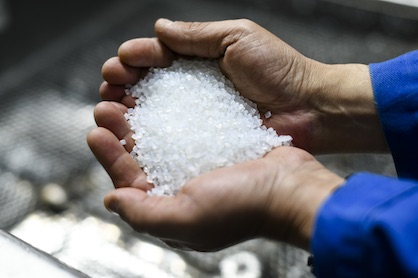
DOMO Belle-Étoile-PA66 base polymers (c) 2022 DOMO


Considering the high-power scale of the future electrolytic hydrogen production facility, the HyDom project is being developed in close collaboration with RTE (an organization in charge of managing the French power grid), to solve connection issues. As a priority project for the industry's zero-carbon strategy and for the “France 2030” investment plan, HyDom is supported by the French government and has been presented to the European Commission for public funding.

According to Christelle Rouillé, CEO of Hynamics: “In line with the goals set out in the France 2030 investment plan for a resilient and decarbonized industrial sector, Hynamics is proud to support leading hydrogen-consuming industrialists in their decarbonization efforts. The scope of the project launched in partnership with DOMO Chemicals reflects Hynamics’ expertise in developing industrial electrolytic hydrogen production projects with a strong environmental impact. In replacing the unit that currently produces hydrogen from natural gas, our project represents an important step towards industrial sovereignty and reaching our climate objectives”.

According to Yves Bonte, CEO of DOMO Chemicals: “The reduction of CO2 emissions remains a major challenge for the industry, and DOMO's low carbon footprint solutions are designed to help customers achieve their own CO2 emission reduction targets. This joint investment in a low-carbon hydrogen unit to replace the existing natural gas-based production unit will provide the first hydrogen infrastructure in the Lyon area. This strategic partnership will help us - and hopefully an entire ecosystem in the Vallée de la Chimie - achieve DOMO's ambitious goals for 2030, focused on decarbonization, the use of renewable energy and delivering customer solutions.”



More News from TEXDATA International

#ITM 2026

ITM 2026: The new geography of textile production

New production hubs are emerging across North Africa and Central Asia, while Türkiye is accelerating its transformation toward higher-value, technology-driven and more sustainable textile manufacturing.

#Research & Development

“Production is a product”

From technical textiles and AI-driven robotics to the limitations of textile circularity: Professor Dr Thomas Gries looks back on more than two decades of development at ITA Aachen. In the interview, he explains why production technology remains a decisive success factor, discusses international collaborations and innovation ecosystems, and shares his views on the transformation of production landscapes and the challenges facing an increasingly regulated industry.

#Knitting & Hosiery

“We need to move away from the price trap and return to a value-driven mindset.”

With its new Textile Innovation Center, KARL MAYER is sending a strong signal for innovation, collaboration, and the future of textile applications. In this interview, Karl Josef Mayer discusses new opportunities in warp knitting, the processing of staple fibres, recycling, the changing role of machinery manufacturers, and why the textile industry must once again focus more strongly on the value of textiles. by Oliver Schmidt

#Associations

“Innovation, resilience and international experience remain the great strengths of the Swiss textile machinery industry”

Geopolitical uncertainty, growing competitive pressure from China, new free trade agreements and the shift towards a circular economy are currently reshaping the global textile industry. In this interview, Cornelia Buchwalder discusses the current mood within the Swiss textile machinery sector, the industry’s distinctive innovative strength, new market opportunities in India and Asia, and the technological trends that could shape the upcoming trade fair cycle leading up to ITMA 2027.

More News on Textile chemistry

#Textile chemistry

ZymoChem secures $4 million in renewed federal funding to advance U.S. biomanufacturing of critical materials and their supply chains

ZymoChem, the specialty chemicals company dedicated to bringing decarbonization, sustainability, and supply chain resiliency to the chemical industry through innovative biological manufacturing, today announced the resumption and expansion of its federal research portfolio. The company has been notified that previously paused work under a $5 million U.S. Department of Energy (DOE) program is officially back on, to be joined by continuing collaborations with three of the nation's premier national laboratories.

#Textile chemistry

bluesign updates chemical reference lists with stronger PFAS restrictions

bluesign has published the 2026 editions of its three core chemical reference lists, introducing updated substance limits and testing requirements in line with the latest scientific findings and regulatory developments.

#Textile chemistry

Fashion for Good launches DW(O)R-X to navigate the emerging landscape of PFAS-free finishes

Fashion for Good announced the launch of Project DW(O)R-X, a collaborative initiative designed to benchmark PFAS alternative durable water- and oil-repellent (DW(O)R) chemistries. Responding to growing market demand for alternatives to PFAS‑based finishes, the project aims to generate reliable, comparable data that can support informed sourcing decisions and the assessment of emerging chemistries.

#Sustainability

Indovinya advances sustainable solutions with agreement for the supply of renewable Oxygen from Air Liquide

Indovinya, the specialty chemicals and surfactants division of Indorama Ventures, has entered into an agreement with Air Liquide — a world leader in gases, technologies, and services for industry and healthcare — for the supply of renewable oxygen. The agreement represents a strategic advancement in Indovinya’s commitment to sustainability, as it increases the share of renewable raw materials in the production of ethylene oxide, one of its key products.

Latest News

#Weaving

Lindauer DORNIER GmbH welcomes new apprentices and dual-study students

For 22 new “DORNIER Talents”, these days mark the beginning of a new chapter at Lindauer DORNIER. For the family-owned company, in-house training is a key pillar in developing skilled professionals and retaining them within the company for the long term.

#Raw Materials

Cotton Brazil Dialogues 2026 concludes with 50 international participants immersed in Brazilian cotton production

The Cotton Brazil Dialogues concludes its 2026 edition after a series of technical visits to farms, cotton gins and reference centers, as well as workshops focused on Brazilian cotton production. A total of 50 participants from 14 countries took part in the field trips. The initiative is led by the Brazilian Association of Cotton Growers (Abrapa) and the National Association of Cotton Exporters (Anea), with support from the Brazilian Trade and Investment Promotion Agency (ApexBrasil).

#Research & Development

Novel flame-retardant and recyclable fiber-reinforced composite

Airplanes and passenger trains must meet strict safety requirements, including fire safety standards. This calls for materials that are flame-retardant, lightweight, robust, and scalable. Empa researchers, in collaboration with their industry partner Elantas, have now succeeded for the first time in making such a material – a composite – fully recyclable.

#Composites

WHILL selects Teijin’s tough, lightweight Carbon Fiber Composite for new last-mile mobility

Teijin Limited announced today that WHILL Inc., a global leader in inclusive mobility technology, has selected Sereebo® P CFP series, a carbon fiber-reinforced thermoplastic (CFRTP) material, for key structural components of the upcoming WHILL Model C Lite. Sereebo® P CFP series provides high strength, light weight, design flexibility and system cost advantages to the Model C Lite, which is a battery powered, single-seat, last-mile device. This new model combines maneuverability with light weight and one-handed folding to ensure ease of handling and operation.

TOP