[pageLogInLogOut]

#Textile chemistry

BASF at Simac – Endless possibilities of combining design, performance, and sustainability for footwear
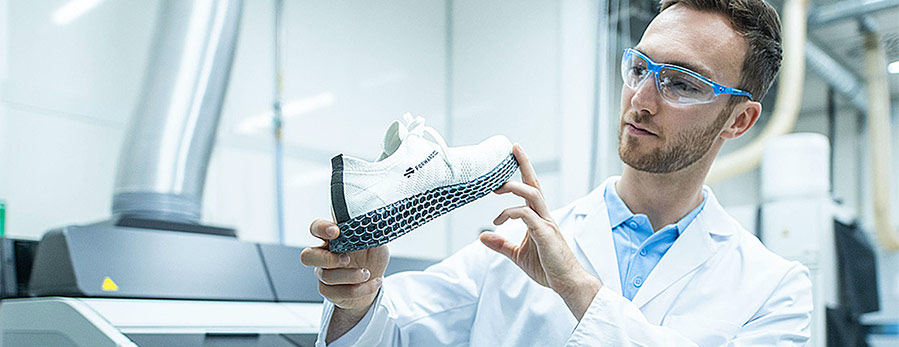
3D printed molds and tools to completely 3D printed shoes will be presented at the BASF booth at Simac. © 2021 BASF
Sustainable PU systems, TPU and E-TPU, 3D printed molds, functional coatings, and the comfort of a sneaker for dress shoes – all these solutions for the footwear industry will be presented by BASF at Simac. The international machinery and technology exhibition for shoes, is being held in Milan from September 22-24. In hall 14, booth G 40, visitors will be given insights into sustainable footwear solutions, high performance materials and coating solutions for shoe soles.
  • Step towards a net-zero emissions with the Reduce, Recycle, Rethink approach
  • Innovative coating technologies for highly flexible substrates
  • Additive manufacturing – a game changer for the footwear industry
  • Infinergy® – more comfort for business shoes

Footwear innovations for circular economy

Future-oriented footwear materials are inconceivable without sustainability. Sustainability is a main pillar of BASF's strategy and an integral part of all business decisions. That is why BASF invests around 2 billion a year in research and development and drives the development of new products that make a significant contribution to sustainability. BASF's approach to a circular economy in footwear consists of three fields of action: Reduce, Recycle, Rethink. At the show, BASF experts will give a deep insight into this approach and present sustainable material solutions for polyurethane systems and thermoplastic polyurethanes.
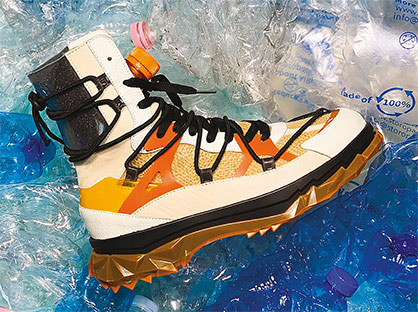

Footwear Design Contest 2020; School for design Calzaturiero Politecnico, Padua, Italy.
Students' unique shoe creations, combinations of design, performance, and sustainability, will be presented at the BASF booth at Simac. © 2021 BASF" alt=""Design in the sign of sustainability"

Footwear Design Contest 2020; School for design Calzaturiero Politecnico, Padua, Italy.
Students' unique shoe creations, combinations of design, performance, and sustainability, will be presented at the BASF booth at Simac. © 2021 BASF">
"Design in the sign of sustainability" Footwear Design Contest 2020; School for design Calzaturiero Politecnico, Padua, Italy. Students' unique shoe creations, combinations of design, performance, and sustainability, will be presented at the BASF booth at Simac. © 2021 BASF


The main goal is to reduce the consumption of fossil resources and thus CO2 emissions. Elastopan® N (PU systems) and Elastollan® N (TPU) contribute to this, as they are partly based on renewable raw materials such as sugar, corn or castor oil. These bio-based plastic solutions are available in various densities and degrees of hardness and are suitable for all applications in the footwear sector.

In addition, BASF's integrated production system enables the substitution of fossil by renewable feedstock derived from bio-waste. This concept, called the BASF biomass balance approach, can be compared to green electricity: When alternative energy sources (e.g., wind and solar energy) are fed into the power grid, the output of the end product, electricity, remains unchanged. Similarly, at BASF: the biobased or recycled raw materials are fed into the production network at the beginning and then further processed in many steps, e.g., into plastics. This principle offers the advantage that greenhouse gas emissions are reduced, and fossil raw materials are saved, while product quality and properties remain the same. For customers in the footwear industry, this also means that the product design and the processing for shoes do not have to be adapted. This concept can be applied to BASF's complete range of PU systems, TPU and E-TPU for footwear.


To achieve the ultimate goal of a circular economy, we need to rethink the production and use of footwear in general. This is the task that Italian designer Linda Lipari, together with designer Pierpaolo Righetto and students from Calzaturiero Politecnico (the School of Footwear Design and Technology) dedicated themselves to during the recent design competition, namely "design in the sign of sustainability". The basis for the students' various creative interpretations is the designers' "RE2.0" sole design. RE implies Restart, Rethink, Recreate, Reconquer the world. The students' unique shoe creations, combinations of design, performance, and sustainability, will be presented at the BASF booth.

Highly elastic soft touch coatings

Furthermore, BASF will present innovative coatings technologies for highly flexible substrates from our Coatings division. These solutions protect, functionalize and color flexible surfaces. They set new standards in design opportunities, individualization and enable BASF's customers to optimize their processes.

As NovaFlex valureTM, BASF markets reverse-coated substrates which can achieve unique optical and haptic properties by combining paint formulation, texture, and carrier material. NovaCoat-D combines in-mold coating and release coating in a new way. Besides its demold properties, the coating provides protection against sunlight, scratches, and dirt. Thanks to its many years of expertise, BASF can offer a wide range of colors and effects and bring in additional functionalities for e.g., shoe uppers and sole.

3D Printing – from molds and tools to completely printed shoes         

From 3D printed molds and tools to completely 3D printed shoes – Additive Manufacturing can be a real game changer for the footwear industry. At Simac 2021, BASF 3D Printing Solutions GmbH with its brand Forward AM presents 3D printed molds and lasts through which development cycles can be shortened tremendously. On top of this, visitors will see completely 3D printed high heels and barefoot shoes as well as midsoles manufactured with latticed designs which enable new ways of cushioning, shock absorption and comfort and which can be tuned to the customer’s specific needs. Lattice designs can be challenging for traditional manufacturing methods but are easy to produce in Additive Manufacturing. So, they perfectly showcase how 3D printing supplements traditional manufacturing methods and how customers benefit from BASF’s cross-technology solutions. This will also be highlighted by a new solution for the shoe industry – presented for the first time at Simac – which combines 3D printing with Infinergy® material.

Infinergy® - the comfort of a sneaker for business shoes

Infinergy®, is the expanded thermoplastic polyurethane (E-TPU) and leading high-performance responsive material by BASF. The closed-cell, elastic particle foam combines the properties of TPU with the advantages of foams, making it as elastic as rubber but lighter. It provides exceptional cushioning. Initially it was designed for the world of sports. Since 2015 Infinergy® is used in the midsole of safety shoes and setting new standards for cushioning and comfort in shoes. These standards are now transferred to business and casual shoes. Professionals who are constantly on the go can now benefit from Infinergy® in particular as it returns the energy in each step, reducing fatigue and dampening shock on joints. Infinergy® offers a natural cushioning effect at the heel and middle part of the foot in the sole.  The responsiveness and rebound allows more comfort in movement which is a real relief for professionals battling long-standing hours at work and commute.

More News from TEXDATA International

#Techtextil 2026

Performance Apparels: Functional textiles drive innovation at Techtextil 2026

From high-performance fibres and advanced membranes to smart textiles and sustainable material concepts – functional apparel is becoming one of the most dynamic innovation fields in technical textiles. At Techtextil 2026, exhibitors demonstrate how new materials, finishing technologies and digital functions are shaping the next generation of protective, workwear and outdoor systems.

#Texprocess 2026

Texprocess 2026: Automation, digitalisation and AI reshape textile processing

Investment decisions in textile processing have become increasingly complex. Rising energy prices, labour shortages and geopolitical uncertainties are forcing companies to prioritise technologies that deliver measurable improvements in efficiency and process stability. This applies not only to apparel production, but also to the processing of technical textiles and high-performance materials. Modernisation projects are therefore being evaluated more selectively – but the pressure to upgrade production systems continues to grow. Texprocess 2026 reflects this tension between cautious investment behaviour and increasing technological demand.

#Techtextil 2026

Textile Chemicals & Dyes: Innovation in Textile Chemistry moves into focus at Techtextil 2026

From PFAS-free finishes and water-saving dyeing technologies to advanced coatings and recycling-compatible formulations, innovation in textile chemistry is accelerating across the industry. Reflecting this development, Techtextil 2026 introduces Textile Chemicals & Dyes as a dedicated product segment, highlighting the growing role of chemical solutions in shaping the next generation of technical textiles.

#Recycling / Circular Economy

textile.4U publishes special edition “Top 100 Textile Recycling Companies 2025”

With a comprehensive 176-page special edition, textile.4U is dedicating its latest issue entirely to one of the most dynamic and influential topics in today’s textile industry: textile recycling. The new issue, published exclusively in high-quality print, presents the Top 100 textile recycling companies researched and selected by TexData – organizations that already play a key role in the transition to circular textiles or are expected to have a significant impact in the near future.

More News on Textile chemistry

#Textile chemistry

A flagship for chemical production: BASF inaugurates world-scale Verbund site in China

BASF today (March 26, 2026) celebrated the official inauguration of its newly built, world-scale Verbund site in Zhanjiang, Guangdong Province in southern China. Covering an area of around four square kilometers, it is more than a major BASF project in the chemical growth market of China. “Zhanjiang shows what the future of chemistry looks like: efficient, digital and sustainable by design. The site showcases a smart integrated Verbund structure on an industrial scale,” said Dr. Markus Kamieth, CEO of BASF, at the ceremony attended by representatives from government, customers, business partners and employees.

#Research & Development

Hof University develops sustainable textile coating for the fashion of tomorrow from mushrooms

Clothing is often treated as disposable: T-shirts for events, general merchandise, or short-term campaigns frequently end up in the trash after only a few uses. This is particularly problematic given that their production still largely relies on fossil-based materials. This is precisely where a new research project at Hof University of Applied Sciences comes in.

#Textile chemistry

DyStar Group announces Board transition to drive innovation

DyStar, a leading specialty chemical company with a heritage of more than a century in product development and innovation, announced today the appointment of Ruan Cunfan to its Board of Directors, effective 20 February 2026.

#Textile chemistry

Jeanologia urges industry to accelerate PP Spray phase-out following ZDHC Watchlist update

Potassium permanganate has officially entered the Chemical Watchlist of the ZDHC Foundation, signaling increased scrutiny and potential phase-out of one of the most hazardous chemicals still used in denim finishing. The inclusion confirms an industry shift that Jeanologia anticipated more than a decade ago.

Latest News

#Techtextil 2026

Modernizing Needling – DiloGroup at Techtextil & INDEX 2026

With the theme “Modernizing Needling”, the DiloGroup presents a comprehensively enhanced portfolio for needling technology. The objective is to further increase the performance and application range of needlefelt production lines in terms of productivity, flexibility, and the development of new products, thereby meeting the growing demands of modern technical textiles.

#Advertorial

New Gravimax MMX-R X-ray sensor platform opens up new application fields

The demands placed on quality control in web-based production processes are increasing: materials are becoming more complex, basis weights are varying more widely, and at the same time, pressure is growing to make processes more efficient and transparent. Precise measurement data across the entire web width has therefore become a key factor in ensuring stable production processes. With its new Gravimax MMX-R sensor platform, Mahlo introduces a radiometric measurement solution designed to set new standards in determining basis weight and material composition. The platform combines advanced X-ray technology with newly developed signal processing, enabling measurement tasks that previously often required multiple sensor technologies.

#Recycling / Circular Economy

Carbios confirms Longlaville plant in France following financing progress

Carbios has reaffirmed its plans to build its Longlaville plant in France within a project financing framework, targeting the start of production in the first half of 2028. The company also reports a solid cash position of around €60 million at the end of 2025 and has appointed Benoît Grenot as Deputy Chief Executive Officer to support the execution of its strategic projects.

#Composites

KARL MAYER strengthens partnerships in the composites industry at JEC World 2026

KARL MAYER further strengthened its role as a reliable and competent partner to the composites industry at JEC World 2026. The global market leader in textile machinery manufacturing used the trade show to meet key customers, establish numerous new contacts, and engage in in-depth technical discussions.

TOP