[pageLogInLogOut]

#Textile chemistry

More sustainable products of proven high quality
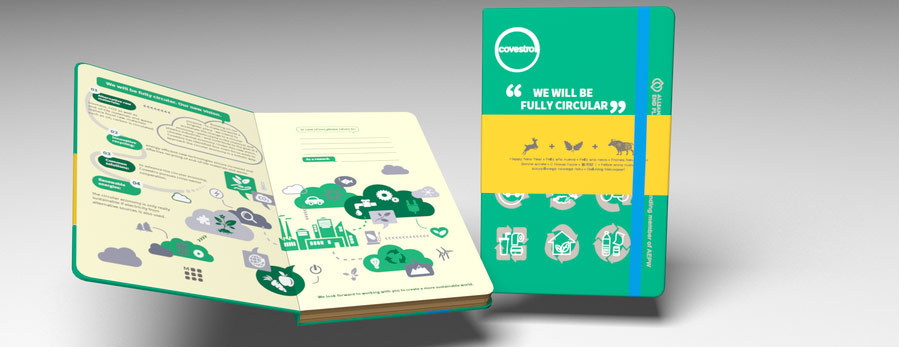
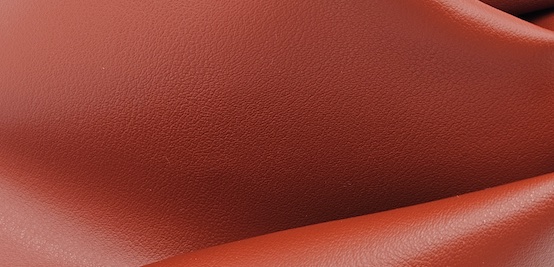
The application focuses on waterborne PU dispersions with up to 50 percent biomass-based carbon content, reducing the carbon footprint accordingly but offering the same good quality as fossil-based raw materials. © Covestro
Increased use of circular raw materials thanks to INSQIN® waterborne PU technology

Moleskine® notebooks are replicas of the legendary notebook used by such notable people as Vincent Van Gogh, Pablo Picasso, Ernest Hemingway, and Bruce Chatwin. Moleskine places great emphasis on more sustainable products and manufacturing processes and has already been certified by the Forest Stewardship Council (FSC). For the covers of its classic notebooks, the company relies on Covestro’s advanced INSQIN® waterborne polyurethane (PU) technology for textile coating with partially bio-based raw materials. This will increase the use of alternative raw materials in the production of the PU synthetics covers.

This application focuses on waterborne PU dispersions with up to 50 percent biomass-based carbon content, reducing the CO2 footprint accordingly but offering the same good quality as fossil-based raw materials. The coating also features a premium look and feel – as befits the characteristic quality of these notebooks. Using INSQIN® technology, Moleskine® and Chinese PU synthetics material specialist Hexin are now able to produce partially bio-based coatings for hardcover and softcover notebooks.

On the path to more circularity

"We are partnering with Covestro to perfect these high-quality, low-solvent coatings for our classic Moleskine® notebook covers," says Daniela Riccardi, the company's Chief Executive Officer. "Covestro’s partially bio-based coating technology enables us to reduce our impact on the environment and improve our sustainability."


"Working with innovative partners like Moleskine® allows us to develop more sustainable materials," explains Dr. Torsten Pohl, global head of Textile Coating at Covestro. "With our new partially bio-based raw material, Covestro allows for a total of approximately 23 percent renewable carbon in this coating, which is in line with our vision to become fully circular."

For the covers of its classic notebooks, Moleskine® relies on Covestro's aqueous INSQIN® polyurethane (PU) technology for textile coating with partially bio-based raw materials. © Covestro


The project is part of a global strategic program with which Covestro is fully committed to the circular economy. That’s why the company is focusing on the use of alternative raw materials and renewable energy, the development of innovative recycling technologies, and collaboration with partners along the value chains.


More News from Covestro AG

#Smart Textiles

Covestro, FILK Freiberg, and OUT e.V. develop flexible, conductive polymer smart textile system

As the smart textiles market continues to grow across healthcare, personal protection, sportswear, and automotive applications, developers are seeking new ways to integrate electronic functionality directly into textiles, without the rigidity and complexity of conventional wiring. To address this challenge, FILK Freiberg Institute, an independent research institution with expertise in polymer coatings for textile applications, collaborated with Optotransmitter-Umweltschutz-Technologie (OUT) e.V. The joint project, funded under the German Industrielle Gemeinschaftsforschung (IGF) program of the Bundesministerium für Wirtschaft und Energie (BMWE), focused on developing flexible, conductive polymer surfaces for next-generation smart textiles.

#Techtextil 2026

Covestro to exhibit solutions for a more sustainable and productive textile industry at Techtextil 2026

Covestro will present a broad portfolio of material innovations for textile coatings, adhesive films and thermoplastic polyurethanes (TPUs) at Techtextil 2026 (Hall 11.0, Booth C79). The exhibits will demonstrate how advanced solutions can enhance durability, recyclability and manufacturing efficiency across applications such as automotive, infrastructure, protective apparel and sportswear. A particular focus will be on more sustainable coating technologies, including antimicrobial systems based on INSQIN® in combination with AGXX from Heraeus Precious Metals, as well as the integration of Pontacol® thermoplastic adhesive films into Covestro’s offering.

#Technical Textiles

Covestro showcases monomaterial concept in autonomous SUE People Mover

UE | STUDIOS has unveiled the fully autonomous electric minibus “Self-driving Urban E-Shuttle” (SUE), placing strong emphasis on sustainable material design. Developed within a project funded by the Federal Ministry for Economic Affairs and Energy (BMWE) and the European Union, the vehicle will begin public road testing this year. At the core of the concept is the consistent use of recyclable monomaterials to improve circularity at end of life.

#Textile chemistry

Covestro and Heraeus Precious Metals collaborate to enable safer, more sustainable antimicrobial textile coatings

Laboratory tests reveal that AGXX antimicrobial surface technology from Heraeus Precious Metals is fully compatible with Impranil® PU dispersions which are part of the waterborne INSQIN® textile coating technology from Covestro, paving the way for more sustainable antimicrobial textile coatings. This discovery comes at a key moment for the textile coatings industry. As the sharing economy continues to grow, more people are coming into regular contact with high-use surfaces, creating ideal conditions for bacteria, viruses, and other microorganisms to thrive.

More News on Textile chemistry

Latest News

#Associations

Keeping products moving with Swedish automation at FILTECH 2026

At FILTECH 2026, taking place in Cologne from June 30th to July 2nd, members of TMAS – the Swedish textile machinery association – will highlight how the country’s engineering expertise is enabling filtration manufacturers to increase productivity, improve traceability and reduce dependence on labour-intensive manual processes.

#ITM 2026

Global Mmeeting of textile technologies, ITM 2026, attracts great interest

ITM 2026, one of the world's most prestigious organizations in the field of textile technologies, opened its doors with the participation of over 1,000 companies and company representatives from 59 countries, as well as thousands of professional visitors from nearly 100 country. Attracting thousands of international visitors on its first day, ITM 2026 once again demonstrated its status as a global meeting point for the textile industry with its advanced technologies on display, newly established business connections, and record-breaking international participation.

#Recycling / Circular Economy

Countdown to Textiles Recycling Expo 2026: Brussels prepares for Europe’s textile recycling gathering

With only two weeks remaining until the start of the second edition of the Textiles Recycling Expo 2026, preparations are entering the final phase. The exhibition and conference, dedicated exclusively to textile recycling and circularity, will take place on 24–25 June 2026 at Brussels Expo and is expected to attract stakeholders from across the textile recycling value chain.

#Recycled Fibers

Indorama Ventures enables brands to scale circular textiles through proven, traceable supply chains

Indorama Ventures, a global leader in recycled polyester staple fibers and filament yarns, will exhibit at Textiles Recycling Expo in Brussels on June 24–25. At the event, the company will show how brands and textile manufacturers can build traceable, circular textile supply chains by working with proven partners who deliver recycled materials on an industrial scale.

TOP