[pageLogInLogOut]

#Texprocess 2019

Assyst presents the Vidya Award at Texprocess
(c) 2019 Human Solutions
3D from the outset – that’s the vision of Assyst GmbH when it comes to the creation of fashion and to the training of tomorrow’s designers. Assyst GmbH, a subsidiary of the Human Solutions Group, presents the Vidya Award once a year to prepare students from technical colleges and universities for the practical requirements of the industry. This year, the award ceremony took place at the Texprocess.

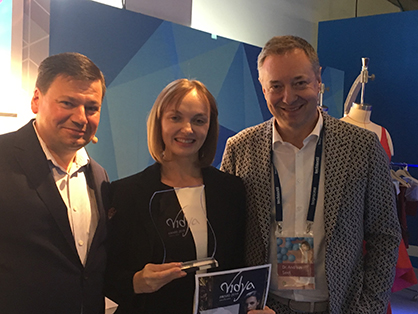
Assyst offers this competition for young designers every year. The main condition is that entrants must work with the 3D simulation software Vidya. At the awards ceremony at the Texprocess, industry experts were discussing how important the skilled use of 3D has become for the fashion industry: Holger Knapp of the Textilwirtschaft moderated a panel discussion between Antje Christophersen, Hochschule Niederrhein, Hans Peter Hiemer, b4b GmbH, Roland Schuler, Director Technical Product Management at the IB Company (a Peek & Cloppenburg subsidiary) and Dr. Andreas Seidl, CEO of Assyst.

Virtual simulation, real sewing

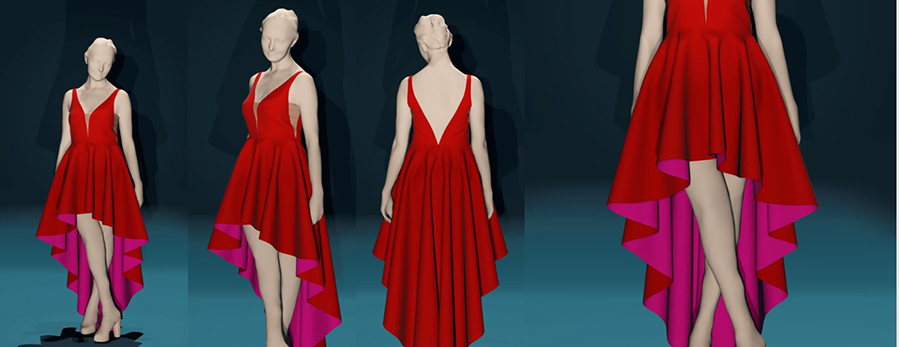
“Bienvenue a? la Moulin Rouge” – that was the motto of the Vidya Awards 2019. Any technical college and university which has a textile and clothing technology department could participate, provided that it used the Vidya 3D simulation software for teaching its students. The task for the award was to design a garment that would reflect the legendary style of the Moulin Rouge – either a one- piece or two-piece for women. The rendering and scene functions in Vidya had to be used to reproduce the unique mood of the Moulin Rouge. The garment was also to be simulated on a posed avatar and sewn not only virtually but also physically.

First place for Anna Maier from the Niederrhein University of Applied Sciences

First place and €1,000 go to Anna Meier from the Niederrhein University of Applied Sciences. This work, with its outstanding simulation quality and a particularly beautiful rendering, which summarized the topic “Moulin Rouges” with a fitting pose, really convinced the judges. The realization of the real garment also attracted the jury’s attention thanks to its particularly careful processing.
 

(c) 2019 Human Solutions


Second place for joint work of the Kerschensteinerschule

Second place and €500 go to a joint project of the Kerschensteinerschule, the “Elephant” design, submitted by Sofie Florentine Flad, Leonie Kadura and Clara Heynhold. This group performance impressed the jury thanks to its concept, which was impressively accentuated by textures and poses in 3D Vidya. The outfit consists of two parts, which were also manufactured in very high quality.



More News from Human Solutions Group

More News on Texprocess 2019

Latest News

#INDEX 2026

“We clearly see that reliability, flexibility, service and total cost of ownership are becoming increasingly important again.”

The nonwovens industry continues to face a challenging market environment. Nevertheless, AUTEFA Solutions reports successful projects, new line sales and growing demand for energy-efficient and flexible solutions. In this interview, André Imhof of AUTEFA Solutions talks about competitiveness against Chinese suppliers, new service and recycling concepts, the growing importance of application development and the opportunities created by countercyclical investments.

#INDEX 2026

“Needle punching technology is more universal and sustainable than ever!”

Needle punching technology was long regarded as a rather traditional and comparatively slow technology within the nonwovens industry. In this interview, Johann Philipp Dilo explains why needle punching is more relevant than ever today – ranging from energy efficiency and resource conservation to hygiene applications, new machine concepts and design-oriented nonwoven solutions.

#Research & Development

Textile climate control system in workwear – exhibition at the 2026 SME Innovation Day!

Conventional protective workwear often reaches its limits during strenuous physical activity. In particular, the transport of sweat and excess body heat poses a problem. The German Institutes of Textile and Fiber Research (DITF) conducted research on flow-optimized, air-conducting textile structures that enable targeted climate control directly on the body. These structures can be integrated straight into protective work garments. The textile climate control system supports the body’s natural thermoregulation. This contributes to improved workplace safety and comfort.

#Nonwovens

PET spunbond from China – EDANA welcomes imposition of provisional anti-dumping measures

On 13 May 2026, after eight months of investigation, the European Commission imposed provisional anti-dumping duties of 45.6-50.0% on imports of PET spunbond from China. EDANA welcomes this expression of the Commission’s clear determination to protect EU industries from the unfair trade practices of Chinese producers.

TOP
