[pageLogInLogOut]

#Nonwovens

EDANA launches landmark continence report to mark the start of the World Continence Week

Today marks the official commencement of the World Continence Week. To honour this global awareness initiative, EDANA has published a comprehensive report titled "The Central Role of Absorbent Hygiene Products in the Management of Adult Urinary Incontinence: Benefits, Costs and Environmental Impact." The World Continence Week (WCW) is an annual global initiative dedicated to raising public awareness about incontinence and bladder or bowel health issues. Traditionally held in June, this awareness week aims to shed light on a condition that affects millions of people worldwide but is frequently kept secret due to widespread social stigma, embarrassment, and taboo.

Urinary incontinence (UI) is a widely prevalent condition affecting millions worldwide across all age groups, with an escalating incidence among older demographics. As global populations age and lifestyle-related risk factors such as obesity and reduced physical activity continue to scale up, the need for reliable, long-term care management frameworks has never been more pressing. This new landmark report provides an essential, multi-dimensional analysis of how Absorbent Hygiene Products (AHPs), and more specifically, continence products, act as a vital lifeline for individuals, macro-economies, and public healthcare systems alike.
© 2026 Edana
© 2026 Edana


Urinary incontinence is a complex condition

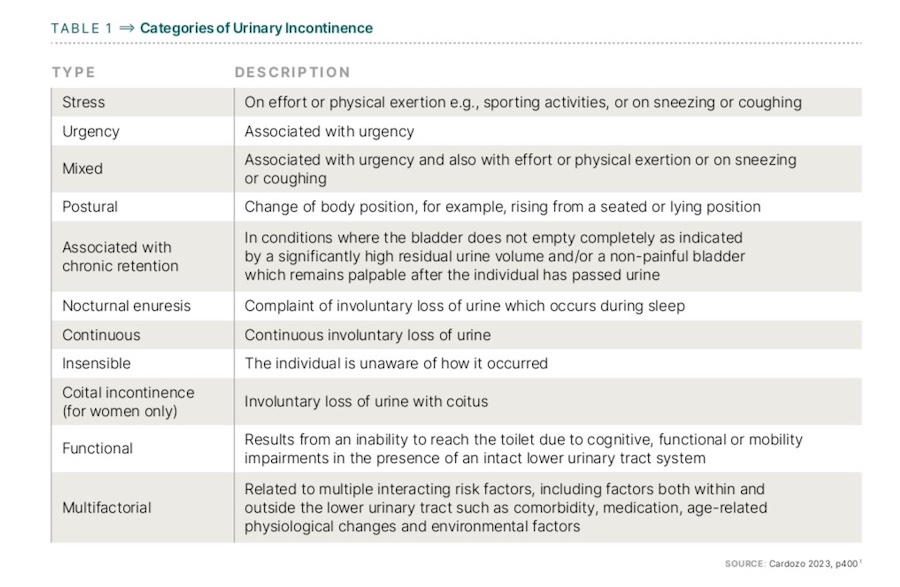
The report establishes that UI is a deeply nuanced clinical reality. It primarily manifests in three main forms—urge, stress, and mixed incontinence—each driven by distinct physiological mechanisms. Other variations, such as functional incontinence caused by cognitive or physical mobility impairments, further highlight that UI is not a single, uniform issue but an intricately layered medical challenge.

Urinary incontinence has a major impact on society

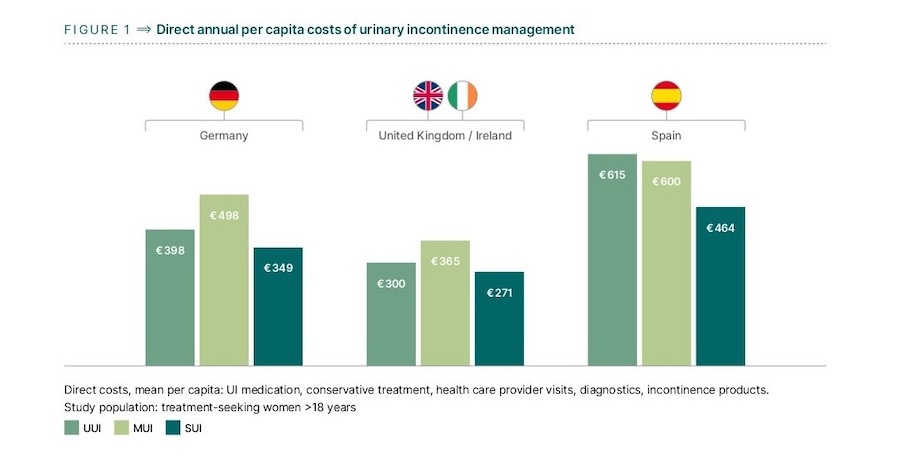
Driven by global aging trends, rising obesity rates, and the expansion of chronic diseases, the global footprint of UI is growing rapidly. Beyond the estimated 465 million adults currently affected worldwide, the macro-economic burden is staggering. Unmanaged UI accounts for billions in direct healthcare costs and tens of billions in indirect costs, creating massive financial strains due to reduced workplace employment, elevated absenteeism, and heavy institutionalization burdens.

People with urinary incontinence manage their condition in a variety of ways

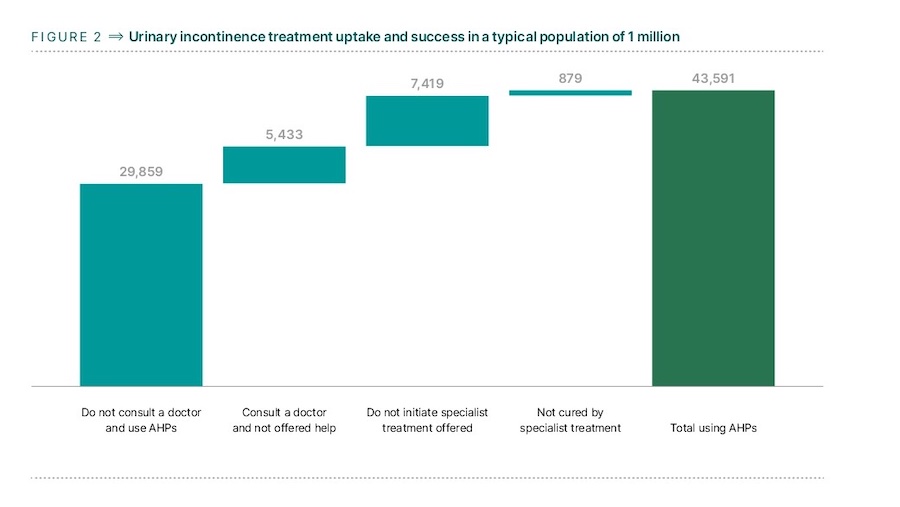
A clear majority of individuals manage UI privately due to lingering social stigma, with up to 80% navigating symptoms without ever consulting a clinician. For those who do seek formal primary care, assistance is not always guaranteed. Clinical pathways dictate a stepwise management sequence—ranging from lifestyle adaptations to specialized surgeries—but for the millions who cannot be fully cured, daily containment remains the primary solution.
© 2026 Edana
© 2026 Edana


Absorbent hygiene products have a significant part to play in managing urinary incontinence

AHPs are heavily proven, effective tools that directly elevate health-related quality of life and preserve user dignity. These purpose-made products are regulated medical devices engineered to the highest performance standards specifically to handle urine loss. Clinical evidence demonstrates that the utilization of high-quality bodyworn AHPs drastically reduces caregiver laundering demands, supports professional workforce participation, and cuts the risk of secondary medical complications like pressure ulcers by up to 67%.

Absorbent hygiene products are a worthwhile expenditure for the public payer

By keeping individuals socially and economically active while preventing severe skin breakdowns or unnecessary hospitalizations, disposable AHPs deliver exceptional socio-economic returns. Public healthcare systems across nations like the UK, the Netherlands, and Australia actively endorse this value by integrating these essential containment products into official public reimbursement and payment schemes.
© 2026 Edana
© 2026 Edana


Industry initiatives are reducing the environmental impact of absorbent hygiene products

The report highlights ongoing sector-wide efforts to lower the ecological footprint of these vital solutions. Through continuous material science innovation and cradle-to-grave Life-Cycle Assessments (LCAs), products have become lighter and down-gauged via advanced superabsorbent polymers (SAP), optimizing resource efficiency while strictly maintaining skin safety. Concurrently, various exploratory initiatives are evaluating mechanical separation, chemical recycling, and anaerobic fermentation pilots to help advance scale-level circular economy solutions for the end-of-life stage.

Discover the full report here:
https://www.edana.org/hubfs/Docs/default-source/absorbent-hygiene-products/EDANA_Continence_Report.pdf?hsLang=en


More News from EDANA

#Technical Textiles

FILTREX™ India 2026 to bring global filtration leaders together in New Delhi

EDANA, the voice of nonwovens, in partnership with the Business Coordination House (BCH), will welcome filtration professionals from across the world to FILTREX™ India 2026, taking place on 7–8 October 2026 at the Eros Hotel, New Delhi.

#Associations

Sustainability: European industry calls on EU to keep Single-Use Plastics Directive unchanged

A broad coalition of European industry associations, including EDANA, Euratex and Plastics Europe, has urged EU institutions to maintain the current legal framework of the Single-Use Plastics Directive (SUPD). In a joint statement, the organisations argue that reopening the Directive at this stage would create legal uncertainty, increase regulatory complexity and undermine investment, while its implementation across the European Union is still incomplete.

#Nonwovens

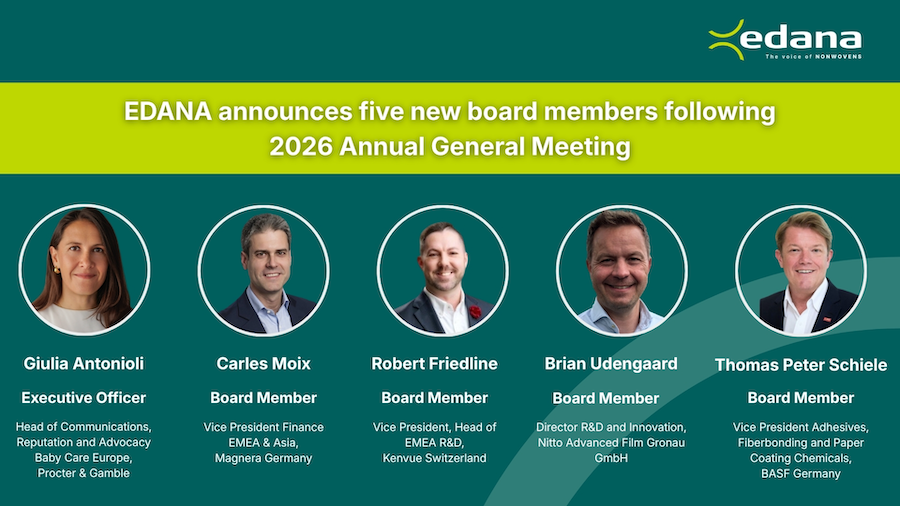
EDANA announces five new board members following 2026 Annual General Meeting

The EDANA Board of Governors is elected or re-elected at the Annual General Meeting by the member companies. The Governors are senior executives (business leaders) from member companies, based in different countries and representing different sectors of the nonwovens industry. The Board has central responsibility for guiding EDANA's overall strategy and approving its policies and priorities. It meets three times a year.

#INDEX 2026

INDEX™26: A strong edition in a challenging context, confirming Geneva’s role as a global hub for innovation in the nonwovens sector

EDANA’s INDEX™26, the world’s leading trade fair for nonwovens, co-organised with Palexpo, officially concluded last Friday 22 May with a successful edition. In a context marked by uncertainty and continued pressure, the 2026 edition of INDEX™ concluded successfully. With a diverse range of 625 exhibiting companies from 44 countries, an important number of visitors, and an expanded international reach, the event confirmed its role as a central hub for innovation and a representative showcase of the nonwovens’ ecosystem.

More News on Nonwovens

#Nonwovens

Katharina Obergruber appointed to the Management Board of Sandler AG

The Supervisory Board of Sandler AG has appointed Katharina Obergruber to the company’s Management Board. Effective September 1, 2026, the Board will consist of Philipp Ebbinghaus (CEO), Dr. Ulrich Hornfeck (currently CCO, future COO), and Katharina Obergruber (CCO). Katharina Obergruber, currently Chief Sales Officer Hygiene and member of the Management Team of Sandler AG, will assume responsibility for all sales activities as Chief Commercial Officer. She will assume this role from Dr. Ulrich Hornfeck, who will focus primarily on production and supply chain topics.

#Functional Fabrics

Ahlstrom launches breathable ChemoGard BVB fabric to enhance protection and comfort in chemotherapy handling

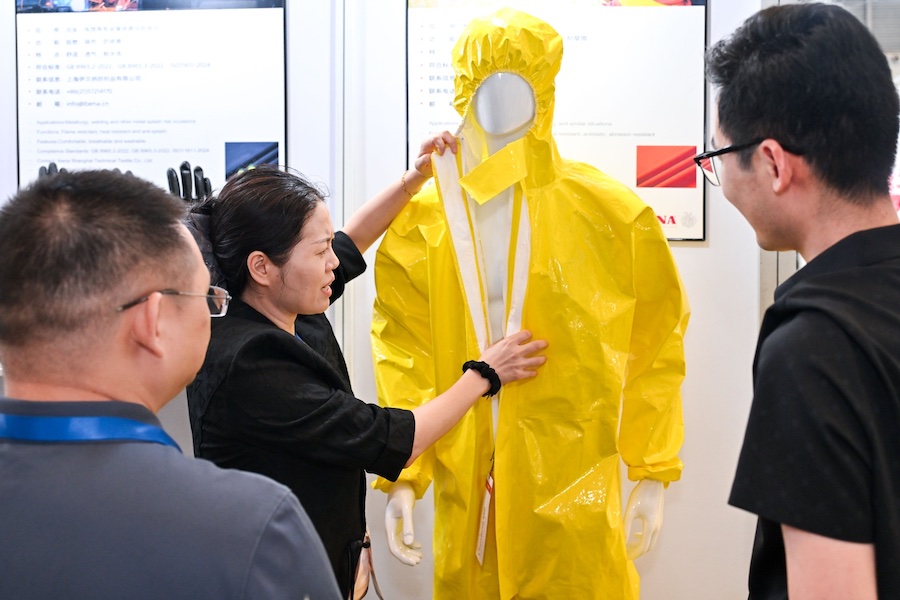
Ahlstrom, a global leader in fiber-based specialty materials, announces today the launch of ChemoGard BVB, a breathable protective apparel fabric designed for chemotherapy drug handling in clinical, laboratory, and operating room environments.

#Nonwoven machines

DiloGroup - Complete nonwoven needling line for hygiene materials in the United States

DiloGroup has received an order for a complete needling line designed for the production of hygiene materials in the United States. This project further strengthens our position in the American hygiene sector and reflects the continued demand for reliable, high-performance nonwoven equipment.

#Nonwovens

Lenzing Group highlights scalable, bio-based nonwovens solutions at leading global industry fairs

From CIDPEX in China to Techtextil in Frankfurt and INDEX in Geneva, the Lenzing Group showcases ready-for-market, bio-based nonwoven solutions and receives industry recognition for LENZING™ Nonwoven Technology.

Latest News

#Research & Development

ALADIN paves the way for circular and demand-driven textile production in Europe

Textile production can be organized sustainably by utilizing short supply chains and preventing overproduction. This can already be achieved today by intelligently connecting and efficiently utilizing existing infrastructure. At the same time, production becomes circular when innovative technologies and materials are used that enable high-quality recycling. The ALADIN research project, launched in May 2026 and co-funded with five million euros under the EU Horizon Europe program, is creating the conditions for this.

#Recycling / Circular Economy

Ence and ShareTex begin initial testing of the ATENEA innovation project to promote textile recycling in Spain

Ence and ShareTex are making progress on the Atenea R&D project, which aims to develop a complete value chain for textile recycling in Spain. Specifically, the goal of the ATENEA project—which is funded by the Center for Technological Development and Innovation (CDTI)—is to connect all the necessary stages for the recovery of textile waste, from collection and management, through recycling and transformation into new raw materials, to their incorporation into new textile products.

#Recycling / Circular Economy

DePoly Inaugurates its Showcase Plant in Monthey Switzerland

What if used plastic bottles, PET packaging material and polyester textiles could become raw materials just as high performing as virgin resources? That is the ambition of DePoly, a circular materials company based in Sion, Switzerland which inaugurated its Showcase Plant in Monthey on July 6th & 7th. The first depolymerization facility of its kind and scale in Switzerland, this industrial Showcase Plant represents a major milestone in the company's growth and its journey toward commercialization.

#Recycling / Circular Economy

Commission clarifies rules on plastic bottles recycling

The European Commission today adopted new rules on recycling of single-use plastic beverage bottles made primarily of polyethylene terephthalate (PET bottles). These rules establish, for the first time, a methodology to calculate, verify and report chemically recycled content. This is part of the Commission’s December 2025 plastics package.

TOP