[pageLogInLogOut]

#Texprocess 2019

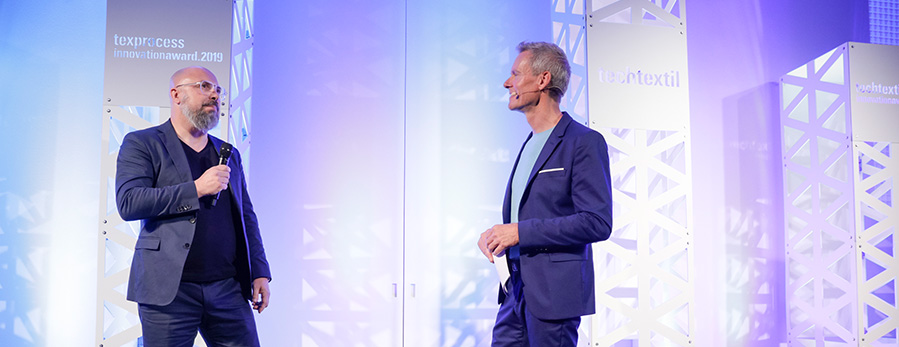
Winners of the Texprocess Innovation Awards 2019 chosen
(c) 2019 Messe Frankfurt
The Texprocess Innovation Award 2019 for new and further technological developments in the field of textile processing was presented to four winners today. All award-winning projects can be seen in a special exhibition at Texprocess until Friday, 17 May. At today’s official opening ceremony, four winners were presented with the Texprocess Innovation Award 2019 for new and further technological developments in the field of textile processing. All award-winning projects can be seen in a special exhibition at Texprocess until Friday, 17 May.

Award winners in the ‘New Technology’ category

In the ‘New Technology’ category, the jury was particularly impressed by the new M-TYPE DELTA sewing system made by Dürkopp Adler AG. The award-winning industrial-sewing concept can be integrated into a fully digitalised sewing production line for automotive interiors, home upholstery, leather goods and technical textiles. Using digital solutions to the maximum extent, the machine guides the operator and continuously augments its functions and ‘knowledge’.

The second award in the ‘New Technology’ category went to Vetron Typical Europe GmbH for the Vetron Viper, an ultra-lightweight sewing system made using carbon components. The system weighs a total of six kg, including yarn corps and drive motor, which means a smaller and more cost-effective industrial robot can be used in the sewing process. Thus, the solution is compact, flexible and easy to install and remove.

Award winners in the ‘New Process’ category

The award winners in the ‘New Process’ category include Assyst GmbH for a 3D innovation process. For the first time, the company is showing at Texprocess how a digital process innovation can revolutionise the textile value chain, from design to development and sales. Assyst has developed a virtual decision-making aid for everyone involved in the process, from designers in the creative phase, via product developers in the virtual fitting stage, to sales staff with a 3D in-store presentation. Moreover, the technology provides a completely new product experience for both B2B and B2C customers.


The second award in this category went to Lectra for its fashion-on-demand technology, the first end-to-end solution for personalising fashions. The turnkey solution automates on-demand production so that companies can now process several individual orders at the same time, including individualized apparel. In other words, individualized products can be delivered just as fast as standard articles.

The Texprocess Innovation Award has been honouring outstanding achievements and new developments for processing textile and flexible materials since 2011. The winning products are selected on the basis of criteria such as innovativeness, choice of materials and ecological quality. The award-winning products can be seen at a special exhibition in Hall 4.0 throughout the fair.

More News from Messe Frankfurt GmbH

#Techtextil 2026

From Nature Performance to Circular Economy: Techtextil 2026 focuses on the future market for technical textiles

Alternative materials and recycling technologies are one of the most important future segments and drivers of innovation in technical textiles. Sustainability goals and regulatory requirements increase their relevance, while advances in performance and economic viability enhance their market competitiveness. Taking place from 21 to 24 April 2026, Techtextil reflects this key industry trend with a growing number of specialised exhibitors. With the new “Nature Performance” label, the leading global trade fair bundles relevant market offerings and facilitates access to new solutions – from natural fibres and yarns to bio-based materials and circular approaches.

#Techtextil 2026

Between innovation pressure and production readiness: Techtextil 2026 showcases market-ready defence textiles

EU defence spending reached a record level of around €381 billion in 2025. The importance of textile innovation in this context is underscored by the European Defence Fund’s 2026 Work Programme, which identifies “smart and multifunctional textiles” as a dedicated priority area. Techtextil translates this demand into industrial practice. From 21 to 24 April 2026, more than 10 per cent of over 1,500 exhibitors in Frankfurt am Main will present material innovations for protective textiles.

#Yarns

Yarn Expo Spring 2026 concludes, connecting buyers with innovative selection of sustainable yarns and fibres

Yarn Expo Spring 2026 wrapped up successfully on 13 March, as a record-high of over 600 exhibitors from 12 countries and regions welcomed more than 25,000 visitors from 113 countries and regions. Held across 27,000 sqm in Hall 8.2 of the National Exhibition and Convention Center (Shanghai), the fair highlighted the textile industry’s accelerating shift toward a lower-impact, more functional future. Exhibitors presented eco-friendly organic, regenerated and recycled yarns and fibres, alongside innovative options such as sweat-resistant and high-performance materials. A comprehensive fringe programme further enriched the event, offering practical market insights and new networking opportunities.

#Techtextil 2026

Where performance becomes product strategy: Techtextil 2026 puts functional apparel in the spotlight

The demand for high-performance textile solutions for the apparel industry increases – and with it the sector’s innovative strength. Techtextil 2026 addresses these developments: The Performance Apparel Textiles area (Hall 9.0) presents around 130 exhibitors from 13 countries showcasing innovative materials for workwear, protective clothing, smart fashion, outdoor and sports. Global key players such as Concordia Textiles, Getzner, Kermel, Klopman International and YKK Europe are among the participants. The live show “Performance Apparels on Stage” brings forward-looking wearables on stage and demonstrates textile innovations where they matter most: in action.

More News on Texprocess 2019

Latest News

#Raw Materials

New study shows low environmental impact by Cotton made in Africa Organic Cotton from Tanzania

Today, the Aid by Trade Foundation (AbTF) is announcing the results of a comprehensive life-cycle analysis (LCA) for cotton produced in Tanzania under the Cotton made in Africa Organic (CmiA Organic) standard. The study emphasises the small ecological footprint of CmiA Organic verified cotton. This can largely be traced back to the absence of synthetic pesticides, artificial fertilisers, and artificial irrigation. Consequently, CmiA Organic cotton can help the textile industry meet regulatory requirements as well as science-based targets. The results also show that the consequences of climate change threaten the livelihoods of these cotton farmers, even though the type of agriculture they practise barely contributes to climate change.

#Raw Materials

Better Cotton Initiative strengthens regenerative focus in standard update

The Better Cotton Initiative (BCI) has strengthened the regenerative focus of its field-level standard with the launch of a new version of its Principles & Criteria (P&C), which marks the next step in the organisation’s journey to becoming a regenerative standards system.

#Man-Made Fibers

Selenis and Kintra Fibers partner to scale 100% bio-based synthetic fiber technology

Selenis, a leading global specialty polyester manufacturer, today announced a strategic manufacturing partnership with materials science company Kintra Fibers to scale Kintra’s patented fiber-grade PBS resin - a 100% bio-based and biodegradable material designed for textile applications.

#Functional Fabrics

PERFORMANCE DAYS proves its relevance as the industry’s key meeting point

Held on March 18–19, 2026, PERFORMANCE DAYS once again confirmed its position as a leading international platform for functional textiles. A total of 3.366 trade visitors and around 560 exhibitors gathered in Munich, with the event already kicking off successfully on DAY 0, which received highly positive feedback for its interactive format. Despite challenging conditions caused by the public transport strike in Munich, the event saw strong attendance and a consistently high level of activity across both exhibition days.

TOP