[pageLogInLogOut]

#Techtextil 2019

Lenzing Innovation at Techtextil 2019: LENZING™ Lyocell fibers – plastic free for aquatic farming
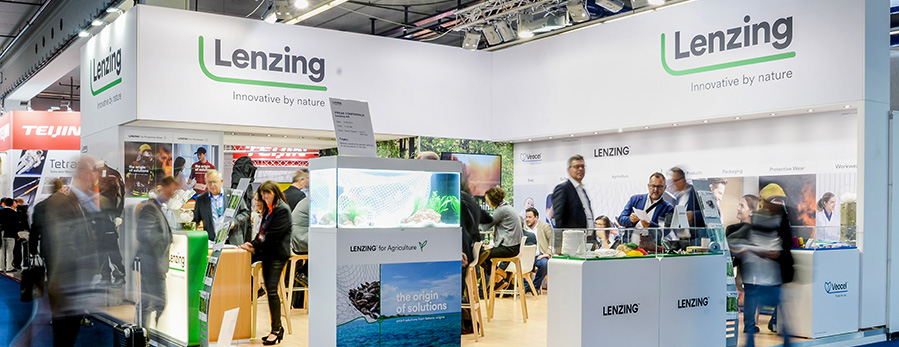
Lenzing booth (c) 2019 Lenzing
The Lenzing Group, world market leader in specialty fibers based on the renewable material wood, today introduced the botanic solution for marine application, in particular for aquatic farming, to the public at the Techtextil Frankurt Fair. The wood-based LENZINGTM branded lyocell fibers are used for the construction of ropes and nets in order to support the cultivation of marine cultures such as mollusks, mussels and edible seaweed to reduce plastic in the sea.

Plastic a serious problem for our marine environment

Annually, about 8 million metric tons of plastics end up in the ocean, resulting in an estimated 165 million tons of plastic debris, currently floating in the marine environment, threatening the health and safety of marine life. The loss of conventionally used synthetic fibers and plastics in the ocean accounts for 80 % of all marine pollution.1 This is not only dangerous for marine life but also for humans as we consume some of these micro plastics through our food. “The development of 100% wood based mussel nets with LENZING™ Lyocell fibers contribute to the reduction of the annual plastic quantity in marine environment”, says Marine Crnoja-Cosic, Head of Application Development New Business Areas.

LENZING™ Lyocell innovation for the marine industry

The Lenzing Group initiated a project in collaboration with two major partners, Sächsisches Textilforschungsinstitut e.V. (STFI) and FIUM GmbH & Co. KG – Institut für Fisch & Umwelt (FIUM) in order to develop a sustainable solution for the marine industry, which does not compromise mechanical performance. There are many different methods of using textile structures as a support for the growth of marine organisms. The important feature of the present invention is that the textile structure is made of wood-based cellulosic fibers. This gives the advantage that any of the textile structure which is released into the environment due to accident, storm damage, negligence or any other cause will degrade in a reasonable time and not leave non- degradable residues.
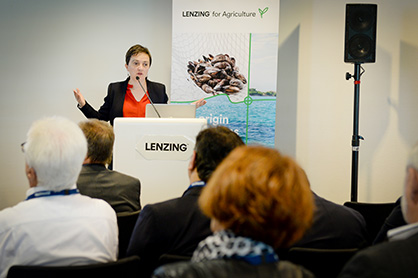
Press conference (c) 2019 Lenzing


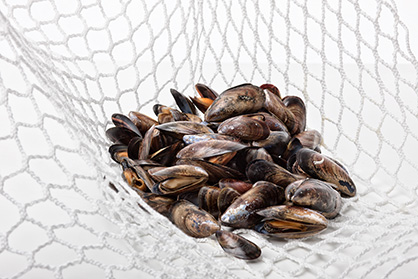
Up to now, nylon and polypropylene are most commonly used for rope and net materials. Although these materials are durable and have a sufficient strength, they do not have a natural origin and are not marine biodegradable. They stay in the oceans for years. Nets and ropes consisting out of LENZING™ Lyocell fibers proved that they have sufficient strength to carry the weight of the growing cultures without breakage and have the big advantage of biodegradability in the oceans.


Proved by tests

The cooperation partner Sa?chsisches Textilforschungsinstitut e.V. constructed different prototypes and replicates out of LENZING™Lyocell fibers in March 2018. Thereafter, an initial underwater material test was started in the Baltic Sea. The prototypes were installed in 6 to 10 meters depth at an artificial reef platform in Rostock Nienhagen. The objective of the trial was to proof that marine applications produced out of LENZING™ Lyocell fibers can fulfill the key properties of conventional marine supports, which are sufficient strength to carry the weights of the growing cultures without breakage. Moreover, the trial should investigate if LENZING™ Lyocell fibers represent a pleasant environment for particular marine organisms and also proof the marine biodegradability after usage.
(c) 2019 Lenzing
(c) 2019 Lenzing


After four organized dives by our project partner FIUM, first test results were available. All LENZING™ Lyocell fibers represent an appealing growing material for marine organisms. Overall 14 different sea dwellers like blue mussels, crustaceans, echinoderms or snails adhered on the test material. First test results regarding performance and biodegradability were promising.2

Compostability and biodegradeability are key

Sustainability advantages in aquatic farming are particularly evident, given the fact that the material is being used directly in the oceanic eco system. LENZING™ Lyocell Standard fibers are certified as compostable and biodegradable under industrial, home, soil and also under marine conditions. If pieces of the nets break off, they will harmlessly decompose and have no influence on marine organisms. In order to close the sustainability loop, the nets can be composted after harvesting and processing.

Further developments

“This development brings sustainable solutions to aquatic farming encouraging Lenzing to assess and establish further steps towards commercialization, together with innovative value chain partners”, says Crnoja- Cosic. “Furthermore, future development will focus on optimizing the nets construction for more durable products broadening the scope of 100% Lyocell based marine nets in marine environment,” concludes Crnoja- Cosic. “.
More News from Lenzing

#Man-Made Fibers

Lenzing and Kaihara to debut REMOD denim collection at Kingpins Amsterdam

The Lenzing Group, a global producer of wood-based fibers for the textile and nonwovens industries, has partnered with Japanese denim manufacturer Kaihara Corporation to launch the “REMOD Collection”. The collection combines three of Lenzing's fiber offerings for denim applications: TENCEL™ Lyocell Standard, TENCEL™ Lyocell – HV100 and TENCEL™ Lyocell dtex 2.2.

#Man-Made Fibers

Lenzing shareholders approve €300 million capital increase

Shareholders of Lenzing AG have approved a capital increase of approximately €300 million, providing financial support for the company's recently announced "Grow Nonwovens, Reset Textiles" strategy.

#Man-Made Fibers

Lenzing reports improved half-year results and advances strategic transformation

Despite a persistently challenging market environment in the first half of 2026, characterized by volatile energy and raw material prices, subdued global consumer demand and intensified competition from Asia, the Lenzing Group significantly improved its financial performance. Net result after tax more than doubled to EUR 35.6 million, compared with EUR 15.2 million in the first half of 2025. Free cash flow increased to EUR 45.8 million, while EBITDA amounted to EUR 239.2 million. Revenue totaled EUR 1.27 billion, compared with EUR 1.34 billion in the previous year.

#Nonwovens

Lenzing Group highlights scalable, bio-based nonwovens solutions at leading global industry fairs

From CIDPEX in China to Techtextil in Frankfurt and INDEX in Geneva, the Lenzing Group showcases ready-for-market, bio-based nonwoven solutions and receives industry recognition for LENZING™ Nonwoven Technology.

More News on Techtextil 2019

Latest News

#Textile chemistry

Nicca names Archroma exclusive ZELAN™ distributor, extending a decade-long legacy

Archroma and Nicca Chemical are collaborating to support the continued growth of ZELAN™ non-fluorinated durable water repellents (DWRs) across the global textile industry. The announcement follows Nicca’s acquisition of the ZELAN™ business from The Chemours Company in March 2026 and extends Archroma’s decade-long legacy with the ZELAN™ brand.

#Functional Fabrics

ROICA™ presents stretch textile innovations from nine partners at PERFORMANCE DAYS 2026

ROICA™ by Asahi Kasei will return to PERFORMANCE DAYS Munich on October 13–14, 2026, presenting textile developments from seven European partners and two Japanese specialists under its global brand message, “STRETCH YOUR FUTURE.” Visitors can discover the developments at Booth P10 in Hall A4.

#IGATEX 2026

SHIMA SEIKI to showcase flat knitting and digital design solutions at IGATEX Pakistan 2026

Leading computerized flat knitting technology provider SHIMA SEIKI MFG., LTD. of Wakayama, Japan, together with its Pakistani representative ALMURTAZA MACHINERY CO., (PVT) Ltd., will exhibit at the upcoming International Exhibition for Garment, Textile Machinery and Accessories (IGATEX Pakistan 2026) in Lahore, Pakistan, from October 15–18. SHIMA SEIKI will introduce computerized flat knitting machines, 3D design software and various web platforms as proposals for sustainable production through innovative shaping technology and the latest digital solutions.

#Dyeing, Drying, Finishing

Brazilian market leader Cedro Têxtil focuses on greater efficiency, sustainability, and product quality with Brückner

After more than 150 years of company history, Cedro Têxtil is once again embracing the challenges of a changing industry. Widely recognized as the largest manufacturer of workwear fabrics in Latin America, the Brazilian textile company continues to invest in the modernization of its production facilities. A key milestone in this process was the decision to install a state-of-the-art Brückner stenter frame just over a year ago.

TOP