[pageLogInLogOut]

#Sustainability

The Indonesian company PT APAC Inti Corpora is the OEKO-TEX® Company of the Month in June 2014
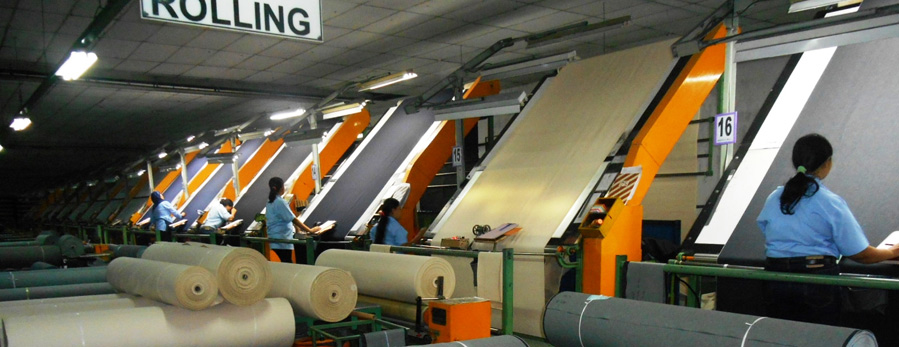
With a total of 6,700 employees in the areas of spinning, weaving and denim production, a total production area of 331,000 m² and a production capacity of 60 million running meters of textile and 65,000 tonnes of yarn per year, the company primarily meets the demand for cotton and mixed fabrics for further processing in the clothing textiles sector. © PT APAC Inti Corpora
The majority of Indonesia's textile and clothing enterprises are located in Java. Among these is the yarn and textile manufacturer PT APAC Inti Corpora, a true giant of textile production: In its 25 year existence, the company has developed into the World's largest spinning and weaving mills at a single location. Every item produced here meets the human-ecological requirements of the OEKO-TEX® Standard 100.
The company's production operation, which is situated in the port city of Semarang on the northern coast of Java, was founded on 8 August 1989, while its headquarters are in Jakarta. With a total of 6,700 employees in the areas of spinning, weaving and denim production, a total production area of 331,000 m² and a production capacity of 60 million running meters of textile and 65,000 tonnes of yarn per year, the company primarily meets the demand for cotton and mixed fabrics for further processing in the clothing textiles sector. High-quality cotton, polyester and mixed yarns are manufactured with the help of over 320,000 spindles. Modal, rayon and stretch yarns, or mixes of each, can be produced on request. Around 30% of the yarns produced are used in the company weaving mill, and the remainder is exported to some 70 countries around the world. In the greige fabric sector, PT APAC Inti Corpora offers an extensive range of quality levels with products ranging from pure cotton, viscose, polyester, through to their mixes and on to linen blended fabrics.
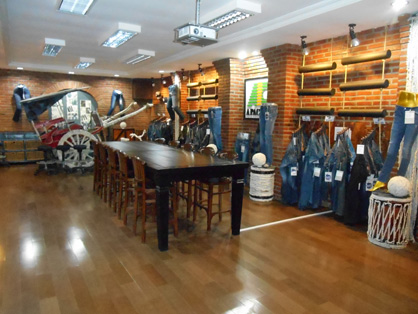
The company-owned Denim Showroom houses an exhibition of its entire product portfolio in denim. © PT APAC Inti Corpora 
First-class quality and a pronounced customer focus play a vital role for the economic success of the company. However, according to Anas Bahfen, Managing Director, these are not the only factors involved in guaranteeing lasting business success: "Our state-of-the-art equipment is geared towards achieving the maximum possible level of efficiency for our extensive product range of more than 100 different items on a monthly basis. We place a massive value on innovations, in relation to both the items and the processes." 
Around 80% of the greige fabric is sent to European markets and the USA for further processing. In the denim sector, PT APAC Inti Corpora is among the leading manufacturers worldwide. According to Indra Firdaus, General Manager Manufacturing, many of the notable classic fashion manufacturers use fabrics produced by the company: "There cannot be a more popular item of clothing around the world than jeans. Hardly any other fabric is provided in so many different variants. We have to bear this in mind as well, because jeans and the denim materials used for them are constantly reinventing themselves! Pure cottons or blend qualities with some stretchiness, heavy quality or light, in indigo or in other stylish dyes, modern washes or more trendy special treatments, we can deliver it all." 
The entire range of products provided by PT APAC Inti Corpora meets the criteria of the OEKO-TEX® Standard 100. All of the manufactured yarns and greige fabrics comply with the strictest human-ecological requirements for certification in accordance with product class I (baby articles). The comprehensive quality management in the production operation in Semarang is certified in accordance with the regulations of the quality management system EN ISO 9001-2008 and, in addition to continuous incoming goods inspections and a separate inspection department (visual quality check, physical product performance, testing of colour fastness), includes as its centrepiece a professional testing laboratory that allows for quality monitoring throughout all stages of production. All of the processes in the spinning and weaving mill are subject to the provisions of the environmental management system EN ISO 14001-2004. Furthermore, the energy management system EN ISO 50001-2011 is implemented in the company and has played a significant role in sustainably improving its levels of energy efficiency through the optimisation of energy sources, use and consumption.
PT APAC Inti Corpora is especially attentive to the requirements of its personnel: In addition to the standard provisions for health and safety, training and further development and health care, the company provides a wide range of recreational activities for its employees, strengthening its sense of community and thus employee motivation. Benny Soetrisno, President Dircetor, is convinced that the fact that employees are so appreciated makes an enormous contribution to the company. "We are of the firm belief that our employees actively shape the future of our whole company and are our biggest asset. Our well-trained specialists should therefore be as closely connected to the company as possible."
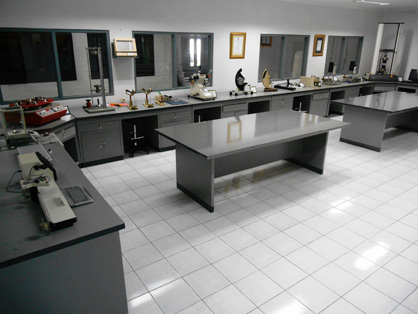
The comprehensive quality management in the production operation in Semarang is certified in accordance with the regulations of the quality management system EN ISO 9001-2008 and includes as its centrepiece a professional testing laboratory that allows for quality monitoring throughout all stages of production. © PT APAC Inti Corpora

More News from Oeko-Tex® Association

#Sustainability

OEKO-TEX® chooses TextileGenesis to advance digital traceability for organic cotton

OEKO-TEX® today announced a full collaboration with TextileGenesis, a Lectra company, to digitally trace and authenticate organic cotton, strengthening fraud prevention across the supply chain. This announcement follows a successful pilot and brings together OEKO-TEX®’s certification expertise and closed testing system with TextileGenesis’ digital traceability platform to deliver a secure, end-to-end solution for managing certified organic cotton flows.

#Sustainability

OEKO-TEX® - New regulations 2025

Fostering trust within the textile and leather industry remains the mission of OEKO-TEX®. Since trust relies on consistently high standards, the OEKO-TEX® Association has released the updated testing criteria, limit values and guidelines for its certifications, based on the latest scientific research and legal developments.

#Sustainability

OEKO-TEX® Annual Report 2023/2024 mentions 50,000+ valid certifications

The international OEKO-TEX® association has continued to demonstrate positive business growth, highlighting the critical role of close collaboration and shared commitment in accelerating sustainable change. More than 35,000 textile and leather companies depend on the certificates and product labels issued by OEKO-TEX®’s independent testing institutes. OEKO-TEX® issued more than 50,000 certificates and labels between July 1, 2023, and June 30, 2024 – an increase of 22% over the previous financial year.

#Sustainability

OEKO-TEX® New regulations 2024

Creating trust within the textile and leather industry and for its customers is the mission of OEKO-TEX®. Since trust is based on consistently high quality, the OEKO-TEX® Association is again publishing updates to the applicable test criteria, limit values and guidelines for its certifications. Based on new scientific findings and legal developments, the OEKO-TEX® Association has published the annual updates to its test criteria, limit values and guidelines.

More News on Sustainability

#Natural Fibers

Global Standard gGmbH launches second public consultation for GRTS Draft 2 for the textile industry (1–30 April 2026)

Global Standard gGmbH is pleased to announce the release of Draft 2 of the Global Responsible Textile Standard (GRTS) for its second public consultation. The consultation will be open from 1 April 2026 to 30 April 2026, inviting stakeholders across the textile and apparel value chain to provide input and contribute to the further development of this new Standard.

#Sustainability

Practical toolkit to drive coordinated climate action launched

An open-access workshop toolkit enables brands, suppliers, policymakers and investors across the textile industry to apply the System Map in their own work, identifying leverage points to halve emissions and enable a just transition.

#Raw Materials

Textile Exchange publishes cotton Life Cycle Assessment study to strengthen impact data

Textile Exchange has published the first in a series of seven Life Cycle Assessment (LCA) studies designed to improve the quality and robustness of environmental impact data for raw material production across the fashion, textile, and apparel industry. The first LCA study focuses on cotton and addresses critical data gaps and methodology variability through new high-quality data across key producing countries. The study includes organic, regenerative, recycled, and country averages for conventional cotton production systems, providing a clearer picture of the associated environmental impact.

#Sustainability

Experts publish APAC policy priorities

Cascale today announced the publication of its APAC Policy Priorities Paper, developed by the Asia-Pacific (APAC) Policy Member Expert Team (MET) to identify key regional sustainability challenges and provide practical, aligned recommendations for policymakers and industry stakeholders across Asia-Pacific.

Latest News

#Raw Materials

New study shows low environmental impact by Cotton made in Africa Organic Cotton from Tanzania

Today, the Aid by Trade Foundation (AbTF) is announcing the results of a comprehensive life-cycle analysis (LCA) for cotton produced in Tanzania under the Cotton made in Africa Organic (CmiA Organic) standard. The study emphasises the small ecological footprint of CmiA Organic verified cotton. This can largely be traced back to the absence of synthetic pesticides, artificial fertilisers, and artificial irrigation. Consequently, CmiA Organic cotton can help the textile industry meet regulatory requirements as well as science-based targets. The results also show that the consequences of climate change threaten the livelihoods of these cotton farmers, even though the type of agriculture they practise barely contributes to climate change.

#Raw Materials

Better Cotton Initiative strengthens regenerative focus in standard update

The Better Cotton Initiative (BCI) has strengthened the regenerative focus of its field-level standard with the launch of a new version of its Principles & Criteria (P&C), which marks the next step in the organisation’s journey to becoming a regenerative standards system.

#Man-Made Fibers

Selenis and Kintra Fibers partner to scale 100% bio-based synthetic fiber technology

Selenis, a leading global specialty polyester manufacturer, today announced a strategic manufacturing partnership with materials science company Kintra Fibers to scale Kintra’s patented fiber-grade PBS resin - a 100% bio-based and biodegradable material designed for textile applications.

#Functional Fabrics

PERFORMANCE DAYS proves its relevance as the industry’s key meeting point

Held on March 18–19, 2026, PERFORMANCE DAYS once again confirmed its position as a leading international platform for functional textiles. A total of 3.366 trade visitors and around 560 exhibitors gathered in Munich, with the event already kicking off successfully on DAY 0, which received highly positive feedback for its interactive format. Despite challenging conditions caused by the public transport strike in Munich, the event saw strong attendance and a consistently high level of activity across both exhibition days.

TOP