[pageLogInLogOut]

#Natural Fibers

Better Cotton partners with Planboo to reduce emissions using cotton crop waste
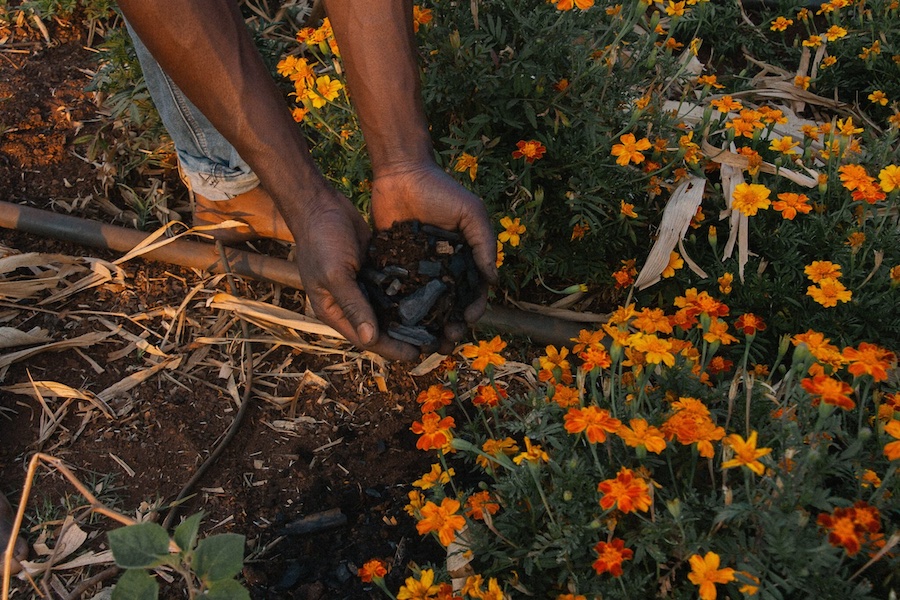
Better Cotton, the world’s largest cotton sustainability initiative, has teamed up with climate technology startup Planboo to help cotton farmers reduce greenhouse gas (GHG) emissions – and earn carbon credits for it.
Farmer holds biochar produced using crop waste © 2025 Planboo.


The partnership will involve biochar, a charcoal-like substance made from agricultural waste and other waste products that, when applied to soils, can improve their health, while helping them store carbon for more than a century.

Biochar is known to improve the structure of soil and enhance its ability to retain water and nutrients, while limiting chemical fertiliser use. In collaboration with Planboo, Better Cotton will support licensed farmers to produce this topical solution from farm waste and later apply it on the ground – providing environmental benefits in both phases.

Lars van Doremalen, Director of Impact at Better Cotton, said: “Planboo has championed biochar for over half a decade, and it is easy to see why. This age-old practice creates value from waste and boosts the climate resilience of land. Add to that the scope for farmers to be financially rewarded for their sustainability efforts, and this is an incredibly exciting proposition.”

Better Cotton will leverage Planboo’s digital Measurement, Reporting, and Verification (MRVin) system throughout this work, capturing data points from the production of biochar to the calculation of carbon reductions and removals.

This end-to-end software synchronises data to accurately calculate waste inputs, biochar volumes, carbon removals, and subsequent carbon allocation. As such, it unlocks new income streams for communities committed to reducing carbon emissions and improving their soil health.

Retailers and brands can also benefit, as their support to scale these efforts within the value chain would help mitigate Scope 3 emissions, which account for the vast majority of greenhouse gas release by the fashion and textile industries.

Freddie Catlow, Co-founder & CEO said: “From our very first days, Better Cotton stood out as the partner to deliver impact within fashion value chains. After seeing a 60% yield increase in cotton crops from our Solidaridad project in Zambia, it became clear this model was well-suited for cotton farming regions.

“With Better Cotton’s global reach and Planboo’s digital MRVin, we’re excited to embed carbon removal and soil health into the fabric of cotton farming, rooted in regeneration, and scaled by software.”

Better Cotton and Planboo will soon provide details of the scope of their first project, targeting smallholder cotton farming communities in India.


More News from Better Cotton

#Raw Materials

Better Cotton Initiative welcomes new and returning Council members

The Better Cotton Initiative (BCI) has confirmed a series of appointments and reappointments to its Council, the multistakeholder board responsible for BCI’s strategic direction.

#Raw Materials

Better Cotton Initiative strengthens regenerative focus in standard update

The Better Cotton Initiative (BCI) has strengthened the regenerative focus of its field-level standard with the launch of a new version of its Principles & Criteria (P&C), which marks the next step in the organisation’s journey to becoming a regenerative standards system.

#Raw Materials

Better Cotton Initiative marks certification anniversary with progress update and accreditation

One year since becoming a certification scheme, the Better Cotton Initiative (BCI) has announced that more than 3,000 supply chain actors have been certified. At farm level, more than 30% of farms and producer units supplying BCI Cotton have received a positive audit outcome.

#Raw Materials

Better Cotton Initiative opens enrollment in the US with promising opportunities for producers

Producer enrollment for the US Program of the Better Cotton Initiative (BCI) is open until May 15 for the 2026-2027 season. With over 2,600 members spanning the cotton supply chain and more than 11,000 users of its Better Cotton Platform (BCP) as of 2025, BCI’s standard is implemented in 15 countries and covers one fifth of global cotton production.

More News on Natural Fibers

#Raw Materials

CSITC adds ABRAPA as a round trial sample provider

Beginning with the Q2 2026 Round Trials, the ICAC's Committee on the Commercial Standardization of Instrument Testing of Cotton has expanded its sample provision framework by adding the Brazilian Cotton Growers Association (ABRAPA) as an official sample provider.

#Raw Materials

Dr N Vigneshwaran is named 2026 ICAC Researcher of the Year

The International Cotton Advisory Committee (ICAC) is pleased to announce the selection of Dr N Vigneshwaran, Principal Scientist and Head of the Chemical and Biochemical Processing Division at the ICAR–Central Institute for Research on Cotton Technology (ICAR-CIRCOT), Mumbai, India, as the ICAC Researcher of the Year 2026.

#Raw Materials

Global Cotton area and production are projected to decline in the 2026/27 Season

The June 2026 issue of Cotton This Month projects a modest contraction in global cotton area, production, and trade during the 2026/27 season, reflecting weaker demand sentiment, rising production costs, and shifting environmental factors across major producing nations.

#Natural Fibers

European Flax-Linen & Hemp step into advanced manufacturing: Enabling filament winding, 3D printing and high-performance composite processes

The Alliance for European Flax-Linen & Hemp announces a new wave of technological advancements demonstrating how flax-linen and hemp fibres are now being successfully integrated into advanced composite manufacturing processes. These developments mark a transition beyond traditional hand lay-up techniques, positioning natural fibres as credible, scalable solutions for high-performance industrial applications.

Latest News

#Associations

Mario Jorge Machado re-elected President of EURATEX

The EURATEX General Assembly has re-elected Mario Jorge Machado as President of EURATEX, renewing its confidence in his leadership at a crucial moment for the European textile and clothing industry. The sector is facing rising costs, global competitive pressure and an increasingly challenging transition towards sustainability and digitalisation.

#ITM 2026

ITM 2026 makes happy participants with its international and qualified visitor profile

ITM 2026 International Textile Machinery Exhibition, one of the most prestigious meeting points of the textile machinery sector, attracted attention in its first three days, particularly with its diverse international visitor numbers. Industry professionals from all over the world had the opportunity to closely examine the latest technology machines and solutions displayed in operation. Thousands of visitors from approximately 100 countries, primarily Egypt, Pakistan, India, Uzbekistan, Syria, Turkmenistan, Tajikistan, Morocco, Algeria, and Tunisia, met at the Tüyap Fair and Congress Center for new investment and cooperation opportunities.

#ITM 2026

KARL MAYER presents a textile TEXTRONIC® innovation at ITM 2026

With highly efficient machines and continuous textile innovations, KARL MAYER underscores its role as a reliable partner for discerning top-tier customers. Just in time for ITM 2026 in Istanbul, the industry leader is introducing a true innovation: an eyelash lace with its characteristic fringed look – combined with a previously unattainable 4-way stretch. While the established fabric could until now only be produced as rigid version or with one-dimensional stretch, the new elasticity in both dimensions expands the possibilities for cross-band panel fabrics.

#Man-Made Fibers

DYNEEMA® and NP Aerospace advance personal protection for military servicewomen

Dyneema®, owned by Avient Corporation, an innovator of materials solutions, is supplying its high-performance unidirectional (UD) materials to world-leading armor manufacturer NP Aerospace, enabling the production of armor systems designed specifically to fit the female body. With 2,000 new armor systems, including 4,000 plates, made in the United Kingdom (UK) and delivered in June 2026, this collaboration addresses a long-standing lack of high-quality personal protection specially built for female defense and security personnel.

TOP