[pageLogInLogOut]

#Sustainability

SAITEX MILL in Vietnam joins bluesign® System Partner as part of bluesign's Global Denim Initiative
bluesign® is proud to announce that SAITEX Mill has officially become a bluesign® System Partner. This collaboration marks a significant milestone in bluesign’s Denim Initiative, furthering the mission to drive sustainability across the global denim industry. SAITEX Laundry, the first denim laundry globally to join bluesign as a system partner over a decade ago, has now been joined by SAITEX Mill, creating a powerful, end-to-end sustainable production solution under one roof.
© 2024 SAITEX
© 2024 SAITEX


Founded by Sanjeev Bahl, SAITEX is a global leader in sustainable garment manufacturing, known for its innovative approach to reducing the environmental impact of textile production. Founded in 2001, the company operates with a commitment to sustainability, circularity, and social responsibility. With facilities in Vietnam and Los Angeles, SAITEX employs cutting-edge technologies such as closed-loop water systems, energy-efficient processes, and clean chemistry to minimize waste and carbon emissions. The garment operation is bluesign®, Fair Trade, LEED, and B Corp certified, underscoring its dedication to ethical manufacturing practices.

SAITEX partners with leading global brands to create high-quality denim and apparel while continuously pushing the boundaries of responsible production, setting a benchmark for the future of fashion.

Now that both the SAITEX Mill and Laundry are bluesign® system partners, brands can label their denim garments as bluesign® DENIM, produced and processed entirely within SAITEX’s facilities. The bluesign® DENIM label requires that the denim fabric is bluesign® APPROVED from a system partner mill, and that the garment is processed in a system partner laundry, ensuring compliance with bluesign’s strict environmental criteria. This allows brands to source bluesign® APPROVED denim fabrics directly from SAITEX Mill, have the garments processed at SAITEX Laundry, and achieve an end-to-end clean denim production process for consumers. With bluesign® APPROVED chemicals used in both fabric manufacturing and garment processing, brands can easily meet sustainability standards with SAITEX as their one-stop solution for clean denim.

This partnership aligns with bluesign's dedication to reducing the textile industry's environmental footprint by ensuring that textiles are made with responsible resource usage and worker safety. By becoming a bluesign® System Partner, SAITEX enhances its commitment to eco-friendly production practices, offering transparency and traceability throughout the garment life cycle.

Opened in 2022, SAITEX's cutting-edge fabric Mill near Ho Chi Minh City, Vietnam, represents the next generation of sustainable manufacturing. The mill integrates spinning, weaving, dyeing, and finishing processes under one roof, with a core focus on environmental responsibility. Leveraging advanced technologies, it reduces energy consumption, minimizes the use of harmful chemicals, and is on track to build a closed-loop water system to minimize freshwater intake, which will be completed by mid-2025. This state-of-the-art facility reflects SAITEX’s commitment to setting new standards for responsible production and circularity in the global textile industry.

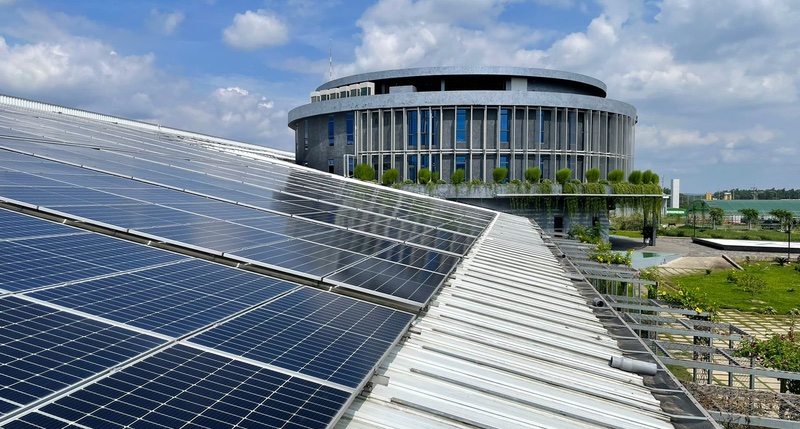
The mill features solar panels with a 3-4 MW capacity, reducing carbon emissions by 2,000+ tons annually.

The facility is designed with LEED Gold Certified specifications, ensuring minimal environmental impact through energy efficiency. LEED Gold certification is expected in November 2024.

The mill utilizes Smart-Indigo™ technology for hydrosulfite-free dyeing, resulting in 90% less CO2 emissions, 70% less energy use, and 30% less water consumption.

SAITEX aims to achieve carbon neutrality by 2030 through continued innovations in energy and resource efficiency.

The fully vertically integrated mill, from spinning to garment manufacturing, ensures lower environmental impact on both the fabric and laundry sides of the production process.

Sanjeev Bahl, CEO of SAITEX, said, “Becoming a bluesign® System Partner is another step in reinforcing our mission of sustainability, transparency, and responsibility. With bluesign®, we’re not just setting a new standard for responsible denim manufacturing; we’re driving a broader movement toward clean chemistry. This is about creating a system that’s safe for people and the planet—putting the human side of manufacturing at the center of everything we do. It’s our responsibility to ensure that our processes are as clean as they are efficient.”

Daniel Rüfenacht, CEO of bluesign®, added, "We were proud to welcome SAITEX Laundry into bluesign over 10 years ago as the first system partner denim laundry in the world, and it is thrilling for us to now have SAITEX Mill join the system partnership as well. Brands can now source bluesign® APPROVED denim fabrics from SAITEX Mill for their collections, and with both the mill and laundry as system partners, they can label their denim garments as bluesign® DENIM, ensuring a fully compliant and sustainable production process under one roof. Together, we are making significant strides toward reducing the global environmental impact of denim production."

This partnership strengthens bluesign's Denim Initiative, which brings together key players in the denim industry to create safer, more sustainable denim products. With SAITEX’s vertical integration and advanced technology, the global denim market is one step closer to achieving environmental responsibility and social equity.


More News from bluesign technologies ag

More News on Sustainability

#Sustainability

Execs help steer Cascale’s consumer goods agenda in Athens

The 2026 Cascale Annual Meeting, taking place September 15–17 in Athens, Greece, will convene leaders from across the global consumer goods value chain to tackle one of the industry’s defining questions: how to accelerate meaningful, system-wide transformation. Guiding those conversations as this year’s co-chairs are Sean Cady, vice president, global sustainability, responsibility, trade, and government affairs at VF Corporation, and Dr. Delman Lee, vice chair at TAL Apparel Limited.

#Textiles & Apparel / Garment

SAITEX reports efficiency gains and greater transparency in 2025 Impact Report

Vietnam-based denim manufacturer SAITEX has published its 2025 Impact Report, documenting progress in resource efficiency, chemical management, digital traceability and knowledge sharing across its manufacturing operations in Vietnam and the United States. Rather than focusing on sustainability ambitions, the report presents operational data, manufacturing developments and lessons learned from the past year.

#Raw Materials

Aid by Trade Foundation presents annual report for 2025: Market position and impact of sustainably verified natural fibres strengthened

Despite global supply chain challenges, the Aid by Trade Foundation (AbTF) was able to further expand its international role in promoting sustainably verified natural fibres in 2025. In doing so, the foundation remains true to its fundamental approach of leveraging market forces. Last year, it generated total revenues of EUR 7.8 million; this included EUR 6.7 million collected through the successful marketing of four standards: Cotton made in Africa (CmiA), CmiA Organic, The Good Cashmere Standard (GCS), and the Regenerative Cotton Standard (RCS). AbTF invested the resulting income in projects aiming to protect biodiversity, support women, increase transparency in the textile supply chain, and implement its verification system.

#Sustainability

Textile Exchange reports growth in certifications and industry engagement

Textile Exchange has published its 2025 Annual Report, highlighting continued growth in certified sites, industry participation and the development of its standards and membership structure. According to the report, more than 100,000 sites worldwide are now certified to Textile Exchange standards, more than three times the number recorded in 2020. Preliminary figures also indicate 12% year-on-year growth across the organization's current standards, including the Global Recycled Standard (GRS), Recycled Claim Standard (RCS) and the Responsible Animal Fiber standards.

Latest News

#Raw Materials

Brazil sets new cotton export record and consolidates global leadership

Brazil ended the 2025/26 commercial year with a new record, consolidating its position as the world’s largest cotton exporter. Between August 2025 and July 2026, the country shipped 3,373,941 tonnes of the fiber, 19% more than in the previous cycle, and reached record revenue of US$5.3 billion. The result represents a milestone in Brazil’s expansion in the international market and reinforces the country’s role as a strategic supplier to the global textile industry.

#Raw Materials

Better Cotton Initiative partners with Avalo in AI plant breeding for climate-resilient cotton

The Better Cotton Initiative (BCI) has partnered with agriculture solutions company Avalo, whose platform accelerates the speed at which plants with key resiliency traits may be developed.

#Man-Made Fibers

The LYCRA Company expands its co-creation vision through an immersive Lifestyle District at Intertextile Shanghai.

The LYCRA Company, a global leader in fiber and technology solutions for the apparel industry, is reimagining the trade show experience at Intertextile Shanghai Apparel Fabrics Autumn Edition, which opened today in China. Building on the success of last year's ALL IN concept, the company has expanded its co-creation vision into a 356-square-meter Lifestyle District featuring partners Jingzili New Material, JYT Textile, Lianxingfa Knitting, and Trend Textile. The district is part of a larger 895-square-meter pavilion showcasing a total of 19 co-exhibitors. Together, they demonstrate how innovations in fiber, fabric, and garments can be combined to create compelling solutions for both work and play.

#Natural Fibers

Plastic-free stretch technologies drive new direction for denim innovation

As the denim industry looks for ways to reduce its reliance on synthetic fibres, plastic-free stretch technologies are gaining momentum. Developments based on mechanical fabric construction and natural rubber are demonstrating that comfort and stretch can be achieved without conventional elastane, supporting both recyclability and circular product design.

TOP