[pageLogInLogOut]

#Sustainability

From Montréal to Morocco: Circle Economy Foundation’s impact was global in 2023

Circle Economy Foundation is excited to announce the launch of the Impact Report 2023. Following a year of firsts for the organisation, they turned their attention inward to take stock of their impact across the three levers of their Theory of Change: Analyse, Act and Scale. Read on to see some of the highlights from 2023.

To Analyse, the Circularity Gap Report Latin America and the Caribbean provided the first of its kind analysis in the region, finding that 40% of the region’s raw materials are exported—revealing the disparity between global material demand and local communities that bear the brunt of ecological breakdown. This year also saw the launch of the Circularity Gap Report for Cities, bringing the Circularity Gap Report to the local level: Munich was up first, demonstrating it can use 43% less materials than it uses now while cutting its consumption-based CO2 emissions by 23%. 
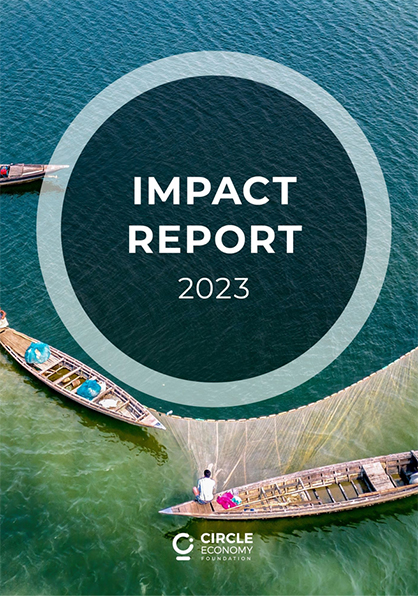
© 2023 Circle Economy Foundation


To Act, Circle Economy Foundation developed a training programme with Oxfam to build the capacity of small- and medium-sized enterprises towards a green and circular economy. The circular training model has so far been implemented across several countries: Nigeria, Egypt, Uganda, Somaliland, Kenya and Cambodia.

To Scale their work, they have finalised their spin-off, Circle Economy Consulting, and they are proud to announce that Deloitte will be its Scaling Partner. They have also been building capacity across key value chains via the UN-led SWITCH to Circular Economy Value Chains programme and the acquisition of Sustainability Games—an educational tool for teaching circular principles. Sustainability Games was implemented by plastics companies in Morocco and textiles companies in Bangladesh via SWITCH to educate and inform workers on the ground.

Zooming in on the practical outcomes of their work, they've seen their  research inform the creation of circular policies across Europe, the UK and Canada. For example, thanks to the Circle City Scan, Circular Montréal: Baseline Assessment, Montréal has released its public consultation document, ‘Towards a Montréal roadmap in the circular economy’, which will inform the creation of their future circular strategy. 


Meanwhile, in Austria, the Circularity Gap Report Austria was presented to the Ministry of Environment in 2019. Four years later, the report has contributed to the country’s recent policy changes. The Austrian Cabinet of Ministers has now adopted a National Circular Economy Strategy. Following their analysis, the comprehensive policy document aims to boost circularity from 9.7% to 18% by 2030.

Wrapping up this year, Circle Economy has empowered 30 businesses, three cities and four nations across three continents to become more circular. This contributes to the total of 150 businesses, 55 cities and 27 nations across six continents that they’ve aided over the past ten years. They’ve also trained more than 4,230 people in circular principles over the past decade.

These are just a few highlights from the Impact Report 2023. Download the full report to see how they’re making the circular economy a reality.


More News from Circle Economy

#Recycling / Circular Economy

Between 121 and 142 million people are employed in the circular economy globally, new study finds

Between 121 and 142 million people worldwide are employed in sectors that contribute to the circular economy, such as repair, recycling, second-hand trade and waste management. This represents roughly between 5 and 5.8 percent of total global employment (excluding agriculture), according to a new joint report by Circle Economy, the International Labour Organization (ILO) and the World Bank Group, in partnership with the UN Partnership for Action on Green Economy (UN-PAGE).

#Recycling / Circular Economy

Circulose welcomes Sara Diez Jauregui and Kalyan Madabhushi to its Board of Directors

Circulose is proud to announce the appointment of Sara Diez Jauregui and Kalyan Madabhushi to further strengthen its Board of Directors, following the recent appointment of Chair Helena Helmersson. These additions bring world-class expertise across the value chain: Sara offers extensive experience with leading fashion and apparel brands, while Kalyan brings a notable career at Aditya Birla Group, a global leader in cellulosic fiber production.

#Recycling / Circular Economy

Successful pilot: biodegradable plastic produced from textile waste

The 'Design for Transformation' (D4T) pilot project, led by Circle Economy and the Biomimicry Institute, has developed an innovative technology to produce bioplastics and gaseous products from textile waste. This set of technologies aims to enable companies to generate additional revenue streams from waste, whilst diverting it from landfills or incineration.

#Recycling / Circular Economy

Circle Economy and partners launch new textile 5R solutions project SOLSTICE

Launched on 28 May, 2024, the SOLSTICE project supports sustainable growth in the textile sector by raising customer awareness, enhancing recycling with new sorting methods, ensuring feedstock traceability using the Digital Product Passport, and providing data and guidelines to decision-makers. ?

More News on Sustainability

#Sustainability

Experts publish APAC policy priorities

Cascale today announced the publication of its APAC Policy Priorities Paper, developed by the Asia-Pacific (APAC) Policy Member Expert Team (MET) to identify key regional sustainability challenges and provide practical, aligned recommendations for policymakers and industry stakeholders across Asia-Pacific.

#Sustainability

GOTS version 8.0 released: advanced supply chain accountability, from fibre to finished product

Global Standard is pleased to announce the release of GOTS Version 8.0, the latest update to the world's leading processing standard for organic textiles. The updated Standard strengthens requirements for air emissions and waste management, as well as criteria for product safety. It introduces new provisions on circularity, microfibre management and updates in residue testing. Version 8.0 also elevates due diligence obligations and formalises governance requirements, including ESG disclosure, anti-corruption policies and conflict-of-interest safeguards, to support credible, responsible business conduct.

#Sustainability

The nova-Institute establishes new Renewable Feedstock Department to lay the groundwork for industrial defossilisation

The transition from fossil-based to renewable carbon – sourced from biomass, CO₂ utilisation and recycling – is the cornerstone of a climate-neutral chemical industry. The nova-Institute’s new department is dedicated to providing the essential data, analyses and strategic roadmaps required to secure a reliable future feedstock supply and make this transition a commercial and ecological reality.

#Sustainability

Textile Exchange unveils commitment-based pathway for members to accelerate responsible raw material production

Textile Exchange has unveiled further details about its new membership structure, designed to guide the fashion, textile, and apparel industry in a collective course of action toward preferred production systems for raw materials and fibers.

Latest News

#Textile processing

Major expansion for ACG Kinna follows record year

In response to growing demand for its full textile and finished product line automation services, ACG Kinna – a member of TMAS, the Swedish textile machinery association – has inaugurated a 1,000-square-metre expansion at its headquarters in Skene, Sweden.

#Textiles & Apparel / Garment

YKK launches “YZiP® Light” aluminum alloy zipper for cotton pants

YKK Corporation (Headquarters: Chiyoda-ku, Tokyo; President: Koichi Matsushima; hereafter, YKK) has launched YZiP® Light, a lightweight aluminum alloy zipper for cotton pants, with sales beginning in late March. The introduction of YZiP® Light expands YKK’s zipper portfolio—led by the flagship YZiP® copper alloy zipper—providing customers with greater flexibility to meet diverse garment needs.

#Techtextil 2026

Shima Seiki showcases WHOLEGARMENT® and 3D knitting solutions for technical textiles at Techtextil 2026

Leading textile technology solutions provider SHIMA SEIKI MFG., LTD. of Wakayama, Japan, along with its Italian subsidiary SHIMA SEIKI ITALIA S.p.A., will be participating in the Techtextil 2026 exhibition in Frankfurt, Germany next month. On display will be WHOLEGARMENT® and other advanced three-dimensional knitting applications across a wide range of industries besides fashion apparel that are not typically associated with knitting, such as technical textiles using industrial materials and advanced three-dimensional knitting.

#Raw Materials

The 83rd Plenary Meeting: Reports from the ICAC Secretariat

Every year, one of the most anticipated sessions at the International Cotton Advisory Committee's (ICAC) Plenary Meeting is the Reports from the Secretariat — and the 83rd edition in Bremen, Germany, did not disappoint.

TOP