[pageLogInLogOut]

#Sustainability

Lenzing reaches further milestones in photovoltaic and e-mobility expansion
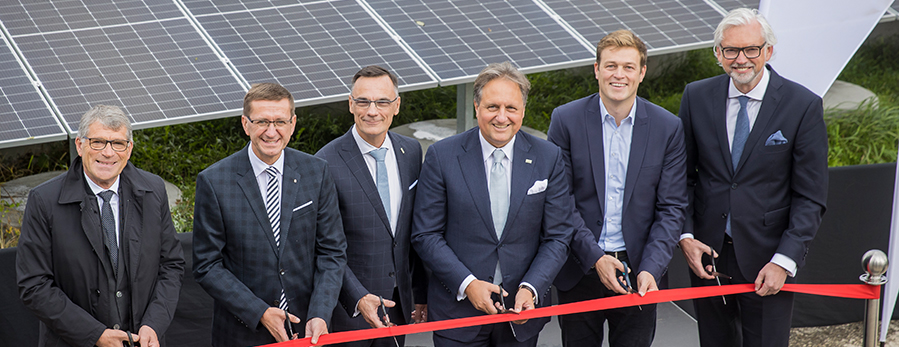
Lenzing x Verbund: First expansion stage of the largest free-field photovoltaic plant in Upper Austria ceremonially put into operation - f.l.t.r. Lenzing Mayor Rudolf Vogtenhuber, Provincial Councillor Markus Achleitner, CEO Stephan Sielaff (Lenzing), Chief Pulp Officer Christian Skilich (Lenzing), Provincial Councilor Stefan Kaineder, CEO Michael Strugl (Verbund) © 2022 Lenzing
The Lenzing Group, a world-leading provider of wood-based specialty fibers for the textile and nonwoven industries, and VERBUND, Austria’s leading energy transition company, are celebrating today’s launch of the first development stage of the largest ground-mounted photovoltaic system in Upper Austria. Together with its energy partner VERBUND, Lenzing is also paving the way for the transition to zero-emission mobility. The installation of electric vehicle charging infrastructure at the company’s premises underlines Lenzing’s commitment to the energy transition process.

Thanks to the ground-mounted photovoltaic system at the “Ofenloch” landfill site, Lenzing, in conjunction with VERBUND, is consistently moving forward on the path to a carbon-free energy supply and has commissioned the first half of the new photovoltaic system with a peak power of 2,780 kWp. Full commissioning of the system with a peak power of 5,560 kWp is envisaged in mid-October. Annual electricity production will amount to 6,000,000 kWh, which is expected to cut CO2 emissions by some 4,400 tonnes per year. The Austrian pioneer in fiber production already commissioned three rooftop photovoltaic systems in spring/summer of 2022, with a peak power of 1,454 kWp and annual electricity production of some 1,508,000 kWh. The electricity flows directly into the company’s on-site production and will also power electric charging stations in future. In the first development stage, 16 wallboxes are set to be installed by the end of the year. A further 32 charging points are planned for 2023. The charging stations will be accessible to staff, visitors and the company’s own vehicle fleet.

Sustainability as a driver of innovation

Sustainability is a precondition for every new development at Lenzing. “Sustainable management forms the basis of our long-term economic success. This is why we are working with strong partners to become more independent of the turmoil on the energy market and to ensure greater planning reliability. Due to our consistent expansion in the field of photovoltaic and the transition to e-mobility, we are playing a pioneering role in Upper Austria and providing an important contribution to the region’s photovoltaic strategy for 2030,” comments Stephan Sielaff, CEO of the Lenzing Group.


“VERBUND’s photovoltaic operator model allows us to make the transition to solar power without incurring investment costs or risks. Thanks to the constant expansion in renewable energy, we remain on course to ecologize the value chain, while optimizing our carbon footprint, cutting costs and reducing the load on the grid, as we are using nearly 100 percent of photovoltaic power in our production,” explains Christian Skilich, Chief Pulp Officer of the Lenzing Group.

“We welcome this strategic partnership with Lenzing. Thanks to our electricity production, which is mainly derived from hydro, wind and solar power, we are making a key contribution to the energy and climate targets of Austria and Europe. We are also consistently investing in securing a future based on renewable energy. VERBUND invests some EUR 1 billion annually in the development of electricity production, storage and networks. But VERBUND also acts as an energy partner, supporting industrial companies with our solutions on their path to a green energy future. Because working together is the only way to manage the energy transition,” says Michael Strugl, Chairman of the Board of VERBUND.

More News from Lenzing

#Denim

TENCEL™ Lyocell - HV100 achieves global denim availability in six months; Vol. 2 debuts at Kingpins Amsterdam

When TENCEL™ Lyocell - HV100 debuted at last year’s Kingpins Amsterdam in October, 17 mill partners across five countries presented fabrics featuring the new fiber. Just six months on, participation has more than doubled, evolving into a global network that spans nine countries and four continents, signaling both strong industry momentum and growing demand.

#Techtextil 2026

Lenzing unveils three-tier cellulosic fiber portfolio for next generation protective wear

The Lenzing Group, a leading supplier of regenerated cellulosic fibers for the textile and nonwovens industries, today introduces Lenzing Solutions for Protective Wear. This integrated three-tier portfolio is anchored by LENZING™ FR fibers at the highest protection tier for inherent flame resistance and brings together complementary solutions including TENCEL™ Lyocell fibers, both EU Ecolabel-certified² and derived from certified or controlled wood sources³, within a unified protective wear architecture for the first time. The launch marks the most significant expansion of Lenzing’s protective wear business since the company pioneered inherently flame-resistant cellulosic fiber in 1977, and comes as the global personal protective equipment (PPE) market accelerates toward an estimated USD 130 billion by 2033⁴.

#Man-Made Fibers

Lenzing commissions 14 MW power‑to‑heat facility, strengthening grid stability and heat management

The Lenzing Group has successfully commissioned a new power‑to‑heat (P2H) facility with an electrical capacity of 14 megawatts. The installation converts renewable electricity directly into process heat, is fully integrated into the existing heat network at the industrial site, and represents a key building block for a fossil‑free heat supply. As project partner, VERBUND was responsible for the energy‑market integration and will operate the facility for balancing energy marketing, enabling it to respond flexibly to short‑term fluctuations in the power grid.

#Nonwovens

VEOCEL™ Lyocell production expands to Asia – Launching a new chapter for nonwovens in the region

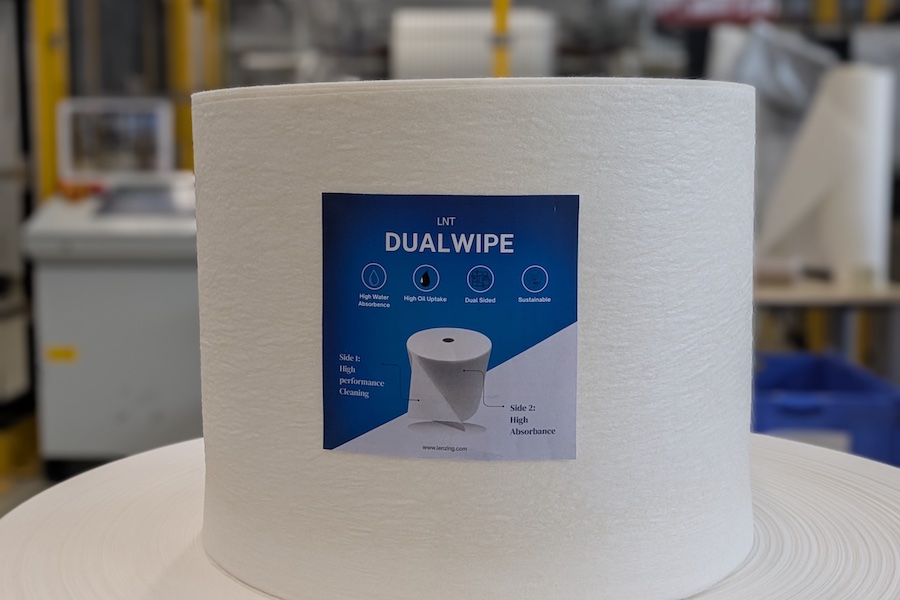
VEOCEL™, Lenzing's flagship specialty nonwovens brand, expands production at its Thai plant in Prachinburi. This is the first-ever production of its nonwoven-grade lyocell fibers in Asia. Built in 2022 with a 100,000-ton annual production capacity, the facility - previously focused on fibers for textile applications - now can directly meet the demand for VEOCEL™’s biodegradable¹, wood-based lyocell fibers for nonwovens products. These fibers are an essential ingredient for high-quality nonwovens products, ranging from baby wipes to facial sheet masks and everyday personal hygiene items.

More News on Sustainability

#Sustainability

Number of GOTS-certified facilities grow 15% globally as demand for credible sustainability standards continues to strengthen

Global Organic Textile Standard (GOTS) certification continued to grow in 2025, with nearly 18,000 certified facilities worldwide, despite ongoing geopolitical uncertainty and rapidly evolving regulatory requirements across global textile supply chains.

#Sustainability

bluesign technologies introduces bluepass

bluesign technologies ag (www.bluesign.com) today announces the launch of bluepass, a new certification mark and product labeling system created to deliver clear, substantiated, and verifiable sustainability claims at scale.

#Research & Development

Hohenstein publishes 2025 Sustainability Report

The testing and research service provider Hohenstein has published its latest sustainability report, outlining key progress and strategic initiatives. The report focuses on ambitious CO₂ reduction targets, the company’s new mission statement and the systematic expansion of sustainable services for customers worldwide.

#Natural Fibers

Global Standard gGmbH launches second public consultation for GRTS Draft 2 for the textile industry (1–30 April 2026)

Global Standard gGmbH is pleased to announce the release of Draft 2 of the Global Responsible Textile Standard (GRTS) for its second public consultation. The consultation will be open from 1 April 2026 to 30 April 2026, inviting stakeholders across the textile and apparel value chain to provide input and contribute to the further development of this new Standard.

Latest News

#Raw Materials

ECCO introduces first shoe featuring innovative protein-based fibre

ECCO, in partnership with Spinnova, announces the launch of the limited edition ECCO BIOM® 720, a first-of-its-kind shoe utilising an often overlooked leather by-product, transformed into a protein-based fibre. The fibres are produced using patented technology that advances material innovation while reducing waste and supporting full resource use across the leather and textile industry.

#Man-Made Fibers

The LYCRA Company strengthens sustainability leadership, appoints Alistair Williamson as VP of Product Sustainability

The LYCRA Company has appointed longtime executive Alistair Williamson as vice president of product sustainability, reaffirming its commitment to developing sustainable solutions for apparel and personal care products. In this role, he will guide the company’s next chapter of sustainability strategy and oversee all initiatives aimed at reducing environmental impact across products, operations, and innovation platforms.

#Raw Materials

Kraig Biocraft Laboratories reports major progress converting record-setting spider silk cocoon production into reeled silk

Kraig Biocraft Laboratories, Inc. (OTCQB: KBLB) (“the Company”, “Kraig Labs”, or “Kraig’s”), a world leader in spider silk technology*, today announced significant progress in the processing of its recently produced recombinant spider silk cocoons into reeled silk.

#Textile processing

trinamiX mobile NIR spectroscopy: New applications for the footwear and textile industry

trinamiX GmbH expands its solution portfolio for the circular economy, now enabling the identification of materials used in the footwear and textile industries. With its mobile near-infrared (NIR) spectroscopy solutions, trinamiX supports manufacturers, sorters, recyclers, and brand owners in reliably identifying materials and improving transparency across increasingly complex value chains.

TOP