[pageLogInLogOut]

#Sustainability

Aid by trade foundation and partners invest EUR 2.8 Million in climate adaptation project
© 2022 Cotton made in Africa
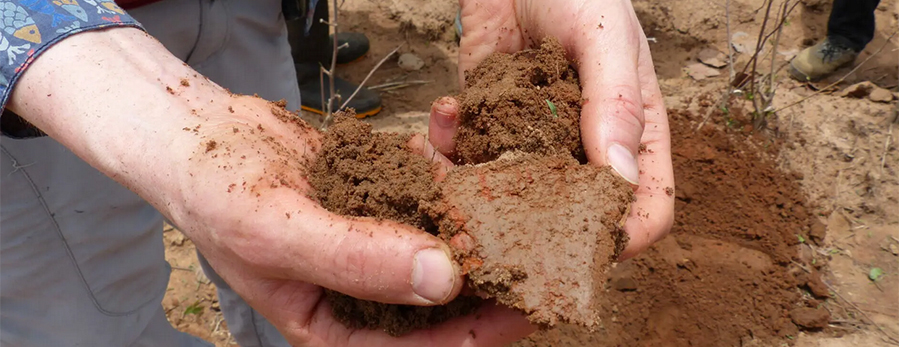
Despite its key function in climate protection, soil management often falls by the wayside. The way we use our soil has significant implications for our climate, and it also plays a role in deciding whether unique species of plants and animals remain extant and whether humanity will be able to live from the soil in the future.

The livelihoods and continued survival of small-scale farmers in Africa largely depend on how changing climate conditions affect the fertility of their soil. To enable the farmers to develop resiliency and adapt to the changing climate, the Aid by Trade Foundation (AbTF), which administers Cotton made in Africa (CmiA), launched CAR-iSMa, a co-operative project with a total budget of around EUR 2.8 million. 

Promoting Climate Protection and Resilience for Small-Scale Farmers in Africa Through Sustainable Soil Management

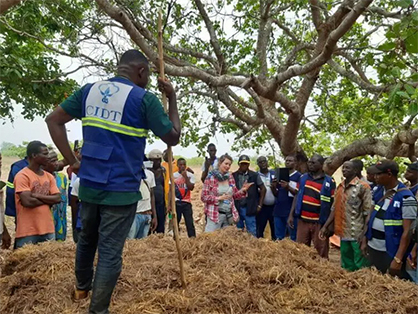
CAR-iSMa is short for “Climate Adaption and Resilience: A Pan-African Learning and Knowledge Exchange Project on Improved Soil Management”. Created at the initiative of the Aid by Trade Foundation, the project is being supported by Deutsche Gesellschaft für Internationale Zusammenarbeit (GIZ) with funding from the German Federal Ministry for Economic Cooperation and Development (BMZ) and is being implemented together with the agriculture organisation LDC Suisse and with three CmiA-verified cotton companies: CIDT from Côte d’Ivoire, JFS from Mozambique, and LDC from Zambia. This co-operative project’s primary objective is to improve soil management through sustainable production methods in order to better the livelihoods of small-scale farming families, reduce the effects of climate change for this target group, and strengthen their resilience. Soil & More Impacts (SMI), a company that provides services for sustainable agriculture with a focus on soil and composting, is supporting the project by offering advice on how to increase soil fertility. SMI is also working with three cotton associations in Africa to start providing small-scale farmers with training in composting and regenerative agriculture.
© 2022 Cotton made in Africa


“Through the CAR-iSMa project, we are making an important contribution to climate protection and are assisting small-scale farmers in Africa in developing strategies to counteract the effects of climate change. Our goal is to enable both current and future generations of farmers to earn a living from the cotton produced in their soil. To achieve this goal, it is crucial to sustainably manage soil as a natural resource, which is why that is our primary focus in this project,” summarises Tina Stridde, the managing director of the Aid by Trade Foundation. “Soil is crucial to the livelihoods of many small-scale farming families. The farmers are suffering as climate change renders the soil increasingly parched and infertile, and they have little access to the knowledge and means they need in order to adapt accordingly. Through an on-site assessment, we were able to confirm that the cotton farmers are interested in learning more about composting and other aspects of regenerative agriculture because they want to reduce erosion, conserve soil fertility, and ensure the long-term productivity of their soil,” adds Britta Deutsch. As the foundation’s head project manager for CAR-iSMa, Ms Deutsch travelled to Côte d’Ivoire to set up the project. The West African country is one of three project countries and a long-time CmiA partner country.


A total of around 100,000 people working in cotton production are expected to benefit from the project activities. The focus is on the small-scale farmers supported by local, CmiA-verified cotton companies. This co-operative project is also planned to include a qualification programme for soil-management trainers as well as training material for agricultural consultants. Innovative approaches like self-cultured compost microbes and pyrolysis—which produces vegetable carbon, thereby capturing carbon in the soil for the long term as well as improving the soil structure and water-retention capacity—are planned to be tested as part of the project before being rolled out in CmiA’s wider network if possible. The plan is to enhance 92,000 hectares of land by improving soil fertility; this is roughly equivalent in size to greater Berlin. Another area of focus is a transnational and inter-organisational knowledge exchange between the participating cotton associations. To scale up the long-term benefits of the lessons learnt and of the positive experiences, successful approaches should be implemented throughout the CmiA network in Africa after the end of the project. In this way, AbTF aims to continue improving the small-scale farmers’ production practices.
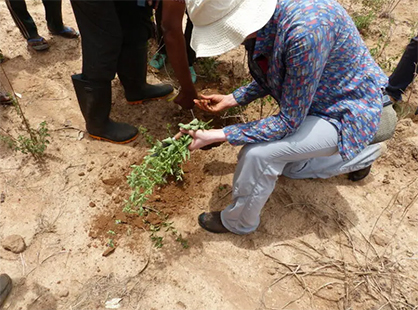
© 2022 Cotton made in Africa


The CAR-iSMa project is part of the Sub-Saharan Cotton Initiative, which supports four public–private partnerships under a global programme pursuing sustainability and value creation in agricultural supply chains under the umbrella of SEWOH, a German special initiative for a world without hunger. At the behest of the Federal Ministry for Economic Cooperation and Development (BMZ), the programme promotes sustainability in a selection of agricultural supply chains.

More News from TEXDATA International

#People

Happy Holidays!

Dear reader, the year 2025 is drawing to a close. We are entering what we hope will be a peaceful holiday season, spending time with our families and taking a moment to pause and reflect. We hope we have been able to support you once again this year with relevant news and articles, and we look forward to surprising you with many innovations in the coming year. Enjoy the festive season, stay healthy, and we wish you a happy and joyful holiday season.

#Recycling / Circular Economy

textile.4U publishes special edition “Top 100 Textile Recycling Companies 2025”

With a comprehensive 176-page special edition, textile.4U is dedicating its latest issue entirely to one of the most dynamic and influential topics in today’s textile industry: textile recycling. The new issue, published exclusively in high-quality print, presents the Top 100 textile recycling companies researched and selected by TexData – organizations that already play a key role in the transition to circular textiles or are expected to have a significant impact in the near future.

#Recycling / Circular Economy

Responsible Textile Recovery Act of 2024 signed by Governor

Senator Josh Newman (D-Fullerton) is proud to announce that Senate Bill 707 (SB 707), the Responsible Textile Recovery Act of 2024, has been signed into law by the Governor of California, Gavin Newsom. This groundbreaking legislation establishes the country’s first Extended Producer Responsibility (EPR) textile recycling program, marking a significant step forward in the state’s efforts to combat waste and promote sustainability.

#Textiles & Apparel / Garment

Modtissimo promotes sustainability with 28 coordinates in the Green Circle

Modtissimo is proving more and more to be a textile and clothing show that delivers the latest innovations in the area of sustainability, with the iTechStyle Green Circle being the main showcase for companies' creations. In this 60+4 edition, taking place on 12 and 13 September, 28 coordinates will be exhibited in a section organised by CITEVE and curated by Paulo Gomes.

More News on Sustainability

#Yarns

Textile Exchange publishes the final criteria for its new Materials Matter Standard, marking a pivotal shift in connecting certification to impact

Textile Exchange has published the final criteria for its Materials Matter Standard—a major milestone in the organization’s multi-year transition toward a unified, impact-driven standards system for raw material production and primary processing. 

#Nonwovens

EDANA wraps up its Sustainability & Policy Forum 2025: Uniting the industry and EU policymakers to navigate the future of nonwovens

Against a backdrop of rapidly evolving environmental legislation, the EDANA Sustainability & Policy Forum 2025 concluded the past week in Brussels, marking a step forward in the dialogue between the nonwovens industry and European policymakers. Held from 9-10 December at the historic Residence Palace, the two-day event successfully brought together business leaders, sustainability experts, and EU officials to address the dual challenges of circularity and industrial competitiveness.

#Sustainability

YKK recognized with Top ‘A’ rating by CDP for climate change leadership for third consecutive year

YKK Corporation announced its achievement of the highest “A List” rating in the 2025 Climate Change survey conducted by the global environmental disclosure nonprofit, CDP . This marks the third consecutive year YKK has received this prestigious recognition.

#Weaving

Itema announces strategic partnership with Ivy Decarb to accelerate decarbonization in weaving process

Itema is pleased to announce the strategic partnership with Ivy Decarb, the digital platform helping textile companies measure and reduce their carbon footprint.

Latest News

#Weaving

Lindauer Dornier announces leadership transition in weaving machine business

After more than ten successful years at Lindauer DORNIER GmbH, Mr Wolfgang Schöffl will leave the family-owned company at the end of the year to enter well-deserved retirement.

#Heimtextil 2026

Texpertise Focus AI: Messe Frankfurt puts Artificial Intelligence centre stage at its international textile and apparel trade fairs

Under the banner 'Texpertise Focus AI, Messe Frankfurt will place a strong emphasis on Artificial Intelligence (AI) across its international textile and apparel trade fairs from 2026 onwards, setting a future-shaping signal for the industry. The initiative highlights the responsible use of AI along the entire textile value chain, from fibre production to the point of sale. The programme will launch at Heimtextil in Frankfurt in January 2026.

#Technical Textiles

Autoneum and Polestar set new benchmarks for passenger experience and sustainability

As the global market leader in sustainable acoustic and thermal management, Autoneum is a key supplier of interior and exterior components for the highly anticipated Polestar 5 model. The successful collaboration between Autoneum and Polestar marks a significant milestone in sustainable automotive engineering: the electric grand tourer sports car features several innovations in lightweight, fully recyclable polyester-based components that ensure a superior driving experience. Polestar 5 was revealed at the IAA Mobility 2025 in Munich and is available in 24 markets.

#Natural Fibers

Cashmere producers stress the importance of The Good Cashmere Standard®

At the invitation of the Aid by Trade Foundation (AbTF), over 70 experts from the cashmere production and supply chain, as well as other specialists, met at the GCS Unit Meeting in Shanghai, China to discuss the progress and new objectives of The Good Cashmere Standard (GCS). The meeting focused on implementation and verification of the standard, important aspects of animal welfare and the importance of the standard in the global textile market.

TOP