[pageLogInLogOut]

#Sustainability

Marchi & Fildi Group: positive balance for 10 years of the photovoltaic installation
© 2021 Marchi & Fildi Group
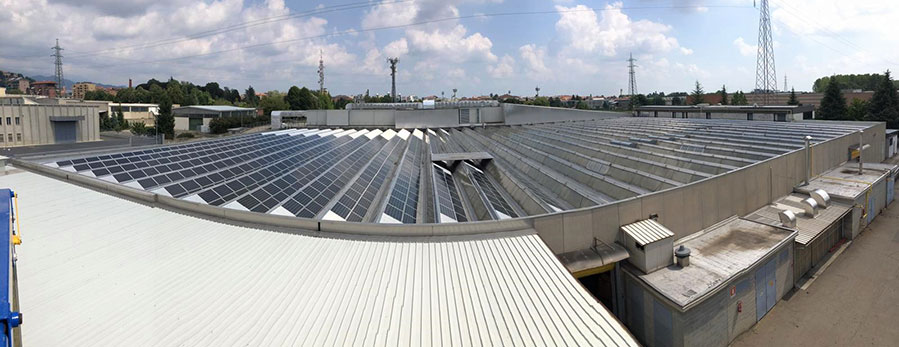
10 years after the installation of the photovoltaic plant in the production units in the Biellese region, the Marchi & Fildi Group takes stock of the operation and publishes the data on energy produced, consumed, and fed back into the grid.

Total savings of approximately €1m in energy costs and energy fed back into the electricity grid to cover the average annual consumption of around 4630 families

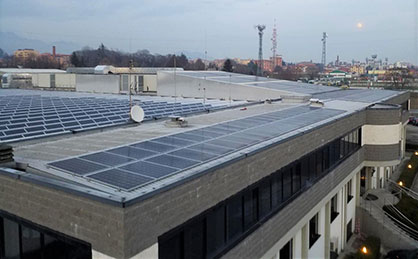
The photovoltaic plant owned by the Group is made up of 11,385 modules divided between the three facilities in Biella (Production), Cerrione (Dyeing mill) and Verrone (Logistics), which in total cover a surface of 16,515 sq.m.

The balance to be drawn from these 10 years is a positive one: in total 22,974,828 kWh have been produced, of which 7,292,027 kWh have been used in company activities, with a saving in energy costs of approximately €1m over 10 years.

The energy kWh produced and not used by the company was fed back into the grid and corresponds to the average annual consumption of around 4630 families *.

The Marchi & Fildi Group has always been committed to rationalising electric energy consumption with the aim of contributing towards an eco-sustainable development without compromising the rate of production and the ability to grow. In addition to producing its own electric energy, over the years, the company has also achieved an increasing number of Energy Efficiency Titles (TEE), otherwise known as white certificates. In 2021, 138 TEEs have been awarded as a result of such interventions as the introduction of LED lighting and the optimisation of the production processes which, while still as efficient as before, permit the company to reduce the electric energy consumption of the machinery.

“Choosing to produce electric energy from renewable sources in order to integrate the energy needs for the running of the establishments was one of the crucial factors on our route of innovation towards a sustainable end product. It is the result of the attention the owners have always paid to technological innovation which optimises processes and rationalises the resources with a view to eco-sustainable development and growth, and which has led to, among other things, the birth of ECOTEC®, our technology which valorises and reuses products both pre- and post-consumer” states Massimo Marchi, CEO of the Marchi & Fildi Group. “We are very satisfied to have been able to make a tangible contribution in an historical moment when the strong connection between the exploitation of resources and climate change is so undeniably apparent, as well as the conservation of such resources by the utilisation of renewable sources and virtuous cycles of recycling waste materials. We have done, and will continue to do, everything possible to make a constructive contribution to the community to which we also belong, seeking to preserve the area and the environment which surrounds us for future generations.


*In the meter class for the range of 3kW to 4.5 kW, the average consumption for residential properties is the equivalent of 3,382 kWh (source: Arera Relazione annual state of services for the year 2020). The calculations are the results of an internal study conducted by the Marchi & Fildi Group.
© 2021 Marchi & Fildi Group


The Marchi & Fildi Group

Marchi & Fildi S.p.a was established in 2007 through the fusion of the mills Filatura Marchi and Fildi, owned by the Marchi and Dissegna families. Filidea is the youngest company within the Group, and was set up in 2008.

The Marchi & Fildi Group proposal for the fashion world consists of linear or circular knitting, weaving and hosiery. The distinguishing element in the collections is the focus on sustainability, which starts with the selection of the raw materials and finishes with the Ecotec® brand owned by Marchi & Fildi. The Filidea brand presents an assortment of natural, sustainable and certified yarns designed for the high-quality market sector. Filidea is also specialised in the production and development of technical yarns intended for protective and work clothing, for the automotive industry and various industrial uses.

The modern dyeing department and the pilot research and development facility allow the Group to create new yarns for the collections, alongside the collaboration with universities and research centres and with various partners for the development of specialised projects.

Today, with the entry of the third generation of entrepreneurs, Marchi & Fildi S.p.a is a group of mills which is known internationally and which has a constant rate of growth.

Ecotec® is the patented production process developed by Marchi & Fildi to create new yarns by upcycling the pre- and post-consumer cut-offs. The Ecotec® range ensures a reduced environmental footprint: up to 46.9% savings in terms of energy consumption, up to 46.6% reduction in terms of CO2 and up to 61.6% reduction in terms of water consumption along the whole supply chain.




More News from TEXDATA International

#Texprocess 2026

Texprocess 2026: Automation, digitalisation and AI redefine textile processing

Making investment decisions in textile processing has become significantly more demanding. Increasing energy costs, a shortage of skilled labour and ongoing geopolitical uncertainties are compelling companies to focus on technologies that deliver clear gains in efficiency and process reliability. This applies equally to apparel manufacturing and to the processing of technical textiles and high-performance materials. As a result, modernisation initiatives are assessed more carefully – even as the need to upgrade production systems continues to intensify.

#Techtextil 2026

Techtextil 2026: Between innovation pressure & market reality

From 21 to 24 April 2026, Techtextil in Frankfurt am Main will once again become the central meeting point for the international technical textiles and nonwovens industry. Running in parallel, Texprocess will focus on the industrial implementation of textile processing technologies as the leading platform in this field. Together, the two trade fairs form a closely integrated presentation and working platform along the entire textile value chain – from material development to finished applications.

#Techtextil 2026

Between geopolitical pressure and industrial resilience

In this interview, Dr. Janpeter Horn (VDMA) discusses the current challenges facing textile machinery manufacturers, shaped by geopolitical tensions, regulatory developments and subdued investment. He also outlines why innovation strength, integrated solutions and strategic positioning remain key to global competitiveness.

#Texprocess 2026

Between investment restraint and modernization pressure

Texprocess 2026 takes place in a complex market environment shaped by uncertainty and innovation pressure. In this interview, Elgar Straub (VDMA) explains why the trade fair is particularly relevant this year and which technologies are driving efficiency and competitiveness.

More News on Sustainability

#Sustainability

A new standard to combat plastic waste in forests

With DIN SPEC 35808 “Tree Shelter for Forestry Applications,” the testing and research service provider Hohenstein, in collaboration with Rottenburg University of Forestry, as well as forestry authorities and industry partners, has established a clear framework for bio-based and fully biodegradable tree shelters. The pre-standard defines requirements and practical testing methods designed to reduce plastic waste in forests and strengthen the long-term protection of soil and the environment.

#Denim

Denim moves towards sustainability

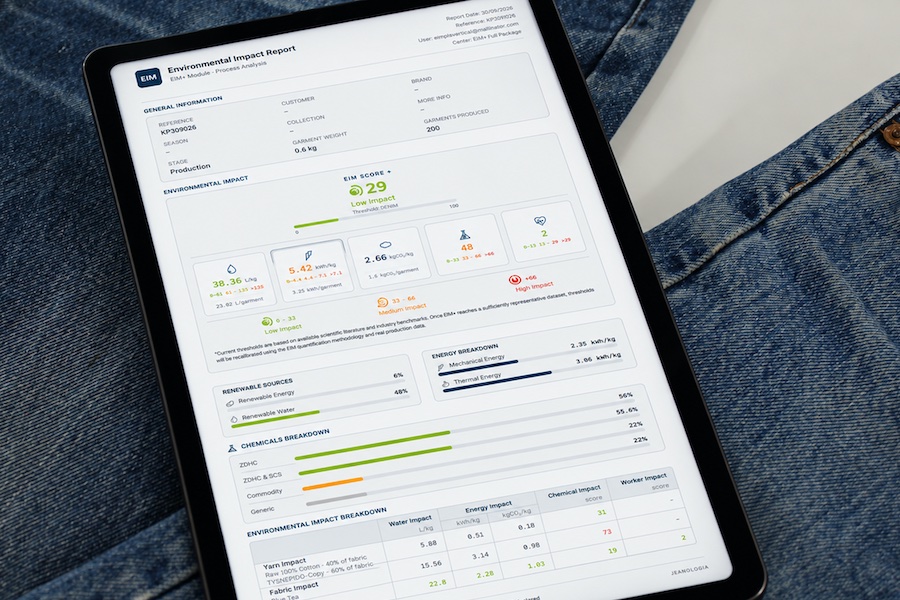
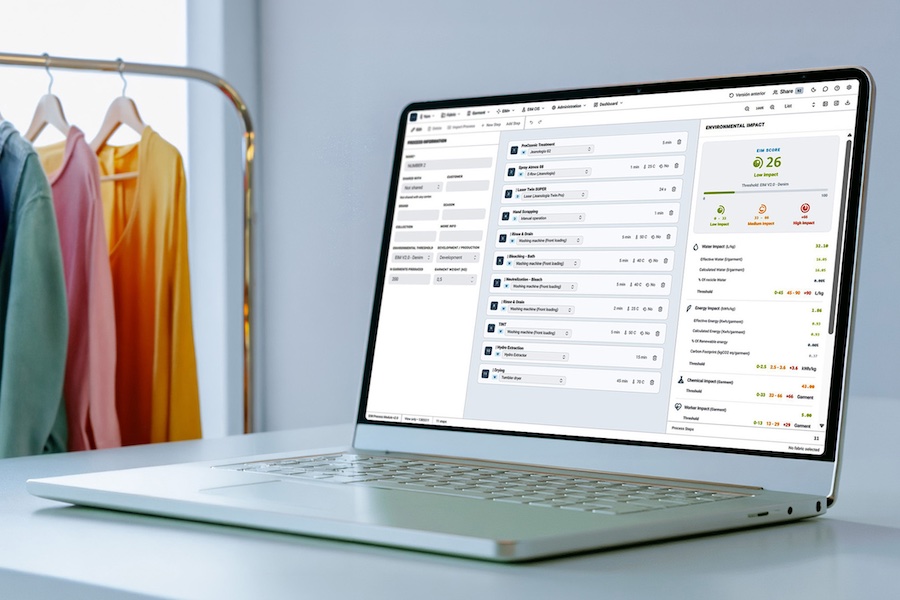
EIM (Environmental Impact Measurement), the global reference platform for measuring the environmental impact of garment finishing, presents the second edition of its annual report Denim Industry Progress & Insights 2025. The study analyses over 100,000 real denim finishing processes, providing an accurate and up-to-date view of the industry’s evolution towards more sustainable models.

#Recycling / Circular Economy

Europe’s textile future at a turning point: New 2030 Circularity Blueprint aims to scale recycling and unlock investment opportunities

The EU textile system is at a critical crossroads. Today, less than 1% of discarded garments are recycled into new garments, despite EU-wide obligations for separate collection. In response, Global Fashion Agenda (GFA) is launching the 2030 Circularity Blueprint, in partnership with ReHubs. This ambitious initiative is designed to support the transformation of the EU textile ecosystem to advance textile-to-textile recycling and drive the transition to a circular economy.

#Sustainability

Number of GOTS-certified facilities grow 15% globally as demand for credible sustainability standards continues to strengthen

Global Organic Textile Standard (GOTS) certification continued to grow in 2025, with nearly 18,000 certified facilities worldwide, despite ongoing geopolitical uncertainty and rapidly evolving regulatory requirements across global textile supply chains.

Latest News

#INDEX 2026

STFI highlights textile circular economy and alternative fibres at INDEX™ 2026

From 19 to 22 May 2026, INDEX will invite visitors to Lake Geneva for the world's leading nonwovens trade fair. The Centre of Excellence in Nonwovens at the Sächsisches Textilforschung- sinstitut e.V. (STFI) will be in attendance to present the latest developments in nonwovens research. In the field of the textile circular economy, the STFI will present acoustically effective nonwovens made from chemical recycling residues. The range also includes innovations aimed at replacing conventional raw materials, such as the biobased and biodegradable polymer polybutylene succinate (PBS) and Kendyr as an alternative to cotton.

#Associations

Italian textile machinery sector faces weak start to 2026 despite domestic growth

In the first quarter of 2026, order intake for Italian textile machinery manufacturers recorded a decrease of 5% compared to the same period in 2025, reflecting a still challenging start to the year. The decline affected foreign markets (-7%), while the domestic market showed growth (+21%).

#Nonwovens

Temafa Maschinenfabrik GmbH supplies a complete decortication plant for processing hemp straw to Hanffaser Geiseltal eG

Temafa Maschinenfabrik GmbH, a leading supplier of machinery and plants for fibre processing, has successfully secured an order to supply a complete plant for processing hemp straw to Hanffaser Geiseltal eG, based in Mücheln.

#Techtextil 2026

FET’s revolutionary gel spinning system wins Techtextil Innovation Award

FET has received the prestigious Techtextil Innovation Award 2026 in the New Production Technology category. The Techtextil Innovation Award honours outstanding ideas in textile technology, sustainability, AI and the creation of technical textiles, selected by an international jury of experts. Ranging from new materials to new production technologies, this award recognises progressive ideas that are driving forces for numerous industries, such as automotive, medical and construction.

TOP