[pageLogInLogOut]

#Sustainability

Fashion for Good celebrates success of first year in South Asia
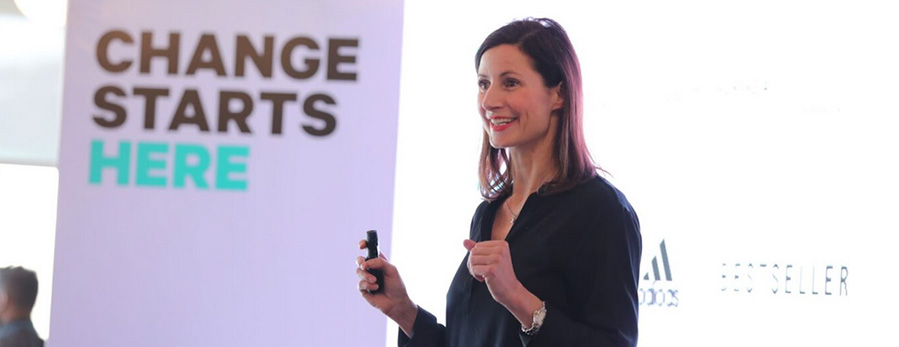
Katrin Ley –  Managing Director, Fashion for Good officially opening the Fashion for Good South Asia Innovation Programme in Mumbai  on January 28th 2020. Credit: Umed Jadeja
Today, Fashion for Good celebrates the progress achieved over the past year since launching their South Asia Innovation Programme during their annual end of year event. To round off an eventful year, Fashion for Good announces their newest regional partner, Birla Cellulose – part of the Aditya Birla Group, as well as the graduation of 9, first batch start-ups, many of whom have successfully engaged with leading manufactures to bring their solutions to market in a year filled with unprecedented challenges.

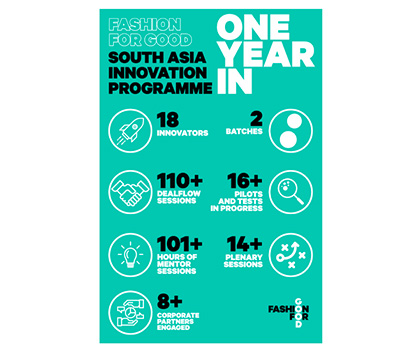
With more than 100 deal flows and 83% engagement in pilot projects, it’s encouraging to see the pace and momentum of transformation in the region, driven by the Fashion for Good South Asia Innovation Programme. We’re extremely proud to have brought together our partners, manufacturers, Arvind Limited, the Welspun Group and Birla Cellulose, and innovators to achieve so much, in such a short period, and under such adverse circumstances; we’re excited to be leading the change.” – Katrin Ley, Managing Director – Fashion for Good

SCALING ALONG THE GROWTH CURVE

Throughout the year, Fashion for Good, working closely with key supply chain players, has identified the critical challenges posed to the circular transformation in the region; the lack of knowledge around circular solutions, the lack of capacity to work with innovations, the lack of funds to invest in new technologies, and lastly, the limited engagement from major fashion brands. In a newly released report “The State of Circular Innovation in the Indian Fashion and Textile Industries”, Fashion for Good highlights these challenges as well as the opportunities for innovation and investment. Fashion for Good addresses these challenges through their programmes to accelerate and scale these technologies as well as through collaborative initiatives with key players in the industry.  

DRIVING INNOVATION AND COLLABORATION

Scouting over 300 innovators from the region, the programme launched early this year with its first selection of 9 innovators, graduating today, and welcoming an additional 9 into their second batch in July. Aiming to scale these technologies through initiating opportunities with industry players, the programme orchestrated over 16 pilots and tests over the past 12 months.

Projects of note include; a collaboration between plastic recycling innovator Lucro and Welspun Limited to close the loop on their packaging waste stream; KB cols, a technology that extracts natural colours from waste that can be applied to textiles, is testing their solution with three partners; Descatuk and Birla Cellulose co-developed eco yarns that incorporate Descatuk’s unique New Natural Fibres (NNF); and most recently, Textile Genesis, a traceability platform using blockchain, together with leading brands BESTSELLER and Kering, join a Fashion for Good led consortium project, the Viscose Traceability Project, to trace the viscose fibres used in 8 garment styles across their supply chains.

Find out more about what the Fashion for Good South Asia Innovation Programme has achieved here: https://fashionforgood.com/south-asia-programme/ 


REGIONAL PRESENCE AND NEW PARTNERSHIPS 

Concluding a successful year of establishing a footprint and successful partnerships in the region, the South Asia Innovation Programme welcomes Birla Cellulose (who earlier this year joined Fashion for Good’s consortium project, Full Circle Textiles Project) as a regional innovation partner alongside launch partners Welspun and Arvind Limited. Birla Cellulose is a global leader in the man made cellulosic fibre industry, pioneering sustainable practices such as sustainable forestry, climate change initiatives, water conservation, innovations in alternative raw materials, Higg FEM, traceability and several other areas. The addition of Birla Cellulose to Fashion for Good’s existing network of global brands and manufacturers further engages pivotal supply chain actors to accelerate industry transformation.
© 2020 Fashion for good


In addition, Fashion for Good is engaged with a number of small scale, regional manufacturers in order to test and implement innovations, and is working closely with investor and expert communities, as well as universities to generate deeper impact within the regional fashion and textile industry.

“Our partnership with Fashion for Good is aligned to our strategy of partnering for creating bigger and broader positive sustainability impacts. We believe that the transformational changes can not be achieved without ground breaking innovations. The future belongs to companies which can learn to collaborate and drive innovation for the benefit of people, planet and profit.” – Mr Dilip Gaur, Business Director, Birla Cellulose, Aditya Birla Group & Managing Director, Grasim Industries Limited

More News from Fashion for Good

#Recycled_Fibers

Advancing the future of stretch: Fashion for Good launches new project to validate bio-based and recycled elastane

Launched today, Stretching Circularity is a collaborative project initiated by Fashion for Good dedicated to accelerating the adoption of lower-impact elastane alternatives that are compatible with circular textile systems. By validating bio-based and recycled elastane solutions through pilot-scale testing and demonstrator garments, the initiative aims to remove one of the most significant technical barriers to a circular textile economy.

#Recycling / Circular Economy

Fashion for Good releases open-source blueprint for near-net-zero textile manufacturing

Fashion for Good launches the first open-source blueprint for near-net-zero textile manufacturing, tackling one of fashion’s biggest emissions hotspots. Developed under the Future Forward Factory project, the blueprint offers Tier 2 manufacturers in India five practical, financially viable pathways to reduce carbon emissions by up to 93%.

#New Materials

From premiums to parity: How Fashion for Good is rewriting the economics of new materials

Fashion for Good launches Price Parity Toolkit: developed with support from Laudes Foundation, Canopy and Finance Earth, the framework introduces an innovative financing approach (premium decoupling) to remove price premiums from the supply chain and unlock faster adoption of lower-impact materials across the industry.

#Natural Fibers

Fashion For Good launches “Beyond50 Denim” to address hemp integration barriers in global denim production

Fashion for Good, together with leading global brands BESTSELLER, C&A, PDS Limited, Reformation, and Target, launched Beyond50 Denim: Combining Cottonised Hemp and Green Chemistry, a project accelerating the use of hemp as an alternative to conventional cotton in denim. By combining two pioneering innovations (SEFF’s Nano-Pulse™ cottonised hemp fibres and FIBRE52™’s proprietary chemistry formulations with soft handfeel), the project seeks to demonstrate that hemp-based denim can match or even surpass cotton in both performance and appeal.

More News on Sustainability

#Sustainability

GOTS version 8.0 released: advanced supply chain accountability, from fibre to finished product

Global Standard is pleased to announce the release of GOTS Version 8.0, the latest update to the world's leading processing standard for organic textiles. The updated Standard strengthens requirements for air emissions and waste management, as well as criteria for product safety. It introduces new provisions on circularity, microfibre management and updates in residue testing. Version 8.0 also elevates due diligence obligations and formalises governance requirements, including ESG disclosure, anti-corruption policies and conflict-of-interest safeguards, to support credible, responsible business conduct.

#Sustainability

The nova-Institute establishes new Renewable Feedstock Department to lay the groundwork for industrial defossilisation

The transition from fossil-based to renewable carbon – sourced from biomass, CO₂ utilisation and recycling – is the cornerstone of a climate-neutral chemical industry. The nova-Institute’s new department is dedicated to providing the essential data, analyses and strategic roadmaps required to secure a reliable future feedstock supply and make this transition a commercial and ecological reality.

#Sustainability

Textile Exchange unveils commitment-based pathway for members to accelerate responsible raw material production

Textile Exchange has unveiled further details about its new membership structure, designed to guide the fashion, textile, and apparel industry in a collective course of action toward preferred production systems for raw materials and fibers.

#Textile chemistry

Jeanologia urges industry to accelerate PP Spray phase-out following ZDHC Watchlist update

Potassium permanganate has officially entered the Chemical Watchlist of the ZDHC Foundation, signaling increased scrutiny and potential phase-out of one of the most hazardous chemicals still used in denim finishing. The inclusion confirms an industry shift that Jeanologia anticipated more than a decade ago.

Latest News

#Techtextil 2026

DIENES at Techtextil 2026: Flexible pilot lines for bio-based fiber development

The growing relevance of bio-based materials in technical textiles is accompanied by increasing demands for reproducibility, high-quality data, and scalable process routes. Especially when working with cellulose and its derivatives, chitosan, lignin-based approaches, or bio-based PAN as a carbon-fiber precursor, R&D teams face variable feedstock quality, tighter process windows, and the need for reliable comparability across trials. This calls for flexible, data-driven experimental setups that can be reconfigured efficiently when recipes, solvents, and raw-material batches change.

#Texprocess 2026

Gunold showcases embroidery product range and services at Texprocess

At Texprocess 2026, GUNOLD will present numerous hands-on examples related to embroidery in Hall 8, Booth E20. The focus is on creative embroidery designs as well as the extensive product range of threads, nonwovens, and accessories for embroidery and embellishment. “Trade visitors can once again look forward to many new and creative embroidery designs. Of course, we will also showcase the matching products required to bring these ideas to life,” announces Marketing Manager Stephan Gunold.

#Nonwovens

EDANA and more than 70 industry organisations call for consistent exemptions in EU packaging regulation

EDANA, together with more than 70 industry associations and organisations, has issued a joint statement commenting on the European Commission’s Delegated Act under Article 29 of the Packaging and Packaging Waste Regulation (PPWR).

#Raw Materials

A Powerful Opening: Global thought leaders launch the International Cotton Conference Bremen

The International Cotton Conference Bremen will open on 25 March 2026 in the Parliament building of the Free Hanseatic City of Bremen with a keynote session of exceptional calibre. Distinguished international experts will set the stage for the conference by offering incisive perspectives on the most pressing challenges and the defining trends shaping the future of the global cotton trade. Their insights will span a broad spectrum — from geopolitically driven disruptions affecting global supply chains to the opportunities emerging from innovation-led agriculture capable of supporting a growing world population. Together, these opening keynotes will frame the dialogue of the conference, highlighting both the complexity of today’s market environment and the pathways toward a resilient and forward-looking cotton sector.

TOP