[pageLogInLogOut]

#Recycling / Circular Economy

Waste, plants, CO2 – the resources of the future
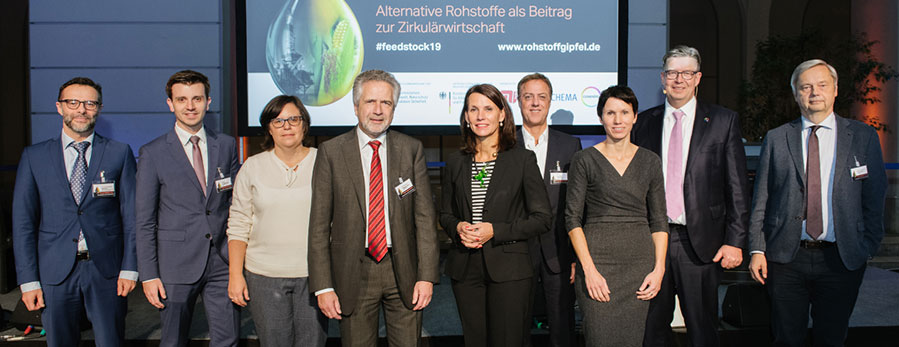
How to get to a Circular Economy was the subject at Raw Materials Summit 2019 in Berlin with representatives from business, politics, media and science. From left: Dr. Frank-Andreas Hatzack, Copenhague Institute for Futures Studies; Philipp Engelkamp, Managing Director Ineratec GmbH; Dr. Adriana Neligan, Senior Economist, German Economic Institute; Professor Kurt Wagemann, Managing Director Dechema; Rita Schwarzelühr-Sutter, State Secretary at the German Federal Ministry for the Environment; Dr. Jürgen Stebani, CEO Polymaterials AG; Judith Skudelny, National parliamentary group FDP; Dr. Klaus Schäfer, Member of the Board of Management Covestro AG; Professor Christian Thomsen, President Technical University of Berlin (c) 2019 Covestro
With sustainable raw materials from waste, plants and CO2, the chemical industry can support the transition to a circular economy. At the Raw Materials Summit 2019, which took place on Monday at the Technical University of Berlin, Germany representatives from business, politics and science called for the increased use of such sources instead of crude oil. Accordingly, non-fossil resources help to close the carbon loop and can contribute to climate protection. At the summit the “Resource Innovator” start-up prize was awarded to the young company Ineratec from Southern Germany.
  • Raw Materials Summit 2019 points way out of the throwaway society  
  • Start-up company wins “Resource Innovator” prize

“The chemical industry is actively pushing ahead with the transformation to a circular economy,” said Dr. Klaus Schäfer, Member of the Board of Management for Production and Technology at Covestro. The materials manufacturer organized the summit again joinly with the Technical University of Berlin and the Dechema Society for Chemical Engineering and Biotechnology.

Waste as a valuable resource

According to Schäfer, it is particularly important to see plastic waste as a resource: “After their use, products must no longer end up uncontrolled in the environment, but must be recycled in an ecologically efficient manner, for example through chemical recycling”, stated Schäfer with a view to politics.

The German government was represented by Rita Schwarzelühr-Sutter, State Secretary at the Federal Ministry for the Environment, Nature Conservation and Nuclear Safety (BMU), who delivered the opening speach. The BMU as well as the Federal Ministry of Education and Research acted as patrons of the event.


Professor Christian Thomsen, President of the Technical University of Berlin, stressed that the academic sector could provide important impetus for research and development into new recycling processes and alternative raw materials. Thomsen: “The interaction of application-oriented basic research and science-based industry is the key to success”.

Promoting a start-up culture

Professor Kurt Wagemann, Managing Director of Dechema, emphasized the importance of a vibrant start-up scene for the realization of new ideas for sustainable production processes and products: “The start-up culture in Germany needs to be more pronounced so that Germany can keep up with international competition”.

Wagemann also selected the “Resource Innovator 2919”. This year's prize at the Raw Materials Summit went to Karlsruhe-based Ineratec GmbH, which was founded in 2016. The company has succeeded in downsizing large chemical plants to miniature size. With these decentralized reactors, high-quality raw materials for the chemical industry can be produced from exhaust gases such as CO2.


More News from Covestro AG

#Technical Textiles

Covestro showcases monomaterial concept in autonomous SUE People Mover

UE | STUDIOS has unveiled the fully autonomous electric minibus “Self-driving Urban E-Shuttle” (SUE), placing strong emphasis on sustainable material design. Developed within a project funded by the Federal Ministry for Economic Affairs and Energy (BMWE) and the European Union, the vehicle will begin public road testing this year. At the core of the concept is the consistent use of recyclable monomaterials to improve circularity at end of life.

#Textile chemistry

Covestro and Heraeus Precious Metals collaborate to enable safer, more sustainable antimicrobial textile coatings

Laboratory tests reveal that AGXX antimicrobial surface technology from Heraeus Precious Metals is fully compatible with Impranil® PU dispersions which are part of the waterborne INSQIN® textile coating technology from Covestro, paving the way for more sustainable antimicrobial textile coatings. This discovery comes at a key moment for the textile coatings industry. As the sharing economy continues to grow, more people are coming into regular contact with high-use surfaces, creating ideal conditions for bacteria, viruses, and other microorganisms to thrive.

#Textile chemistry

Covestro celebrates decade of innovation and sustainable growth

Covestro celebrates its 10-year anniversary today. Since its carve-out from Bayer in 2015, the company has developed into a global leader in high-performance polymer materials and a pioneer in circular economy solutions. With a strong focus on innovation and sustainability, Covestro’s materials are now embedded in countless applications worldwide – from mobility and construction to electronics, healthcare, and consumer goods.

#Textile chemistry

Covestro extends contract with CTO Dr. Thorsten Dreier ahead of schedule until 2031

Dr. Thorsten Dreier will remain Chief Technology Officer of Covestro for a further five years. The Supervisory Board has extended his contract, which runs until June 2026, ahead of schedule from July 1, 2026 to June 30, 2031.

More News on Recycling / Circular Economy

#Recycling / Circular Economy

AI Circular Economy Conference 2026 fuels innovation at the intersection of AI and Circular Economy

The AI Circular Economy Conference 2026, organised by nova-Institute, brought together 116 participants from 15 countries in Cologne and online to explore the transformation of the chemical and materials industry supported and accelerated by artificial intelligence. During the two-day event, leading experts from industry, research, start-ups and the investment community discussed how AI can maximise the potential of renewable carbon creating efficient circular value chains. The conference featured 24 presentations and multiple panel discussions, highlighting the growing convergence of digital technologies and circular material systems. It demonstrated how artificial intelligence is progressing from the experimental stage to real industrial implementation within the circular economy.

#Recycled_Fibers

Circ deepens access to recycled fibers with Xinxiang Bailu Chemical Fiber Co., Ltd. partnership agreement

Circ®, a global leader in textile‑to‑textile recycling, today announced a new partnership agreement with Xinxiang Bailu Chemical Fiber Co., a Canopy Dark Green Shirt producer and one of the world’s leading producers of viscose filament. The agreement marks a significant step in Circ’s continued expansion in China and strengthens its position within the country’s rapidly evolving circular textile ecosystem; further supporting Circ’s ability to supply recycled fibers near existing fashion supply chains.

#Recycled_Fibers

Worn Again Technologies unveils the Accelerator

Worn Again Technologies unveils the Accelerator, the next major step towards commercialising its pioneering Textile-to-Fibre recycling process and proving the technical and economic feasibility of polycotton recycling.

#Recycling / Circular Economy

Textile‑to‑textile recycling leader Circulose joins Spinnova’s ecosystem to accelerate technology scale‑up

Textile‑to‑textile recycling leader Circulose joins Spinnova’s ecosystem (consortium) to help advance the scale‑up of Spinnova’s technology. Spinnova has actively sought partners to accelerate commercial scale‑up, and Circulose, as a key player in textile recycling, strengthens the ecosystem by providing a raw material that is in high demand across the industry.

Latest News

#Techtextil 2026

Gebr. Otto highlights versatility at Techtextil with regional supply chains, yarn innovations and new hygiene segment

At this year’s Techtextil, Gebr. Otto places its versatility at the center of its presentation. In addition to spinning, twisting and dyeing – traditionally focused on fine cotton – textile processors will also find a competent development partner for technical specialty solutions. The Dietenheim-based spinning mill has now built up a decade of experience in the production of technical yarns, particularly from aramids. A new hygiene segment has also been established, where yarns for medical and hygiene products are currently being produced. In the future, this department could also develop textile products for the food sector. Gebr. Otto will once again be present at the BW-i joint stand, booth D81, hall 12.1. What is wound onto the spool is determined by the customer: Gebr. Otto develops according to specific customer requirements and transforms its own ideas into yarn innovations.

#Europe

Commission presents proposal for EU Inc. - unlocking the full potential of the Single Market for Europe's entrepreneurs

Today, the European Commission presented its proposal for EU Inc., a new single set of corporate rules, building the cornerstone and starting point for the EU's 28th regime. EU Inc. is an optional, digital-by-default European corporate framework. It will make it easier for businesses to start, operate and grow across the EU – incentivising them to stay in Europe, and encourage those who once looked elsewhere to return.

#Man-Made Fibers

OnceMore® from Södra brings end-to-end traceability for circular Man-made Cellulosic Fibers (MMCF) using TextileGenesis

OnceMore® from Södra, the world’s first large-scale process for recycling blended fabrics into high‐quality dissolving pulp, will begin using TextileGenesis, a Lectra company, to strengthen traceability from raw material to retail across the value chain. OnceMore® produces dissolving pulp made from blended textile waste and wood sourced from responsibly managed Swedish forests. By integrating TextileGenesis, OnceMore® supports the growing need for verified data and secure, transparent tracking throughout increasingly complex supply chain.

#Sustainability

Experts publish APAC policy priorities

Cascale today announced the publication of its APAC Policy Priorities Paper, developed by the Asia-Pacific (APAC) Policy Member Expert Team (MET) to identify key regional sustainability challenges and provide practical, aligned recommendations for policymakers and industry stakeholders across Asia-Pacific.

TOP