[pageLogInLogOut]

#Sustainability

Spinnova’s technology for sustainable textile fibres gets 11 MEUR investment for commercial scaling

With new growth capital of 11 million euros, the sustainable fibre technology company Spinnova is now starting the commercialization phase of the world’s most sustainable textile fibre. The company aims to revolutionize the raw material base of the textile industry with its cellulose-based fibre products in collaboration with major textile brands.

Spinnova is a Finnish, sustainable deeptech company that has developed a disruptive technology for manufacturing cellulose-based textile fibres. Spinnova’s patented method includes 0% harmful chemicals and 0% waste or side streams, making the fibre and the production the most sustainable in the world.

Spinnova is beginning to plan for its commercial phase after passing its most important milestone so far; getting proof of concept from its pilot factory. The pilot line was completed in Finland last December and ramped up over early 2019. Now fully operational, the pilot is producing fibre for Spinnova’s brand partners, while Spinnova scales towards a commercial facility.

Spinnova recently completed a financing round that ensures getting to the commercial phase without further financing needs. The 11 million euro total investment came entirely from Spinnova’s existing investors; family investment offices, private investors, a venture capital investment fund and industrial partners.


There has been a significant amount of brand interest towards Spinnova’s innovation. As Spinnova and its industrial partners begin to plan for the first commercial facilities, uptake agreements will be available to brands who want to make sure they are early adopters of the world’s most sustainable fibre. The fibre recently passed industrial spinning tests, which was an important step of the fibre’s journey towards a commercially viable drop-in material.

Following close collaboration with piloting brands, several demo products will be introduced to consumers in the near future. Spinnova’s vision is that its sustainable fibres become an attractive option to brands and this way available to all consumers.

– We have proven success in both strategic focus areas related to our vision: We work closely with brands in developing our fibre products and will scale the sustainable technology to big volumes with industrial partners, comments Spinnova’s CEO and co-founder Janne Poranen.
More News from TEXDATA International

#ITM 2026

ITM 2026: The new geography of textile production

New production hubs are emerging across North Africa and Central Asia, while Türkiye is accelerating its transformation toward higher-value, technology-driven and more sustainable textile manufacturing.

#Research & Development

“Production is a product”

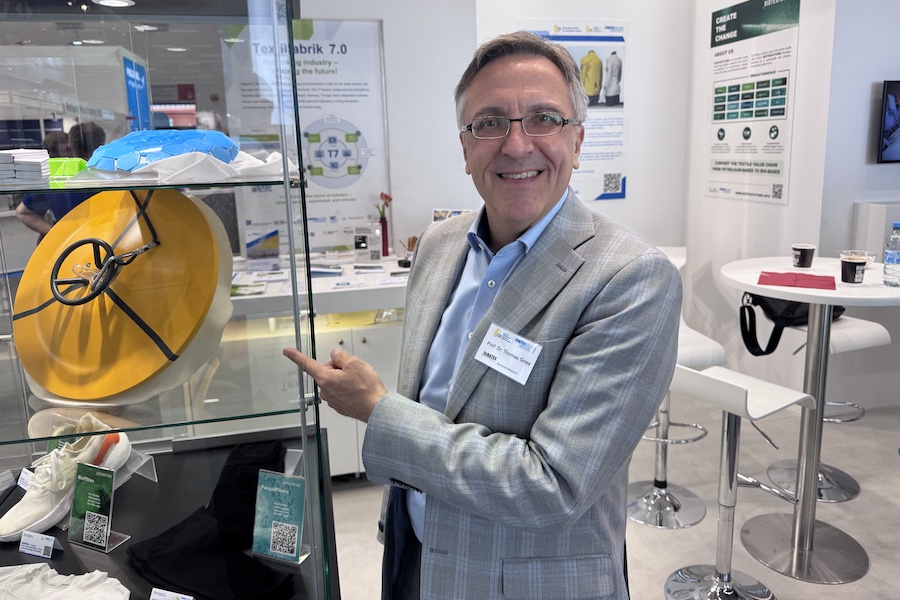
From technical textiles and AI-driven robotics to the limitations of textile circularity: Professor Dr Thomas Gries looks back on more than two decades of development at ITA Aachen. In the interview, he explains why production technology remains a decisive success factor, discusses international collaborations and innovation ecosystems, and shares his views on the transformation of production landscapes and the challenges facing an increasingly regulated industry.

#Knitting & Hosiery

“We need to move away from the price trap and return to a value-driven mindset.”

With its new Textile Innovation Center, KARL MAYER is sending a strong signal for innovation, collaboration, and the future of textile applications. In this interview, Karl Josef Mayer discusses new opportunities in warp knitting, the processing of staple fibres, recycling, the changing role of machinery manufacturers, and why the textile industry must once again focus more strongly on the value of textiles. by Oliver Schmidt

#Associations

“Innovation, resilience and international experience remain the great strengths of the Swiss textile machinery industry”

Geopolitical uncertainty, growing competitive pressure from China, new free trade agreements and the shift towards a circular economy are currently reshaping the global textile industry. In this interview, Cornelia Buchwalder discusses the current mood within the Swiss textile machinery sector, the industry’s distinctive innovative strength, new market opportunities in India and Asia, and the technological trends that could shape the upcoming trade fair cycle leading up to ITMA 2027.

More News on Sustainability

#Sustainability

bluesign appoints Hanane Taidi as CEO to lead next phase of global impact

bluesign, which partners with the textile industry to reduce adverse impact across the value chain, appoints Hanane Taidi as Chief Executive Officer, marking a pivotal moment as the company builds on its leadership amid rapid industry change.

#Sustainability

Updated supply chain taxonomy advances apparel alignment

The apparel alliance (Apparel Impact Institute, Cascale, Textile Exchange, and ZDHC Foundation) today announced the launch of Version 2 of the Supply Chain Taxonomy, an updated harmonized framework designed to improve consistency, transparency, and collaboration across the textile, clothing, leather, and footwear (TCLF) sectors of the broader apparel industry.

#Sustainability

The first widely accessible Life Cycle Assessment study for cashmere production published by Textile Exchange.

Crucial new data to better understand, measure, and address the impacts of cashmere production has been made available to the fashion, textile, and apparel industry through a new Life Cycle Assessment (LCA) published by Textile Exchange.

#Sustainability

Indovinya advances sustainable solutions with agreement for the supply of renewable Oxygen from Air Liquide

Indovinya, the specialty chemicals and surfactants division of Indorama Ventures, has entered into an agreement with Air Liquide — a world leader in gases, technologies, and services for industry and healthcare — for the supply of renewable oxygen. The agreement represents a strategic advancement in Indovinya’s commitment to sustainability, as it increases the share of renewable raw materials in the production of ethylene oxide, one of its key products.

Latest News

#Europe

The Digital Product Passport registry is now live

On 20 July, the European Commission launched the Digital Product Passport Registry together with a testing environment, marking an important milestone in making the Digital Product Passport (DPP) a practical reality for businesses placing products on the EU market.

#Europe

EU ban on destroying unsold clothing and footwear now in force

The European Union's ban on the destruction of unsold clothing, clothing accessories and footwear has entered into force. Since July 19, 2026, large companies across the EU have been prohibited from destroying unsold textile products, while medium-sized companies will be required to comply with the same rules from 2030.

#Recycled Fibers

Eastman Naia™ brings its inside-out denim vision to Kingpins New York

Following its debut at Kingpins Amsterdam, Eastman Naia™ brings the next chapter of its denim story to Kingpins New York, taking place July 22–23. At Booth Green 7, Naia™ presents its denim proposition built around three complementary design directions: Performance Denim, Fashion Denim and Authentic Denim.

#Recycling / Circular Economy

Pirelli, Pyrum, Synthos and BASF partner to transform end‑of‑life and scrap tyres into recycled materials for new products

Pirelli, Pyrum, Synthos and BASF are jointly advancing a tyre-to-tyre circular economy initiative in Europe, driving the development of an industrial ecosystem designed to increase the use of recycled materials derived from end-of-life and scrap tyres.

TOP