[pageLogInLogOut]

#Spinning

Rieter ROBOdoff: Automation reduces labor costs in rotor spinning

Gaoyi Delida Textile Co., Ltd., China, has upgraded their 30 semi-automated rotor spinning machines R 35, R 36 and R 37 with ROBOdoff, Rieter’s automatic doffing solution. ROBOdoff reduces the operator’s workload and labor costs thanks to a doffing success rate of up to 98%. The yarn package length and weight are consistently maintained, resulting in a lower conversion cost.

Delida faced difficulties in recruiting skilled operators for its rotor spinning mill. The noisy and dusty mill environment paired with the heavy workload involved in manual doffing don’t provide an attractive work environment. Finding qualified operators therefore became critical, resulting in increased labor costs.

Based on market requirements, Delida produces a wide range of yarn counts with the rotor spinning machines, which require frequent batch changes, adding additional workload to the operators.

The weaving and knitting markets demand for consistent yarn package length and weight to minimize downstream yarn waste. In addition, the yarn package with the target length and weight is also a very popular requirement in the market. For Delida, this was a constant challenge with the traditional manual doffing, as the weight deviation between the yarn packages is greater, leading to increased conversion costs.
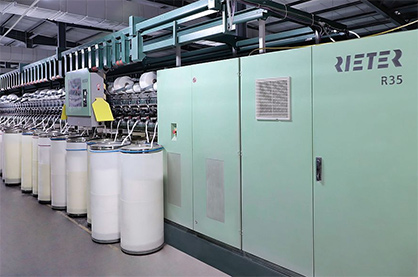
ROBOdoff installed on an existing rotor spinning machine R 35. © 2023 Rieter


Delida aims to increase the level of automation to overcome the problems of growing labor costs, improve the flexibility of the batch process and meet the market requirements of delivering consistent yarn package weight. Managing these challenges will help to further strengthen its competitive advantage and consolidate its market leadership position. Delida turned to Rieter to learn about automation solutions.

Automated Doffing with ROBOdoff as an Upgrade

Rieter’s after sales team recommended the ROBOdoff upgrade for Delida’s rotor spinning machines R 35, R 36 and R 37. ROBOdoff is a device for automated package change that runs on each side of the machine. Given the solution's promising potential to mitigate the persistent labor shortages, Delida ordered 30 devices. ROBOdoff has the following three smart setting features that meet multiple customer needs and provide maximum flexibility during operation:

• automated block doffing regardless of the package length,

• doffing in delta length securing that all doffed packages contain the target length, which ensures the weight deviation of the yarn packages is minimal, and

• ROBOdoff works as a traveling cleaner when doffing is not required, which cleans the rail and the machine's spinning positions.

Reliable performance with 24/7 working mode reduces the operator's workload of manual doffing. The customer was so satisfied with the stable performance of ROBOdoff that they will choose ROBOdoff again when investing in new machines.
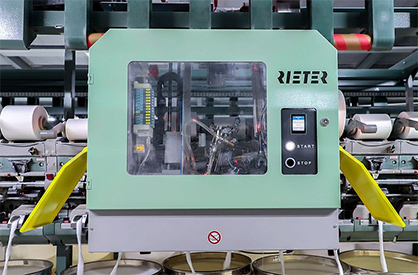
ROBOdoff with smart setting features enables maximum flexibility during operation. © 2023 Rieter


Improved Operational Agility Resulting in Labor Cost Reduction

The automatic doffing system ROBOdoff delivers an impressive doffing success rate of 98%, eliminates the need for manual doffing and reduces the operational workload, resulting in labor cost savings. The enhanced flexibility of the block doffing option allows Delida to manage frequent changes in yarn production batches with ease, improving overall operational agility significantly and ultimately reducing labor costs.
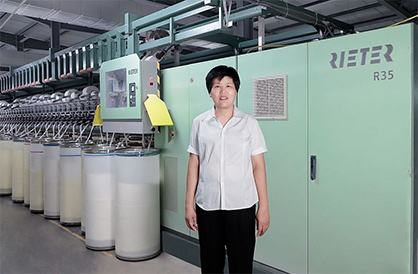
Zhang Xiuzhen, Factory Director of Gaoyi Delida Textile Co., Ltd., China © 2023 Rieter


ROBOdoff does not only automate the unpleasant task of manual doffing. With the option of the delta length securing feature, the doffed packages are maintained with the same package length, resulting in a uniform package weight. The operator can set the package length and ROBOdoff will automatically doff packages whose length lies within the defined tolerance. The yarn waste in subsequent weaving or knitting processes is minimized to a greater extent. Another signature advantage of the ROBOdoff is a consistent and proper formation of the transfer yarn tail.

The uniform doffing process reduces the damage and replacement cost of the doffing arms, which helps extend the lifetime of the rotor machine in general. ROBOdoff also works as a traveling cleaner when doffing is not required, which cleans the rail and the machine's spinning positions from micro dust offering maximum flexibility to customers.

ROBOdoff enables more efficient work organization. The physically exhausting process of manual doffing is now a thing of the past and operators are free to focus on more value-adding tasks. This investment pays off in about two to three years.


"ROBOdoff ensures that all doffed packages contain the consistent target length thanks to the delta length module. This is extremely helpful for our customers in the weaving and knitting segment. At the same time, ROBOdoff has significantly reduced our labor costs, increased yarn profitability and improved the efficiency of our mill operations."

Zhang Xiuzhen, Factory director of Gaoyi Delida Textile Co., Ltd., China



More News from Rieter Textile Systems

#Spinning

Rieter responds to higher raw material prices

Global political and economic developments have been leading to rising raw material and energy costs for some time. The textile machinery industry is also affected by this trend. Rieter machines and components consist to a large extent of steel, copper, aluminum and electronics. These materials in particular have seen higher demand and higher prices in recent months.

#Spinning

Rieter completes acquisition of Barmag

Rieter has successfully completed the acquisition of Barmag as of February 2, 2026. This strategically important acquisition makes Rieter the world’s leading system provider for natural and synthetic fibers.

#Spinning

Rieter adjusts group structure in preparation for Barmag integration

The planned acquisition of the “Barmag” Division of OC Oerlikon will create the leading system provider worldwide for natural and man-made fibers. Rieter is confident it will receive all regulatory approvals to complete the acquisition in the fourth quarter of 2025. The Rieter Group is therefore adjusting its Group structure as of January 1, 2026, to take this acquisition into account and to be able to provide an even more agile response to market challenges.

#Spinning

Rieter reports stable order backlog and strategic progress – outlook for 2025 adjusted

In its Investor Update 2025, Rieter announced an order intake of CHF 203.9 million in the third quarter and CHF 559.3 million after nine months, reflecting a continued cautious investment climate in the textile machinery sector. Sales totaled CHF 121.5 million in the third quarter and CHF 457.7 million for the first nine months of the year, while the order backlog stood at around CHF 590 million as of September 30, 2025.

More News on Spinning

#ITM 2026

The hub of smart and sustainable transformation in yarn technologies: ITM 2026

With global fiber production projected to reach 169 million tons by 2030, yarn manufacturing is becoming one of the most strategic fields within the textile machinery industry. Located in Halls 6, 7, and 10, the Yarn Hall at ITM 2026 is set to bring together industry professionals with innovative solutions developed around automation, energy efficiency, digitalization, and circular production.

#Spinning

Barmag: DTY efficiency for the future of fancy yarns

Fancy yarns continue to gain importance in the textile market: Whether in fashion, home textiles or the automotive industry - the trend towards individuality is fueling the demand for textured, haptically differentiated and at the same time comfortable yarns.”

#Spinning

Perfect quality through collaboration: Machinery from Trützschler, Toyota and Murata at Zirve Tekstil

In today’s textile industry, excellence is not achieved by chance – it’s the result of deliberate decisions, technical expertise, and the courage to go beyond conventional paths. The Turkish company Zirve Tekstil has done just that: by combining the best technologies from Trützschler, Toyota and Murata, they’ve created a production setup that delivers outstanding yarn quality – recognized worldwide.

#Spinning

Monitor, adjust, perfect

FiberGuard BCF is the name of the new system for real-time monitoring of yarn tension in all Neumag BCF production processes. Barmag, the innovation and technology leader for filament spinning systems, presented this innovation of its Neumag product line at ITMA Asia + CITME in Singapore last November. The new BCF yarn tension sensor is compatible with all current Neumag BCF machines and can be easily retrofitted to existing Neumag BCF S8 machines.

Latest News

#Sustainability

Ying McGuire becomes new CEO of Cascale

Cascale today announced the appointment of Ying McGuire as Chief Executive Officer, effective June 1, 2026.

#Technical Textiles

Sustainable, lightweight, and sound absorbing: Polyester-based front trunk solution for BEVs

As car manufacturers look to further reduce their carbon footprint, Autoneum has developed an innovative front trunk solution for battery electric vehicles (BEVs), made entirely from polyester-based textile. The Ultra-Silent Frunk offers significant weight reduction, improved acoustic and thermal insulation, and uses up to 70 percent recycled material, supporting sustainable and efficient vehicle design. Autoneum, global technology leader in acoustic and thermal management for vehicles, has already received orders for the new frunk from three major OEMs in Asia and Europe to be built in three BEV models. Series production for two BEVs has been underway in China and Germany since last year.

#Raw Materials

Modern testing methods for raw cotton

The 38th International Cotton Conference Bremen will take place from 25 to 27 March 2026 at the Bremen Parliament. This conference has traditionally stood for in-depth expertise and international exchange. The program will focus on technical innovations, market trends, and regulatory frameworks across the entire value chain – from agriculture to the circular economy. With high-profile speakers, the conference is regarded as the key meeting point for the global cotton industry. Today’s focus: Cotton quality and testing methods.

#Weaving

Stäubli demonstrates how innovation translates into real benefits for weaving mills at SITEX 2026

One of India’s most prominent textile industry events, SITEX 2026, is held from February 21 to 23 in Surat. Committed to empowering Indian weaving mills with state‑of‑the‑art solutions tailored to regional needs, Stäubli will present a selection of solutions designed for performance, reliability, and power efficiency. Through its weaving preparation, cam and dobby shedding solutions and Jacquard technologies, Stäubli highlights its global expertise tailored to the specific needs of the local market.

TOP