[pageLogInLogOut]

#Spinning

Artificial intelligence supports sustainable yarn production
© 2023 Rieter
Artificial intelligence also contributes to minimizing energy and raw material consumption. ESSENTIAL, Rieter’s digital platform for spinning mill control, for example, enables the detection and elimination of deviations at an early stage in the process.

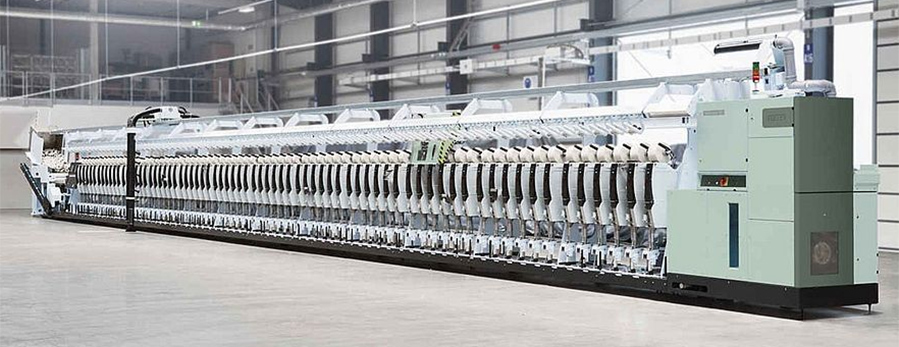
The integration of the Autoconer X6 winding machine in ESSENTIAL opens up the potential for enhanced transparency and optimization across all process steps. The winding machine is the last process step in the production of ring or compact yarn. It reliably detects foreign fibers, impurities, and unevenness in the yarn and removes these faults. Connection of the winding machine to ESSENTIAL helps make detection of quality deviations during production even more effective. On top of this, it also makes it possible to trace the causes back to upstream process steps and to rectify them.

For example: A combed cotton yarn of yarn count Ne 40 deviates from the quality standard. For a yarn with these criteria, the winding machine normally makes 75 quality cuts per 100 km of yarn. The number of cuts increases with unsatisfactory yarn quality, with an increase in this example to 90 per 100 km of yarn. More cuts translates to more waste, corresponding to an increase from 0.4% to 0.5%. This seemingly small difference correlates to a considerable amount of yarn over the course of a year. For a spinning mill that produces 5 000 tons of yarn per year, this totals five tons of additional waste.


ESSENTIAL makes expertise accessible

If the number of cuts on the winding machine exceeds a preset value, ESSENTIAL analyzes the entire process from fiber to yarn. Deviations are detected and corrective measures initiated based on rules, threshold values, and evaluation of machine events throughout the process. This is how ESSENTIAL uses the potential of artificial intelligence to reflect the expertise of the spinning mill. Evaluation of specific cases will enable the system to learn for the future, thereby allowing further development of the expertise related to optimization of the spinning process.

The use of artificial intelligence is a significant contribution to automation and process optimization and thus to improving sustainability in the textile industry. To expand this capacity in the field of industrial artificial intelligence, Rieter and the Johann Jacob Rieter Foundation are funding a professorship at ZHAW School of Engineering in Winterthur, Switzerland.


More News from Rieter Textile Systems

#Spinning

Rieter responds to higher raw material prices

Global political and economic developments have been leading to rising raw material and energy costs for some time. The textile machinery industry is also affected by this trend. Rieter machines and components consist to a large extent of steel, copper, aluminum and electronics. These materials in particular have seen higher demand and higher prices in recent months.

#Spinning

Rieter completes acquisition of Barmag

Rieter has successfully completed the acquisition of Barmag as of February 2, 2026. This strategically important acquisition makes Rieter the world’s leading system provider for natural and synthetic fibers.

#Spinning

Rieter adjusts group structure in preparation for Barmag integration

The planned acquisition of the “Barmag” Division of OC Oerlikon will create the leading system provider worldwide for natural and man-made fibers. Rieter is confident it will receive all regulatory approvals to complete the acquisition in the fourth quarter of 2025. The Rieter Group is therefore adjusting its Group structure as of January 1, 2026, to take this acquisition into account and to be able to provide an even more agile response to market challenges.

#Spinning

Rieter reports stable order backlog and strategic progress – outlook for 2025 adjusted

In its Investor Update 2025, Rieter announced an order intake of CHF 203.9 million in the third quarter and CHF 559.3 million after nine months, reflecting a continued cautious investment climate in the textile machinery sector. Sales totaled CHF 121.5 million in the third quarter and CHF 457.7 million for the first nine months of the year, while the order backlog stood at around CHF 590 million as of September 30, 2025.

More News on Spinning

#Spinning

A breakthrough innovation for diaper manufacturers

Developed and manufactured by Mesdan, Italy, the Loop knotter type 093E is a special version of the well-known Loop knotter, specifically designed to join hygiene-grade spandex yarns used in the personal care industry.

#ITM 2026

The hub of smart and sustainable transformation in yarn technologies: ITM 2026

With global fiber production projected to reach 169 million tons by 2030, yarn manufacturing is becoming one of the most strategic fields within the textile machinery industry. Located in Halls 6, 7, and 10, the Yarn Hall at ITM 2026 is set to bring together industry professionals with innovative solutions developed around automation, energy efficiency, digitalization, and circular production.

#Spinning

Barmag: DTY efficiency for the future of fancy yarns

Fancy yarns continue to gain importance in the textile market: Whether in fashion, home textiles or the automotive industry - the trend towards individuality is fueling the demand for textured, haptically differentiated and at the same time comfortable yarns.”

#Spinning

Perfect quality through collaboration: Machinery from Trützschler, Toyota and Murata at Zirve Tekstil

In today’s textile industry, excellence is not achieved by chance – it’s the result of deliberate decisions, technical expertise, and the courage to go beyond conventional paths. The Turkish company Zirve Tekstil has done just that: by combining the best technologies from Trützschler, Toyota and Murata, they’ve created a production setup that delivers outstanding yarn quality – recognized worldwide.

Latest News

#Raw Materials

Esquel Group adds two new extra-long staple cotton varieties approved

Esquel Group’s Xinjiang Research & Development Center has successfully developed two new Sea Island cotton (Extra-Long-Staple cotton, ELS cotton) varieties named “Yuan Loong 37” and “Yuan Loong 42,” which have been officially approved and granted registration numbers. Both varieties have also obtained Plant Variety Rights certificates, marking another significant breakthrough for the Group in cotton breeding and commercial application.

#Weaving

Itema America acquires Palmetto Loom Reed, strengthening local manufacturing and service in the U.S.

Itema America, the U.S. subsidiary of Italy-based Itema Group, has acquired – through an Assets Purchase Agreement – Palmetto Loom Reed, a Greenville, South Carolina-based manufacturer of weaving reeds and one of the last remaining domestic producers of these precision components in the United States.

#Recycled_Fibers

Reju announces site selection for French Regeneration Hub in Lacq advancing Europe’s circular textile infrastructure

Reju, the textile-to-textile regeneration company based in France, announces the site selection for an industrial sized Regeneration Hub, in Lacq, in the Pyrénées-Atlantiques, on the Induslacq platform. Reju, a Technip Energies owned company, is deepening its roots in France through the development of this new Regeneration Hub.

#Functional Fabrics

lululemon introduces Unrestricted Power™ — A new sensation for strength training

lululemon (NASDAQ: LULU) has unveiled Unrestricted Power™, a new innovation platform engineered for heavy lifts and demanding gym sessions. The assortment, which launches in North America, is backed by thousands of hours of research and development, providing secure support without compromising comfort and mobility, enabling a distraction-free fit built to match every move.

TOP