[pageLogInLogOut]

#Spinning

Rieter reports good figures for the third quarter

Rieter recorded a significant increase in sales in the third quarter of 2022, reaching a level of CHF 366.8 million (2021: CHF 257.3 million). The measures introduced to increase sales and profitability in the second half of 2022 are taking effect and will continue to be implemented in a systematic manner. These include a close cooperation with key suppliers, the development of alternative solutions to eliminate material shortages, the enforcement of price increases, and the improvement of the margin quality of the order backlog.

• Sales of CHF 366.8 million in the third quarter, CHF 987.4 million after nine months

• Order intake of CHF 226.4 million in the third quarter, CHF 1 095.8 million after nine months

• Order backlog of around CHF 2 000 million as of September 30, 2022

• Precautionary measures taken against potential energy crisis in Europe

• Financing of a Professorship for Artificial Intelligence

• Rieter site sales process on schedule

• Outlook 2022

The order intake of CHF 226.4 million in the third quarter of 2022 reflects the expected normalization of demand for new equipment compared to the record year of 2021, which was characterized by catch-up effects and the regional shift in demand. In addition, the well-known uncertainties and risks and the continuing extremely long delivery times at key manufacturers had a dampening effect on demand. Due to the slowdown in capacity utilization in the spinning mills, demand for consumables, wear & tear and spare parts also declined in the third quarter of 2022. Major orders continued to be recorded from Turkey, Uzbekistan, and China.

Rieter has an exceptionally high order backlog of around CHF 2 000 million as of September 30, 2022 (September 30, 2021: CHF 1 562 million), which will guarantee capacity utilization in all three business groups until well into 2023 or rather 2024. The cancellation rate in the reporting period was around 5% of the order backlog.
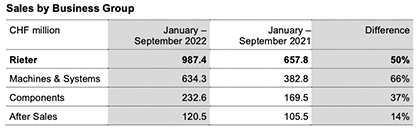

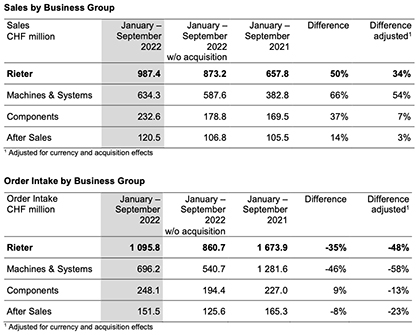
The Business Group Machines & Systems achieved total sales of CHF 634.3 million in the first nine months of 2022 (+66%). The Business Group Components recorded an increase of 37% to CHF 232.6 million in the first nine months of 2022, while the Business Group After Sales posted sales of CHF 120.5 million, 14% higher compared to the prior-year period. In all three business groups, the measures introduced to eliminate material bottlenecks and safeguard supplies are having a positive impact.
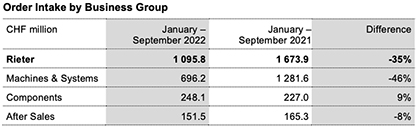

Following the record year of 2021, the Rieter Group received an order intake totaling CHF 1 095.8 million in the first nine months of 2022 (-35%).

In the Business Group Machines & Systems, compared to the record year in 2021, the expected normalization of demand was clearly reflected in an order intake of CHF 696.2 million.

Order intake in the Business Group Components rose to CHF 248.1 million, an increase of 9% compared to the first nine months of the previous year, mainly as a result of the acquisition of the Accotex and Temco components businesses. In the Business Group After Sales, order intake decreased to CHF 151.5 million, a fall of 8% compared to the first nine months of the previous year. The evolution of order intake in both business groups is attributable to the drop in demand for consumables, wear & tear and spare parts.


Precautionary Measures Taken Against Potential Energy Crisis in Europe

Rieter has largely completed preparations in connection with a potential energy crisis in Europe. All European locations have drawn up and already implemented suitable plans.

Financing of a Professorship for Artificial Intelligence

With the aim of further expanding its technology leadership, Rieter is financing together with the Johann Jakob Rieter Foundation a Professorship for Artificial Intelligence at the Zurich University of Applied Sciences (ZHAW) in Winterthur (Switzerland). Rieter will use this technology in the context of the further development of ESSENTIAL, the platform for the digitalization of Rieter spinning systems.

Rieter Site Sales Process on Schedule

The process for the sale of the remaining Rieter site in Winterthur (Switzerland) is proceeding according to plan. In total, around 75 000 m2 of land will be sold. The Rieter CAMPUS is not part of this transaction.

Outlook 2022

Rieter anticipates weakened demand for new systems in the coming months. The demand for consumables, wear & tear and spare parts will depend on the capacity utilization of spinning mills in the months ahead.

For the full year 2022, Rieter expects sales of around CHF 1 400 million. The realization of sales revenue from the order backlog continues to be associated with risks in relation to the well-known uncertainties.

Despite significantly higher sales compared to the prior-year period, Rieter expects EBIT and net result for 2022 to be below the previous year’s level. This is due to the considerable increases in the cost of materials and logistics, additional costs for compensation of material shortages as well as expenses in connection with the acquisition in the years 2021/2022.

As market and technology leader, Rieter will benefit from the continuing exceptionally high order backlog of around CHF 2 000 million, the significantly improved market position, and the continuation of the regional shift in demand.
More News from Rieter Textile Systems

#Spinning

Rieter advances strategic repositioning amid market volatility

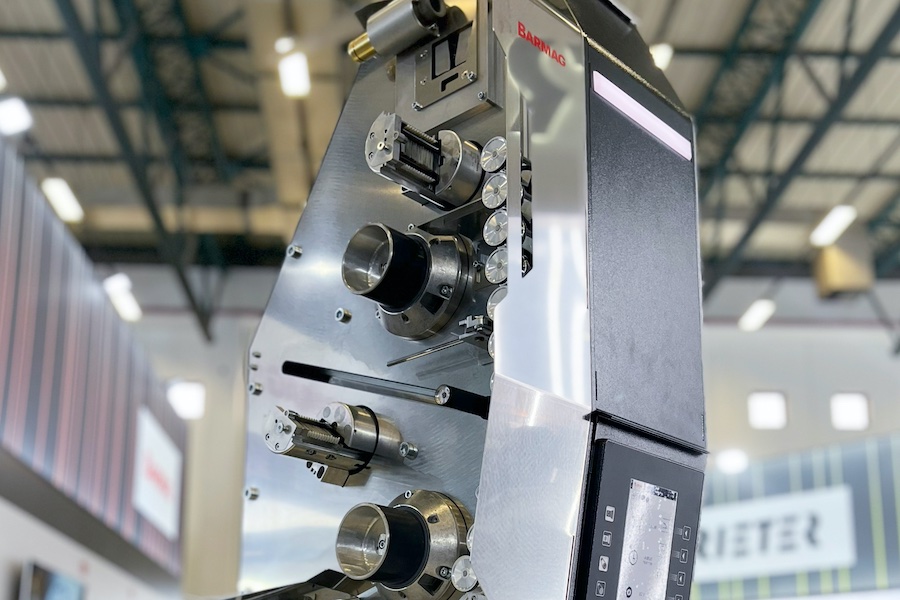
Rieter successfully completed the acquisition of Barmag on February 2, 2026, and reached an important milestone in the company’s repositioning. Barmag will be integrated into the Rieter Group as the “Man-Made Fiber” Division. With this strategically transformative acquisition, Rieter is expanding its core business beyond the short-staple fiber business in a targeted way. This positions Rieter as the global market leader along the entire value chain for natural and man-made fibers. In addition, as a complete systems supplier, Rieter is further strengthening its technological leadership in the areas of automation and digitization.

#Spinning

Rieter responds to higher raw material prices

Global political and economic developments have been leading to rising raw material and energy costs for some time. The textile machinery industry is also affected by this trend. Rieter machines and components consist to a large extent of steel, copper, aluminum and electronics. These materials in particular have seen higher demand and higher prices in recent months.

#Spinning

Rieter completes acquisition of Barmag

Rieter has successfully completed the acquisition of Barmag as of February 2, 2026. This strategically important acquisition makes Rieter the world’s leading system provider for natural and synthetic fibers.

#Spinning

Rieter adjusts group structure in preparation for Barmag integration

The planned acquisition of the “Barmag” Division of OC Oerlikon will create the leading system provider worldwide for natural and man-made fibers. Rieter is confident it will receive all regulatory approvals to complete the acquisition in the fourth quarter of 2025. The Rieter Group is therefore adjusting its Group structure as of January 1, 2026, to take this acquisition into account and to be able to provide an even more agile response to market challenges.

More News on Spinning

#Spinning

Graf at EXINTEX – Strengthening presence in Latin America

Graf successfully participated in EXINTEX, one of the leading textile exhibitions in Latin America, together with its local agent Eurotecnica. The exhibition provided an excellent platform to engage with customers, partners and industry experts across the region.

#Spinning

Temco launches a new DTY all-in-one solution

Temco introduces the DTY All-in-One Solution – a fully harmonized set of components engineered to give customers a highly stable, low maintenance and reproducible process environment. The solution reduces interruptions, extends component lifetimes and supports consistent yarn quality across all machine positions. All-in-One Solution – a fully harmonized set of components engineered to provide maintenance and reproducible process environment.

#Techtextil 2026

DIENES at Techtextil 2026: Flexible pilot lines for bio-based fiber development

The growing relevance of bio-based materials in technical textiles is accompanied by increasing demands for reproducibility, high-quality data, and scalable process routes. Especially when working with cellulose and its derivatives, chitosan, lignin-based approaches, or bio-based PAN as a carbon-fiber precursor, R&D teams face variable feedstock quality, tighter process windows, and the need for reliable comparability across trials. This calls for flexible, data-driven experimental setups that can be reconfigured efficiently when recipes, solvents, and raw-material batches change.

#Techtextil 2026

RETECH showcases high-precision godets for high-performance fiber processing at Techtextil 2026

RETECH designs and manufactures godets and draw frames for heated, ambient and cooled processes, enabling precise heat treatment and consistently high yarn quality for a wide range of polymers and applications, with process temperatures of up to 400 °C for high-performance fibers. The company’s key competence lies in exact and stable temperature and speed control, individually adapted to the specific material and process requirements.

Latest News

#Raw Materials

New study shows low environmental impact by Cotton made in Africa Organic Cotton from Tanzania

Today, the Aid by Trade Foundation (AbTF) is announcing the results of a comprehensive life-cycle analysis (LCA) for cotton produced in Tanzania under the Cotton made in Africa Organic (CmiA Organic) standard. The study emphasises the small ecological footprint of CmiA Organic verified cotton. This can largely be traced back to the absence of synthetic pesticides, artificial fertilisers, and artificial irrigation. Consequently, CmiA Organic cotton can help the textile industry meet regulatory requirements as well as science-based targets. The results also show that the consequences of climate change threaten the livelihoods of these cotton farmers, even though the type of agriculture they practise barely contributes to climate change.

#Raw Materials

Better Cotton Initiative strengthens regenerative focus in standard update

The Better Cotton Initiative (BCI) has strengthened the regenerative focus of its field-level standard with the launch of a new version of its Principles & Criteria (P&C), which marks the next step in the organisation’s journey to becoming a regenerative standards system.

#Man-Made Fibers

Selenis and Kintra Fibers partner to scale 100% bio-based synthetic fiber technology

Selenis, a leading global specialty polyester manufacturer, today announced a strategic manufacturing partnership with materials science company Kintra Fibers to scale Kintra’s patented fiber-grade PBS resin - a 100% bio-based and biodegradable material designed for textile applications.

#Functional Fabrics

PERFORMANCE DAYS proves its relevance as the industry’s key meeting point

Held on March 18–19, 2026, PERFORMANCE DAYS once again confirmed its position as a leading international platform for functional textiles. A total of 3.366 trade visitors and around 560 exhibitors gathered in Munich, with the event already kicking off successfully on DAY 0, which received highly positive feedback for its interactive format. Despite challenging conditions caused by the public transport strike in Munich, the event saw strong attendance and a consistently high level of activity across both exhibition days.

TOP