[pageLogInLogOut]
TRÜTZSCHLER SPINNING - FROM WASTE TO VALUE

#Spinning

Success with SUPERTIP
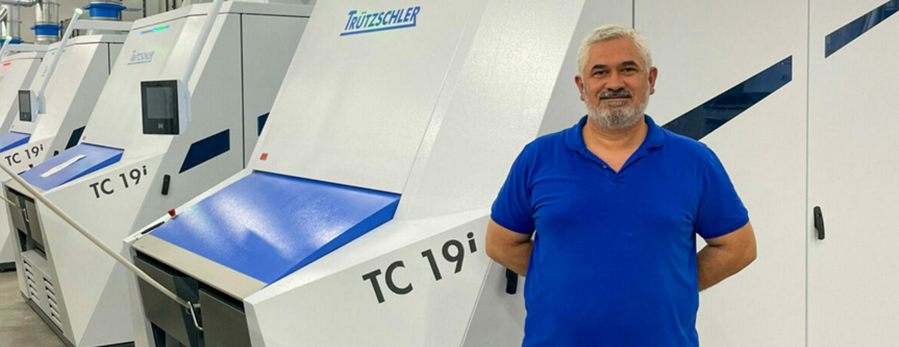
Kaz?m Vurur, Technical Manager of Saf Mensucat and HRN, shares his experiences of using the innovative SUPERTIP wires. © 2022 Trützschler
The new SUPERTIP wire family from Trützschler Card Clothing is raising the bar for quality, efficiency and cost-cutting. But what’s it really like to use this kind of high-value product? Listen to an expert! Kazim Vurur, Technical Manager of Saf Mensucat and HRN, shares his first-hand experience of using these innovative wires in carding applications at his company’s site in Kahramanmaras, Turkey.

Saf Group was established in 1994 and operates in the steel industry with brands including Saf-Lon and Saf-Ten – and it is active in the textile industry too. Saf Group’s “Saf Mensucat” business employs 260 people and produces 70 tons of weaving and knitwear yarn from Ne 4/1 to Ne 40/1 each day. The group also launched HRN during the pandemic, which produces 45 tons of compact ring yarn per day.
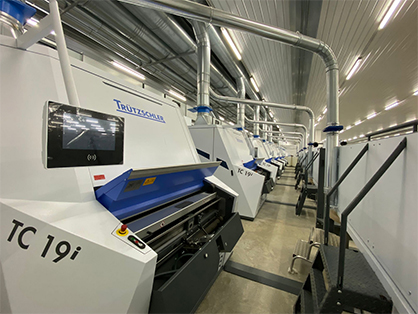
Saf Mensucat use SUPERTIP wires in combination with state-of-the-art machines from Trützschler and derive many advantages from it. © 2022 Trützschler


In 2022, Saf Group achieved turnover of 110,000,000 dollars in the field of textiles with its Saf Mensucat and HRN brands. Both textile businesses use state-of-the-art machines from Trützschler, as well as our new SUPERTIP wires for carding that increase the utilization time of the wires to reduce maintenance needs.

How are these technologies performing in the real world? We contacted Kaz?m Vurur for answers. As Technical Manager for Saf Mensucat and HRN, he has direct insights into exactly how Trützschler is supporting the company’s production activities. Kazim began working in the textile sector in 1992 and has been employed in his current role for almost 25 years.

Here’s what he had to say…
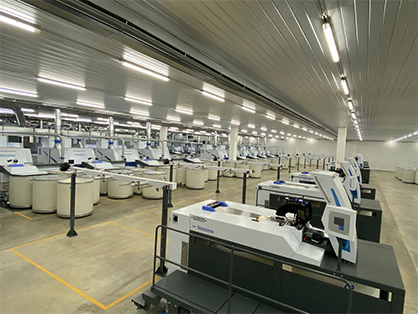
View into the production halls of Saf Group. © 2022 Trützschler


Could you please tell us about Saf Mensucat and its customers?

Kazim Vurur: “Sure! About 60 % of our products are used in knitting, while around 30 % are used in weaving. The remaining 10 % is for technical textiles like brush cloth, vehicle upholstery and materials for the medical sector.”

How did the pandemic affect Saf Mensucat?

Kazim Vurur: “Before the pandemic, most of our products were exported. Now, around half of our products are provided to the domestic market and the other half is exported.

During the pandemic, we carried out the construction, installation and assembly processes of HRN. At the same time, we continued our production on a full-time basis while taking all necessary precautions. We started our compact ring business, which we planned in line with customer demands – including a preparation group containing 39 TC19i Trützschler cards. Our new facility now produces compact ring yarn in the range of Ne16-Ne80, generating 45 tons per day with 63,360 spindles.”

And what is your opinion about X2 SUPERTIP wires?

Kazim Vurur: “We’re using the X2 SUPERTIP at our Saf Mensucat facility and it has a lot of benefits. The biggest advantage is that it achieves stable performance levels throughout the life of the wire. On top of that, the X2 SUPERTIP has a much longer wire life – about 30 % longer than a NOVOSTAR X1 wire. The X2 SUPERTIP also achieves a wire life expectation of up to 1800 tons, while the NOVOSTAR X1 offers just 1350 tons. In fact, we’re now experimenting with 2000 tons on one of our lines. Wire costs are also lower because of the longer service life and reduced maintenance needs.

Quality is another big advantage. We’re seeing a much smaller quality variation between cards when using the X2 SUPERTIP wire compared to the NOVOSTAR X1.

In addition, MAGNOTOP 52 flats, which we started to use with X2 SUPERTIP wire, provide great benefits in yarn quality. A significant improvement of up to 50% has been achieved in total IPI values in all of the Ne ranges that we produce. In neps specifically, the improvement is 280%.

I think Trützschler Turkey’s constantly increasing customer-oriented service quality is also generating the success of the X2 SUPERTIP wire.

On the occasion of this interview, I would like to thank the entire Trützschler team for supporting us in every way.”
More News from Truetzschler Card Clothing GmbH

More News on Spinning

#Spinning

Object Carpet tests production of rPET BCF yarn on Neumag BCF line

In a joint project with Object Carpet GmbH, Denkendorf; the Institute for Textile Technology (ITA), Augsburg; and Next Generation Recyclingmaschinen GmbH (NGR), Feldkirchen, Austria, Barmag investigated the processing of recycled polyester for BCF yarn. The goal was to evaluate the fundamental suitability of 100% recycled carpet material for reuse in carpet yarn production to create a closed-loop system in carpet manufacturing. To date, commercial rPET BCF processes have been based solely on rPET from bottle pellets.

#Spinning

New spinning package with two-step filtration for recycled yarns and more

At the ITM in Istanbul, BB Engineering unveiled its new, patented ValuePack spinning package for the first time, which features a two-stage filtration system. This is particularly beneficial for re-cycling processes. Until now, spinning packs have used either metal powder (“sand”) or filter candles as filter media. Both options are suitable for differ-ent applications, and each has its own specific advantages and dis-advantages.

#Research & Development

GenuTrace client advisory: Is your cotton supply chain UFLPA ready?

U.S. Customs and Border Protection has released updated operational guidance (CBP Publication No. 5560-0526) expanding its forced labor enforcement framework. The guidance supersedes the original 2022 UFLPA Operational Guidance and now covers all forced labor enforcement authorities — UFLPA, CAATSA, and WROs/Findings — in a single unified document. For cotton importers, the enforcement posture has not softened. It has become more structured, more documented, and more demanding. Learn more about UFLPA.

#Spinning

"We will become a recycling powerhouse"

The textile industry is now in its fourth consecutive year of crisis, while automation, artificial intelligence and recycling are reshaping the rules of the game. In this interview, Rieter CEO Thomas Oetterli discusses the first signs of a market recovery, reflects on his first three years at the helm of the company, explains the integration of Barmag, outlines Rieter’s vision of the fully automated spinning mill and highlights the strategic importance of recycling. In doing so, he explains why the new Rieter Group aims to play a leading role in transforming the textile value chain into a circular economy.

Latest News

#Research & Development

2026 general meeting of the Friends and Supporters of RWTH Aachen at ITA

The Friends and Supporters of RWTH Aachen e. V. (proRWTH) looked back on a successful year of support at their 2026 general meeting. The meeting took place at Institut für Textiltechnik (ITA) of RWTH Aachen and was combined with a joint session of the Executive Board and the Administrative Board. Before the general meeting began, participants were given a guided tour of ITA, providing them with fascinating insights into current research and development topics in textile engineering.

#Natural Fibers

Cotton ConneXions Insight to Impact brings supply chain leaders together around cotton innovation

Cotton Incorporated’s Cotton ConneXions Insight to Impact brought together more than 300 industry leaders from 140 companies across 10 countries, including more than 45 top global brands and sourcing organizations, underscoring strong global interest in cotton-rich product development, sourcing and supply chain collaboration.

#Knitting & Hosiery

Footwear innovation enabled by warp knitting technology– insights from New Balance

The future of the athletic shoe is increasingly being shaped on warp knitting machines. For KARL MAYER, the footwear industry is one of the most important growth markets – and one of the sectors where innovative textiles can realize their full potential. In his keynote address at the opening of KARL MAYER’s TEXTILE INNOVATION CENTER in Obertshausen in April, Vishnu Prakash Muthusamy, Senior Textile and Materials Engineer at New Balance, explained the opportunities that warp knitting technology opens up for performance, sustainability, and faster development processes, and why textile manufacturers are transitioning from suppliers to development partners.

#Natural Fibers

Cashmere specialist joins AbTF Board of Trustees

The Aid by Trade Foundation (AbTF) is pleased to welcome Brian Yu, the chief executive officer of the Artwell Group, to its board of trustees. As CEO, Brian Yu developed Artwell into the world’s largest supplier of responsibly produced cashmere knitwear.

TOP