[pageLogInLogOut]

#Spinning

Rieter reports strong recovery for the first half of the year

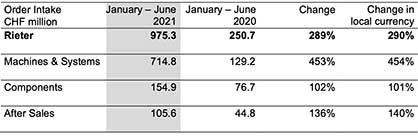
Rieter posted an order intake of CHF 975.3 million, which corresponds to an increase of 289% compared to the previous year period (first half of 2020: CHF 250.7 million). The recovery is broadly supported globally and is based on a catch-up effect relating to the years 2019 and 2020 and a regional shift in demand. Rieter is benefitting from its innovative product portfolio and the company’s global positioning. The highest order intake was recorded in Turkey.

• Order intake of CHF 975.3 million

• Sales of CHF 400.5 million

• EBIT of CHF 9.0 million and net profit of CHF 5.3 million

• Strategy implementation and crisis management

• Outlook

On June 30, 2021, the company had an order backlog of about CHF 1 135 million (June 30, 2020: about CHF 490 million).

Order Intake by Business Group

In the Business Group Machines & Systems, order intake amounted to CHF 714.8 million (first half of 2020: CHF 129.2 million). In the Business Group Components, order intake rose to CHF 154.9 million (first half of 2020: CHF 76.7 million), and in the Business Group After Sales it increased to CHF 105.6 million (first half of 2020: CHF 44.8 million).

A key driver of growth in the machinery business has been the demand for innovative complete systems in the areas of ring and compact spinning. The successful commercialization of the compacting devices and the piecing robot ROBOspin, launched in 2019, contributed to the increase in the Business Groups Components and After Sales.

Sales by Business Group

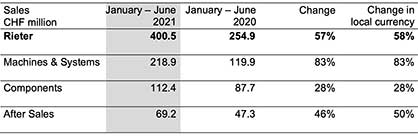
The Rieter Group recorded sales of CHF 400.5 million (first half of 2020: CHF 254.9 million). Sales significantly increased compared to the previous year period; however, as expected, they were still impacted by the low order intake of the financial year 2020.

In the first half of 2021, the Business Group Machines & Systems realized sales in the amount of CHF 218.9 million, which corresponds to an increase of about 83% compared to the previous year period.

Spinning mills are working at good capacity levels with an increased demand for components as well as spare and wear parts, which is the reason for the positive development in the Business Groups After Sales and Components. In the Business Group Components, sales rose to CHF 112.4 million (+28%), and in the Business Group After Sales to CHF 69.2 million (+46%).

Sales by Region

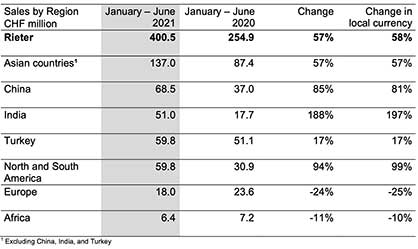
In the Asian countries, Rieter recorded sales of CHF 137.0 million (+57%) for the first half of the financial year 2021. In China, sales rose by 85% to CHF 68.5 million due to spinning mills investing in the improvement of their competitiveness. The recovery of the market in India resulted in a significant increase of 188% to CHF 51.0 million. In Turkey, sales improved slightly to CHF 59.8 million (+17%). Sales increased by 94% to CHF 59.8 million in the region North and South America, driven by a considerable increase in demand in Latin America. 

EBIT, Net Profit and Free Cash Flow

In terms of EBIT, Rieter posted a profit of CHF 9.0 million for the first half of 2021 and a net profit of CHF 5.3 million. A one-off effect associated with the reversal of allowances for machinery that was delivered in the first half of 2021 contributed to this development. Free cash flow amounted to CHF 53.2 million, which was considerably influenced by the advance payments received from customers in conjunction with the significantly increased order intake.


Strategy Implementation and Crisis Management

In recent years, Rieter has consistently implemented its strategy based on the cornerstones of innovation leadership, strengthening the components, spare parts and services businesses, and adjusting cost structures.

Crisis management in the pandemic year of 2020 was aimed at protecting employees, fulfilling customer commitments, ensuring liquidity, and also strengthening the market position for the time after the pandemic as well as retaining the ability to benefit from the incipient market recovery.

The focus for 2021 remains on the implementation of this strategy. The measures for crisis management relating to the protection of employees and fulfilling customer commitments are still in effect in countries that continue to be affected by the pandemic.

The Rieter Board of Directors has approved the implementation of the CAMPUS project. The Rieter CAMPUS comprises a customer and technology center as well as an administration building at the Winterthur location. It will make an important contribution to the implementation of the innovation strategy and to the enhancement of Rieter’s technology leadership position.


Outlook

As already announced, the first half of 2021 has been characterized by a strong market recovery in combination with a regional shift in demand for new machinery and systems. Rieter anticipates a normalization of the demand for new systems in the coming months. The company assumes that spinning mills will continue to work at high-capacity levels.

For the full year, Rieter expects sales to be above CHF 900 million.

The realization of sales from the order backlog continues to be associated with risks in light of bottlenecks in material deliveries and freight capacities as well as the ongoing pandemic in key markets for Rieter.
More News from Rieter Textile Systems

#Spinning

Rieter advances strategic repositioning amid market volatility

Rieter successfully completed the acquisition of Barmag on February 2, 2026, and reached an important milestone in the company’s repositioning. Barmag will be integrated into the Rieter Group as the “Man-Made Fiber” Division. With this strategically transformative acquisition, Rieter is expanding its core business beyond the short-staple fiber business in a targeted way. This positions Rieter as the global market leader along the entire value chain for natural and man-made fibers. In addition, as a complete systems supplier, Rieter is further strengthening its technological leadership in the areas of automation and digitization.

#Spinning

Rieter responds to higher raw material prices

Global political and economic developments have been leading to rising raw material and energy costs for some time. The textile machinery industry is also affected by this trend. Rieter machines and components consist to a large extent of steel, copper, aluminum and electronics. These materials in particular have seen higher demand and higher prices in recent months.

#Spinning

Rieter completes acquisition of Barmag

Rieter has successfully completed the acquisition of Barmag as of February 2, 2026. This strategically important acquisition makes Rieter the world’s leading system provider for natural and synthetic fibers.

#Spinning

Rieter adjusts group structure in preparation for Barmag integration

The planned acquisition of the “Barmag” Division of OC Oerlikon will create the leading system provider worldwide for natural and man-made fibers. Rieter is confident it will receive all regulatory approvals to complete the acquisition in the fourth quarter of 2025. The Rieter Group is therefore adjusting its Group structure as of January 1, 2026, to take this acquisition into account and to be able to provide an even more agile response to market challenges.

More News on Spinning

#Techtextil 2026

RETECH showcases high-precision godets for high-performance fiber processing at Techtextil 2026

RETECH designs and manufactures godets and draw frames for heated, ambient and cooled processes, enabling precise heat treatment and consistently high yarn quality for a wide range of polymers and applications, with process temperatures of up to 400 °C for high-performance fibers. The company’s key competence lies in exact and stable temperature and speed control, individually adapted to the specific material and process requirements.

#Spinning

Barmag presents the next generation of POY production – energy-efficient and partial-automated

With POY 2.0, Barmag is introducing a completely redesigned spinning concept that takes the production of partially oriented yarn (POY) to a new level in terms of technology and economy. The solution, which was presented to a selected audience of experts for the first time at ITMA Asia + CITME 2025, was met with great enthusiasm: several yarn producers worldwide immediately expressed their interest in a pilot plant.

#Spinning

Development of bio-based polyethylene fibers for textile applications – BB Engineering partici-pates in the bioPEtex research project

In the German research project bioPEtex, BB Engineering (BBE) is working with other partners to develop textiles made from 100% bio-based polyethylene (PE). The aim is to make use of this poly-mer, which has hardly been used in the chemical fiber industry to date. BBE is contributing its spinning and texturizing expertise and developing the texturing process on an industrial scale. The first promising results are already available – opening up new opportu-nities for sustainable and economically attractive applications in the textile industry.

#Techtextil 2026

Saurer sets new standards at Techtextil 2026

When the international textile industry gathers at Techtextil in Frankfurt from April 21 to 24, Saurer is going to present a powerful solution for the growing demands in the field of technical yarns with the TechnoCorder TC2plus.

Latest News

#Raw Materials

Lenzing Group positions bio‑based materials as a strategic asset for Europe’s economic security

The Lenzing Group, a leading supplier of regenerated cellulose fibers for the textile and nonwovens industries, hosted a high‑level roundtable in Brussels to discuss how bio‑based materials can strengthen Europe’s economic security and support the shift toward a fossil‑free future. Organized in cooperation with Euractiv, the event brought together representatives of the European Commission, the UK Mission to the EU, academia, civil society, and industry.

#Natural Fibers

Beyond Cotton: Natural Fibres in the Spotlight at the Bremen Cotton Conference - Branded by DNFI

Climate targets, fragile supply chains, and rising regulatory requirements are fundamentally changing the perspective of the textile industry - the focus is increasingly shifting toward the base material. Not only cotton, but natural fibres are gaining significant importance: they stand out not only because of their outstanding functional properties, but also because they make a valuable contribution to the bioeconomy and responsible product development.

#Textiles & Apparel / Garment

Coats to showcase innovative reinforcement and filler materials for leather goods and accessories at APLF 2026

Coats, a world-class Tier 2 manufacturer and trusted partner for the apparel and footwear industries, will be promoting four advanced materials from its ‘Lifestyle Solutions’ portfolio at APLF 2026 in Hong Kong in March. Each innovation has been specifically engineered to help luxury and premium brands elevate the craft, durability, sustainability and creative expression required in the manufacturing of handbags, purses, and other high-end designer accessories.

#Textiles & Apparel / Garment

Design, innovation and sustainability propel VIATT 2026’s expanding role in ASEAN textile sourcing

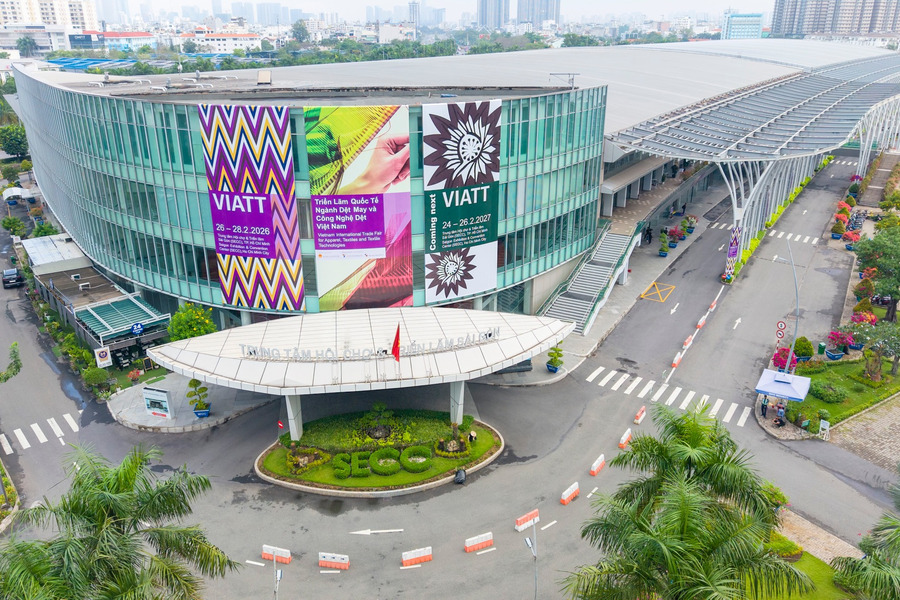
At its third edition, the Vietnam International Trade Fair for Apparel, Textiles, and Textile Technologies (VIATT) further reinforced its role as a key sourcing and business platform for ASEAN’s textile industry. The three-day fair welcomed over 17,000 visits from 54 countries and regions, and featured over 460 exhibitors from 21 countries and regions across 18,000 sqm. The 2026 edition was marked by the introduction of new international pavilions and zones, broadening the fair’s sourcing scope across new geographies and product categories. The fringe programme, headlined by the debut Trend Forum, further distinguished VIATT as the region’s most integrated textile trade platform – uniquely spanning the entire value chain.

TOP