[pageLogInLogOut]

#Spinning

First information on the financial year 2019

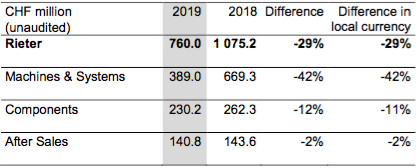
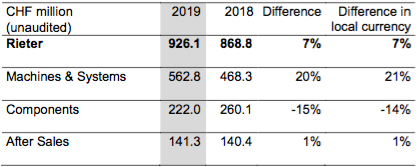
The Rieter Group closed the 2019 financial year, as expected, with considerably lower sales than in the previous year. According to the first, unaudited figures, total sales of CHF 760.0 million were achieved, which is 29% down on the previous year (2018: CHF 1 075.2 million). At CHF 926.1 million, order intake was 7% higher than in the prior year period (2018: CHF 868.8 million). Rieter will publish the full annual financial statements and the 2019 Annual Report on March 10, 2020.
  • As expected, sales were significantly down on the previous year, falling by ?29% to CHF 760 million ?
  • EBIT margin of around 11% and net profit of around 7% of sales ?anticipated, non-recurring profit contribution from sale of real estate in ?Ingolstadt (Germany) ?
  • Order intake up 7% on previous year; order intake amounting to CHF 401.6 ?million booked in fourth quarter 2019 (4th quarter 2018: CHF 119.0 million) ?
  • First half of 2020 expected to be significantly lower than previous year in ?terms of sales and earnings ?
  • Further capacity adjustment measures introduced ?
  • Start of construction of Rieter CAMPUS expected during 2020, subject to ?granting of building permit

Sales by Business Group

As already reported, 2019 as a whole was characterized by the trade conflict between the USA and China, excess capacity in the spinning mills as well as political and economic uncertainties in regions of importance to Rieter. 
(c) 2020 Rieter
(c) 2020 Rieter


Thus, in the Business Group Machines & Systems, with a decline of 42% in the 2019 reporting year, sales of new machines were at a very low level. 

In the Business Group Components, the 12% decline in sales compared to the same period in the previous year is also due to the lower order intake as a consequence of reluctance to invest. Above all, this affected the business activities of SSM and Suessen. The wear and tear parts business continued at a normal level.

The 2% year-on-year decline in sales in the Business Group After Sales is mainly attributable to the lower volume in the machinery business (low demand for installation services). 

Sales by Regions
1 excluding China, India, Turkey (c) 2020 Rieter

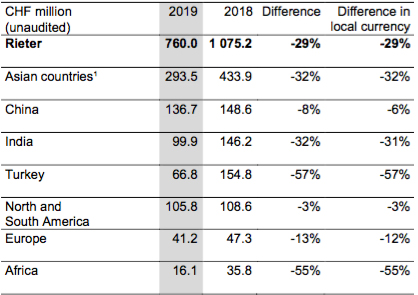
The market situation described above is also reflected in sales in the Asian countries, in India and Turkey. Sales in China as well as North and South America remained at the prior year level.

Order Intake by Business Group
(c) 2020 Rieter
(c) 2020 Rieter


The Business Group Machines & Systems posted an order intake of CHF 562.8 million, an increase of 20% compared to the previous year. This is primarily due to the fourth quarter of 2019, in which an order intake of CHF 307.0 million was booked. This figure includes orders from Cotton & Textile Industries Holding Company, Cairo (Egypt), for the delivery of compact and ring spinning systems in the amount of around CHF 165 million.


In the Business Group Components, order intake of CHF 222.0 million was down by 15% compared to the previous year. Due to weaker macroeconomic conditions, order intake in the fourth quarter of 2019 was CHF 49.1 million, lower than in the previous quarters. Overall, the decline in the year under review can be attributed to a low level of investment by customers in the Business Units SSM and Suessen.

With an order intake of CHF 141.3 million, the Business Group After Sales recorded a year-on-year increase of 1%. The fourth quarter of 2019, in contrast, with an order intake of CHF 45.5 million, was significantly higher than the previous quarters, which is largely attributable to the installation services for the Cotton & Textile Industries Holding Company project in Cairo (Egypt).

At the end of 2019, Rieter’s order backlog amounted to about CHF 500 million (December 2018, 31: about CHF 325 million).

First Half of 2020 Expected to Be Significantly Lower Than Previous Year in Terms of Sales and Earnings?

Due to the low order intake in the 2019 financial year, Rieter expects sales and earnings in the first half of 2020 to be significantly below the prior year level.

Further Capacity Adjustment Measures Introduced

The Rieter Group is planning further measures to adjust capacities due to structural changes in the market situation. This concerns the locations Winterthur (Switzerland), Suessen and Gersthofen (both Germany), Enschede (Netherlands) and Boskovice (Czech Republic).

In the Business Group Machines & Systems, the assembly of machines is to be discontinued at the Winterthur location. This is expected to affect 87 jobs out of a total of 980 jobs in Switzerland.

In the Business Group Components, a total of 90 jobs are likely to be lost at the locations Suessen, Gersthofen, Boskovice and Enschede.

The consultation processes with employee representatives begin today, January 29, 2020.

With these measures, Rieter aims to cut running costs by around CHF 15 million from 2021. For the implementation of the adjustment measures, Rieter anticipates non-recurring expenses of approximately the same amount in 2020. The goal remains to successfully implement the ongoing innovation program and to be able to respond quickly to increasing demand.

Start of Construction of Rieter CAMPUS

Rieter applied for a building permit for the Rieter CAMPUS at the end of 2019. The Rieter CAMPUS comprises a new Customer and Technology Center as well as an administration building. The Board of Directors of Rieter Holding Ltd. has decided to start construction work on the Rieter CAMPUS most probably during 2020, provided that the legally building permit is issued in good time.

Profit Outlook for 2019

In financial year 2019, Rieter anticipates an EBIT margin of around 11% (2018: 4.0%) and a net profit of around 7% of sales (2018: 3.0%). This includes the non- recurring profit contribution from the sale of real estate in Ingolstadt in the amount of around EUR 60 million at the net profit level.

Annual General Meeting of April 16, 2020

The 2020 Annual General Meeting of Rieter Holding Ltd. will take place this year on April 16, 2020, at the Eulachhalle arena in Winterthur, Switzerland. Any proposals regarding the agenda must be submitted in writing to Rieter Holding Ltd., Company Secretary's Office, Klosterstrasse 32, CH-8406 Winterthur, Switzerland, by February 22, 2020, at the latest, accompanied by information concerning the relevant motions and evidence of the necessary shareholdings (with a par value of CHF 0.5 million as stipulated by Article 699 of the Swiss Code of Obligations and §9 of the Articles of Association).


More News from Rieter Textile Systems

#Recycling / Circular Economy

Rieter and partners launch Recycling Powerhouse for industrial-scale textile recycling

Recycling Powerhouse Ltd. was established in July 2026 to industrialize, standardize and scale textile recycling. Based in Switzerland, the venture will operate a franchise-driven business model that enables the production of high-quality, certified recycled yarns. The project is supported by the following partners: Rieter Group, the world’s leading system supplier for natural and man-made fibers, Säntis Textiles, a Swiss textile engineering company, and Valvan, a Belgian sorting technology company. The first blueprint franchise operation is scheduled to launch early 2027 in partnership with Suhail Industrial Holding Group in Qatar.

#Spinning

Rieter sees Barmag integration on track as orders and sales rise

The first half of 2026 was shaped by the successful completion of the largest acquisition in Rieter’s history. The Man-Made Fiber Division enables entry into the growth segment of man-made fibers and sustainably strengthens Rieter’s market position in the Asia region. The expanded Group is now the world’s leading system supplier for the processing of natural and man-made fibers. In the first half of the year, initial cost savings in material costs and operating expenses have already been realized. The targeted synergies are expected to amount to at least CHF 20 million by the end of the 2028 financial year. Due to the completion of the acquisition on February 2, 2026, the first half of the year for the Man-Made Fiber Division only amounts to five months.

#Spinning

"We will become a recycling powerhouse"

The textile industry is now in its fourth consecutive year of crisis, while automation, artificial intelligence and recycling are reshaping the rules of the game. In this interview, Rieter CEO Thomas Oetterli discusses the first signs of a market recovery, reflects on his first three years at the helm of the company, explains the integration of Barmag, outlines Rieter’s vision of the fully automated spinning mill and highlights the strategic importance of recycling. In doing so, he explains why the new Rieter Group aims to play a leading role in transforming the textile value chain into a circular economy.

#ITM 2026

Rieter at ITM 2026: Spinning Redefined with Automation and Intelligence

Spinning mills need solutions that deliver stability, efficiency and future-proof performance. Rieter has put together a powerful portfolio for ITM 2026 in Istanbul, Türkiye. These innovations give customers the tools to enhance cost efficiency, improve responsiveness and actively develop their competitive edge. Step-by-step, Rieter is moving closer to its Vision 2027 – the fully automated spinning mill. With each new technology, Rieter enables spinning mills worldwide to operate with greater precision and reliability, ensuring they remain at the forefront of an increasingly demanding global market.

More News on Spinning

#Spinning

Barmag expands its portfolio for PA6/PA6.6 applications — also available as a retrofit solution

With the new type 6020 ceramic oiler, Barmag is introducing a powerful addition to its product portfolio for processing PA6 and PA6.6 yarns. The solution is specifically designed for low-titer applications in the range of 5 to 100 denier.

#Spinning

Pre-Cleaner CL-X: Proven in cotton cleaning – creating value beyond the spinning mill

Since its market launch, the CL-X has firmly established itself in blowroom lines worldwide. Hundreds of installations confirm its ability to deliver superior cleaning efficiency, lower waste, higher productivity and significant energy savings. Now, new customer applications show that the CL-X not only continues to excel in spinning preparation – it is also entering a completely new field of application: ginning.

#Spinning

Barmag Fuzhou Customer Day concludes successfully, boosting high-quality chemical fiber growth in Fujian & Guangdong

Barmag hosted its Customer Day themed “A New Era. Powered by Innovation.” in Fuzhou on June 28, welcoming nearly one hundred invited customers from Fujian and Guangdong provinces. Georg Stausberg, CEO of Barmag Group, attended along-side the sales and R&D expert China team to jointly present integrated solutions covering the entire man-made fiber value chain.

#Spinning

STEELTOP®: A new benchmark in flat tops for spinning preparation

Modern carding generations achieve higher production performance, placing significantly greater stress on flat tops. Higher cylinder speeds and increased fiber density, combined with tighter carding gaps, create more demanding operating conditions. At the same time, poorer raw material quality and the increased use of recycled materials further intensify these challenges. With STEELTOP®, Trützschler introduces a new full steel flat top series developed for these demanding modern carding processes.

Latest News

#Research & Development

Networking Day 2026: Industry stakeholders unite around textile recycling

In 2026, the Industry Research Group (IRG) Polymer Recycling once again brought together some of the key stakeholders in textile recycling for its annual Networking Day. This year, the event took place at EREMA’s premises in Ansfelden, Austria. It brought together key players from across the textile recycling value chain for a day of structured exchange and in-depth discussions.

#Knitting & Hosiery

The new RDJ 7/3 defines the design footprint of modern athletic shoes

Stylish, functional, and efficient to produce – spacer fabrics are the all-arounders among textile materials. These versatile fabrics are particularly in demand in the sports and casual footwear sector, as they combine comfort, breathability, and design freedom. At the same time, this industry is trend-driven, dynamic, and price-sensitive like few others. Innovations are therefore a decisive factor for success. With the RDJ 7/3, KARL MAYER offers a solution specifically tailored to these requirements. The particular strength of the new double raschel machine: its exceptional flexibility, thanks to its three jacquard bars.

#Research & Development

Smart textiles reversibly change shape in an energy-efficient manner in response to ambient temperature

Self-actuating textile structures are used in a wide range of applications, such as medical technology, automation, architecture, agriculture, and the apparel industry. An example is the use of shading nets in greenhouses, which can be deployed and retracted depending on the sunlight intensity. The German Institutes of Textile and Fiber Research Denkendorf (DITF) are developing textiles based on shape-memory polymers with reversibly controllable geometry.

#Natural Fibers

2026 ICAC report projects World cotton trade to reach 10.3 million tonnes by 2028/29

The International Cotton Advisory Committee has released the 2026 World Cotton Trade Report, which provides analysis of global cotton trade patterns, key trading relationships, import and export trends, and the geopolitical and policy developments shaping cotton trade flows.

TOP