[pageLogInLogOut]
TRÜTZSCHLER SPINNING - FROM WASTE TO VALUE

#Spinning

The Truetzschler Card TC 19i: The first intelligent card
(c) 2019 Truetzschler
Is there a formula for successful innovations? Definitely not. But how does Truetzschler manage to continuously raise the bar in carding technology? How can the Truetzschler Card TC15 be surpassed in terms of quality and performance?
“The dialogue with our customers is decisive for our developments. We listen to them very carefully when they talk about unresolved problems. High raw material costs, personnel bottlenecks and fluctuating raw material qualities combined with constantly high quality requirements are among the present circumstances that need to be overcome”, stated Markus Wurster, Sales Director at Truetzschler Spinning.

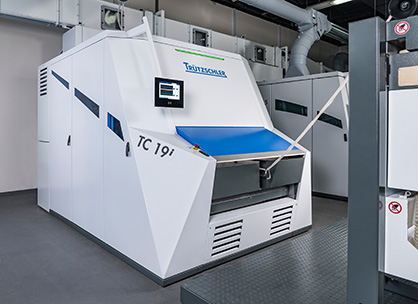
The fact that Truetzschler has the technical competence to implement these requirements was demonstrated once again at ITMA 2019. A new chapter in card development has been be opened: The Truetzschler card is intelligent. It performs important settings completely independently and with a precision not achievable by humans, which results in an unprecedented level of quality.
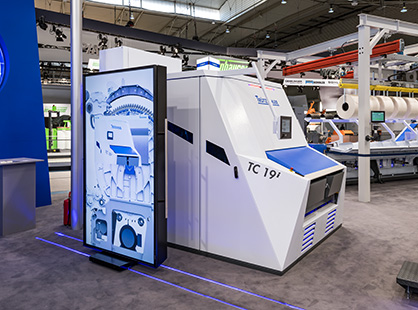
The new Card Tc 19i presented on ITMA 2019 (c) 2019 truetzschler


“This is the future!” and “This is the development we need!” were the reactions of booth visitors which sales manager Ralf Müller experienced at this year’s ITMA. “The possibility to increase quality and productivity as well as solving personnel issues through features like T-GO or WASTECONTROL fascinated our customers”, he summarized the visitor' s interests. 

TC 19i main features at a glance:

  • Self-optimizing precision 

For cotton carding, the carding gap between the cylinder and flat clothing should be as small as possible. The optimum gap is 3/1000” (0.075mm) for many types of cotton. For comparison: Not even a sheet of paper fits inbetween. Even an experienced technologist cannot carry out such narrow settings when the card is cold. During operation, centrifugal forces and temperature increases influence these settings significantly.
(c) 2019 Truetzschler


On the Truetzschler Card TC 19i with the Gap Optimizer T-GO, a basic flat setting is only carried out once by our specialists. Afterwards, T-GO ensures an ideal carding gap at all times, whether the card is cold or warm, after clothing grinding, even after clothing replacement. This is a permanent, self-optimizing, intelligent process that takes place without any production interruption. It responds automatically to changing parameters such as:

    • Material properties
    • Production level
    • Cylinder speed
    • Environmental influences such as room temperature
    • Maximum raw material utilization 


    :UL


Many visitors have been very interested in the new card TC 19i and wanted to learn more about its intelligence (c) 2019 Truetzschler


The key to the profitability of a spinning mill is the maximum utilization of the raw material. On TC 19i, an optical sensor monitors the waste in the suction, thus providing the data for WASTECONTROL. If too many good fibers end up in the waste, the system adjusts the mote knife setting on the WEBFEED via a servomotor.

  • Permanent quality control 

The Truetzschler Nep Sensor NCT (separat option) permanently monitors the web on the doffer. A camera registers and distinguishes neps, trash particles and seed coat fragments. The data is displayed on the screen of the cards and also transmitted to the Truetzschler mill monitoring system My Mill. In this way, multiple cards can be monitored regarding quality delivery, and any deviation will immediately be recognized.

  • Smart and easy operation


The TC 19i provides a multitouch screen that can be used as easily and intuitively as a smartphone. Individual operator recognition and authorization is possible through an RFID chip. In addition, the remote card display T-LED visualizes important machine information in an easy way and helps operators to stay aware of each machine’s status. 

Jürgen März, carding specialist at Truetzschler, received a lot of positive feedback at ITMA: “By talking to our customers about problems in their mills, we learned about their dependence on skilled staff. The precision of the flat setting is highly influenced by the operator, but reliable and well-trained personnel is difficult to find today. Customers were very impressed by the fact that very narrow settings can be set completely independent. The carding gap is no longer set by a technician, but by an intelligent system. The limitations of human precision have been overcome by Truetzschler machinery at this point.”
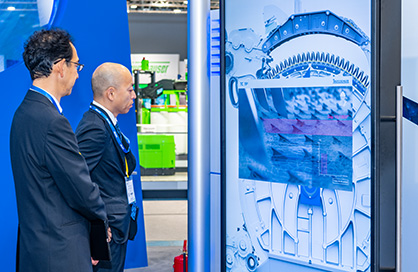
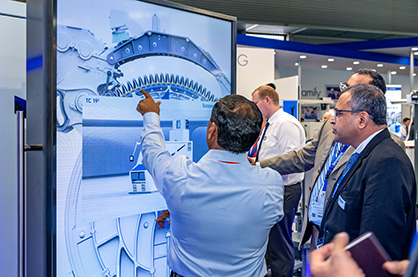
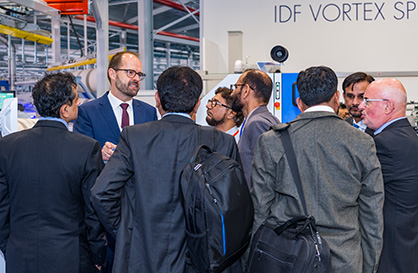
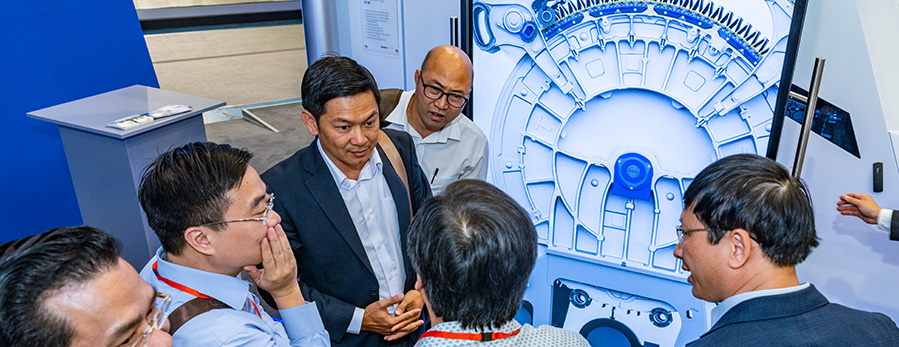
Impressed visitors in front of the new card TC 19i (c) 2019 Truetzschler


(c) 2019 truetzschler


More News from Truetzschler GmbH & Co. KG

#ITM 2026

Trützschler’s Integrated Draw Frame IDF 3: Unlocking the full potential of short fiber processing

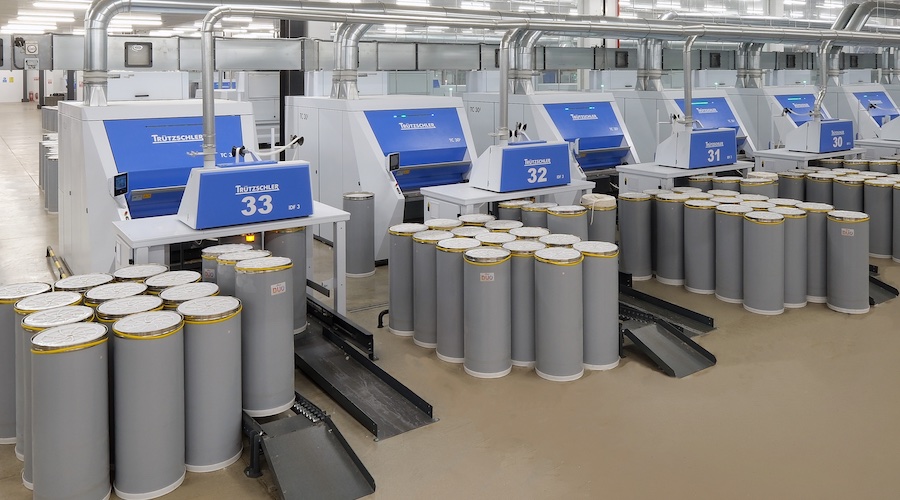
Spinning mills worldwide are looking for solutions that combine higher productivity, stable quality and shorter processes, especially when processing short fibers. Trützschler’s integrated draw frame IDF 3 has proven to be a powerful answer to these requirements. Evaluations from several customer trials in Türkiye under real production conditions highlight the strong performance of the IDF 3, particularly when combined with the next-generation card TC 30i.

#ITM 2026

Experience Trützschler’s leading fiber processing technologies at ITM 2026

From June 9 to 13, the Trützschler Group will present its latest machinery, service expertise and digital solutions at ITM 2026 in Istanbul, Türkiye. Visitors are invited to explore innovations across Spinning, Card Clothing, and Nonwovens at Hall 7, Booth 714A at the Tüyap Fair Convention and Congress Center. They can experience modern fiber processing with Trützschler!

#Spinning

Perfect quality through collaboration: Machinery from Trützschler, Toyota and Murata at Zirve Tekstil

In today’s textile industry, excellence is not achieved by chance – it’s the result of deliberate decisions, technical expertise, and the courage to go beyond conventional paths. The Turkish company Zirve Tekstil has done just that: by combining the best technologies from Trützschler, Toyota and Murata, they’ve created a production setup that delivers outstanding yarn quality – recognized worldwide.

#Spinning

Details matter: How Trützschler cylinder wires boost efficiency in Pakistan’s spinning sector

Pakistan’s textile industry, especially its spinning sector, is the backbone of the national economy and a vibrant hub of innovation. Today’s spinning mills face growing demands for efficiency, quality, and sustainability. From the serene northern valleys to the vibrant port city of Karachi in the south, mills like Suraj Cotton Mills, Liberty, and Nishat Chunian are turning to advanced solutions.

More News on Spinning

#Spinning

Object Carpet tests production of rPET BCF yarn on Neumag BCF line

In a joint project with Object Carpet GmbH, Denkendorf; the Institute for Textile Technology (ITA), Augsburg; and Next Generation Recyclingmaschinen GmbH (NGR), Feldkirchen, Austria, Barmag investigated the processing of recycled polyester for BCF yarn. The goal was to evaluate the fundamental suitability of 100% recycled carpet material for reuse in carpet yarn production to create a closed-loop system in carpet manufacturing. To date, commercial rPET BCF processes have been based solely on rPET from bottle pellets.

#Spinning

New spinning package with two-step filtration for recycled yarns and more

At the ITM in Istanbul, BB Engineering unveiled its new, patented ValuePack spinning package for the first time, which features a two-stage filtration system. This is particularly beneficial for re-cycling processes. Until now, spinning packs have used either metal powder (“sand”) or filter candles as filter media. Both options are suitable for differ-ent applications, and each has its own specific advantages and dis-advantages.

#Research & Development

GenuTrace client advisory: Is your cotton supply chain UFLPA ready?

U.S. Customs and Border Protection has released updated operational guidance (CBP Publication No. 5560-0526) expanding its forced labor enforcement framework. The guidance supersedes the original 2022 UFLPA Operational Guidance and now covers all forced labor enforcement authorities — UFLPA, CAATSA, and WROs/Findings — in a single unified document. For cotton importers, the enforcement posture has not softened. It has become more structured, more documented, and more demanding. Learn more about UFLPA.

#Spinning

"We will become a recycling powerhouse"

The textile industry is now in its fourth consecutive year of crisis, while automation, artificial intelligence and recycling are reshaping the rules of the game. In this interview, Rieter CEO Thomas Oetterli discusses the first signs of a market recovery, reflects on his first three years at the helm of the company, explains the integration of Barmag, outlines Rieter’s vision of the fully automated spinning mill and highlights the strategic importance of recycling. In doing so, he explains why the new Rieter Group aims to play a leading role in transforming the textile value chain into a circular economy.

Latest News

#Research & Development

2026 general meeting of the Friends and Supporters of RWTH Aachen at ITA

The Friends and Supporters of RWTH Aachen e. V. (proRWTH) looked back on a successful year of support at their 2026 general meeting. The meeting took place at Institut für Textiltechnik (ITA) of RWTH Aachen and was combined with a joint session of the Executive Board and the Administrative Board. Before the general meeting began, participants were given a guided tour of ITA, providing them with fascinating insights into current research and development topics in textile engineering.

#Natural Fibers

Cotton ConneXions Insight to Impact brings supply chain leaders together around cotton innovation

Cotton Incorporated’s Cotton ConneXions Insight to Impact brought together more than 300 industry leaders from 140 companies across 10 countries, including more than 45 top global brands and sourcing organizations, underscoring strong global interest in cotton-rich product development, sourcing and supply chain collaboration.

#Knitting & Hosiery

Footwear innovation enabled by warp knitting technology– insights from New Balance

The future of the athletic shoe is increasingly being shaped on warp knitting machines. For KARL MAYER, the footwear industry is one of the most important growth markets – and one of the sectors where innovative textiles can realize their full potential. In his keynote address at the opening of KARL MAYER’s TEXTILE INNOVATION CENTER in Obertshausen in April, Vishnu Prakash Muthusamy, Senior Textile and Materials Engineer at New Balance, explained the opportunities that warp knitting technology opens up for performance, sustainability, and faster development processes, and why textile manufacturers are transitioning from suppliers to development partners.

#Natural Fibers

Cashmere specialist joins AbTF Board of Trustees

The Aid by Trade Foundation (AbTF) is pleased to welcome Brian Yu, the chief executive officer of the Artwell Group, to its board of trustees. As CEO, Brian Yu developed Artwell into the world’s largest supplier of responsibly produced cashmere knitwear.

TOP