#Software
Retail powerhouse, The Foschini Group (TFG) realises productivity improvements of 12.8% with Coats Digital’s GSDCost

The retailer selected GSDCost to leverage international method-time standards for fact-based, transparent garment costing to support sustainable supplier relationships and optimise manufacturing time and cost processes within the group’s factories.
Established in 1924, TFG is one of the leading retail brands in South Africa, with a workforce of over 34,000 and more than 4,300 outlets located in 32 countries, on five continents across the globe. The group is comprised of 31 retail brands that offer a variety of lifestyle products for men and women, including: clothing, jewellery, mobile phones, accessories, cosmetics, sports apparel, homeware and furniture – ranging from value to luxury segments.

TFG is committed to finding innovative ways to deliver on business imperatives, while maintaining a sustained focus on its responsibilities towards environmental, social and corporate governance within the business itself, and to ensure an optimised and more sustainable supply chain overall. As part of this strategy, TFG made the decision to adopt recognised international method-time standards via a robust digital solution that would support transparent, sustainable garment costing so it could negotiate fair labour costs with vendors and establish optimised manufacturing processes within its own factories.
Kevin Meyer, Workstudy & Engineering Manager, The Foschini Group, said: “We were searching for a solution that would help us overcome the difficulties we faced in negotiating labour costs with our vendors. After evaluating multiple systems in the market, we found GSDCost was the best solution to benchmark labour costs effectively and provide a transparent costing and sourcing policy.”
Prior to implementing GSDCost, TFG calculated the labour time and cost associated with the production of garment orders on historical data. Since the material, styles and machinery change continuously, the company found that this data was flawed with inaccuracies and inconsistent values. A highly subjective approach to costing and the lack of manufacturing method standards consequently made it difficult to accurately calculate and benchmark sustainable labour costs, which greatly undermined TFG’s ability to make informed costing and sourcing decisions or properly assess the productivity levels at its factories.
GSDCost Practitioner Training
When TFG commenced its GSDCost practitioner training, Coats Digital’s Training Manager, Manjula Jeevananda, guided the TFG team through various levels and applications of the GSD Predetermined Time Standard (PTS) system, which included a detailed analysis of the system and practical visualisation exercises - carefully structured to aid the team in the interpretation and use of the GSD codes. This was followed by comprehensive GSDCost software training which enabled TFG team participants to understand the user interface and features of the software, and how to build customised databases for products into the solution.
Core Style Analysis
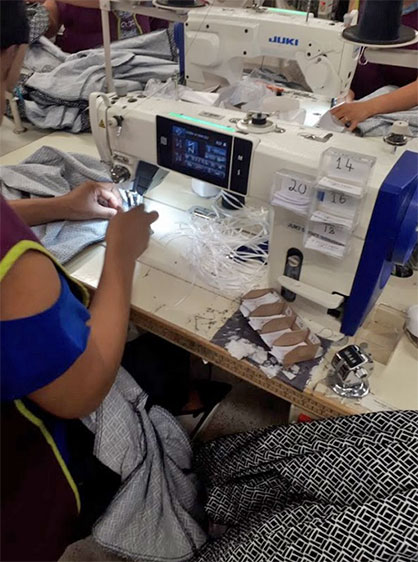
Under the guidance of Coats Digital’s GSDCost experts, the newly qualified GSDCost practitioners at TFG were taken onto the production floor to apply their newly learned skills to a selected core style.
The principle of the training was to illustrate the variability in the previous time standards used by the factory and to demonstrate how GSDCost can be used to establish accurate method standards which support improved line balancing, planning and productivity. The core style chosen for initial GSDCost analysis was a pair of skinny pants (trousers). An analysis of the 14 operations used in the production of this garment highlighted significant variances between the previous time values used for these operations, and those established using GSDCost - with the new method standardisation and associated standard minute values (SMVs).
TFG were delighted to see a productivity improvement of 12.8% in the production of this core style, as a result of the implementation of GSDCost, and is in the process of rolling out the solution across the whole business.
Kevin Meyer, Workstudy & Engineering Manager, The Foschini Group, added: “GSDCost helped us to reduce our core style SMV and increase productivity by 12.8% - which is a great achievement for us. GSDCost has enabled us to set a standard time for each operation in the manufacture of our products according to an international benchmark – giving us a clear idea of production costs.”
Transformational change with GSDCost
As a result of implementing GSDCost, TFG now adopts a “design for manufacturing” approach which supports pre-costing analysis of the styles using GSDCost’s feature libraries. TFG can now accurately calculate labour costs using scientifically derived standard minute values, eliminating any possibility of over or under costing.
Coats Digital’s GSDCost method analysis and pre-determined times solution is widely acknowledged as the de-facto international standard across the sewn products industry. The solution supports a more collaborative, transparent and sustainable supply chain, in which brands and manufacturers establish and optimise ‘International Standard Time Benchmarks’ using standard motion codes and predetermined times. This use of a common language and standards supports accurate cost prediction, fact-based negotiation, and a more efficient garment manufacturing process, while concurrently delivering on CSR commitments.
Coats Digital’s enhanced feature of a globalised fair wage tool combines the international standard time for any given style, with detailed factory efficiencies, contracted hours and the fair living wage for the country (data provided by the Fair Wage Network). This added tool enables brands and manufacturers to quickly agree the fair living wage allowance for any given garment, in any factory in the world.
Harry Champaneri, Senior Pre-Sales Consultant at Coats Digital, said: “It is fantastic news that TFG was able to realise such great results on its first application test of GSDCost. TFG now has the solution it needs to facilitate transparent, win-win negotiations with its vendors, ensure significant cost and waste reduction efficiencies and future-proof its manufacturing operations and we look forward to working closely with them to fully support their digital transformation journey.”