[pageLogInLogOut]

#Research & Development

First 3D measurement study to improve garment sizing for children

All those involved in pattern development and fit assessment of children's clothing know the problem: developing children's basic and graded patterns. Up-to-date body data helps. © Hohenstein
Garment fitting pioneer Hohenstein has conducted the first ever measurement series on babies and toddlers. The data will aid the pattern development and fit assessment that is particularly challenging for children's clothing. The new database will help brands and manufacturers design their children's clothing in an accurate, efficient and more sustainable way using fit testing and pattern optimisation.

Hohenstein has been taking body measurements for all target groups since 1957. Based on regular serial measurements taken with 3D body scans over 20 years, data is continuously updated. With the measurement of toddlers and babies, Hohenstein is now closing a large gap in the German market for the first time. 5626 girls and boys in sizes 56 to 182 were measured. 


This means that 3D scans of infants are available for the first time. The 3D body data form an indispensable basis for customer-specific measurement tables, child-friendly patterns and gradings, optimal fits as well as 3D children's avatars for the simulation of clothing.


More News from Hohenstein Institute

#Textiles & Apparel / Garment

Global size study for brands and retailers to optimize fit and market coverage

Hohenstein Apparel Fit Solutions, a global leader in apparel fit, sizing, and product development, today announces the launch of its Global Size Study, a new initiative designed to equip brands to better understand and serve their target consumers through more accurate, market-relevant sizing.

#Sustainability

A new standard to combat plastic waste in forests

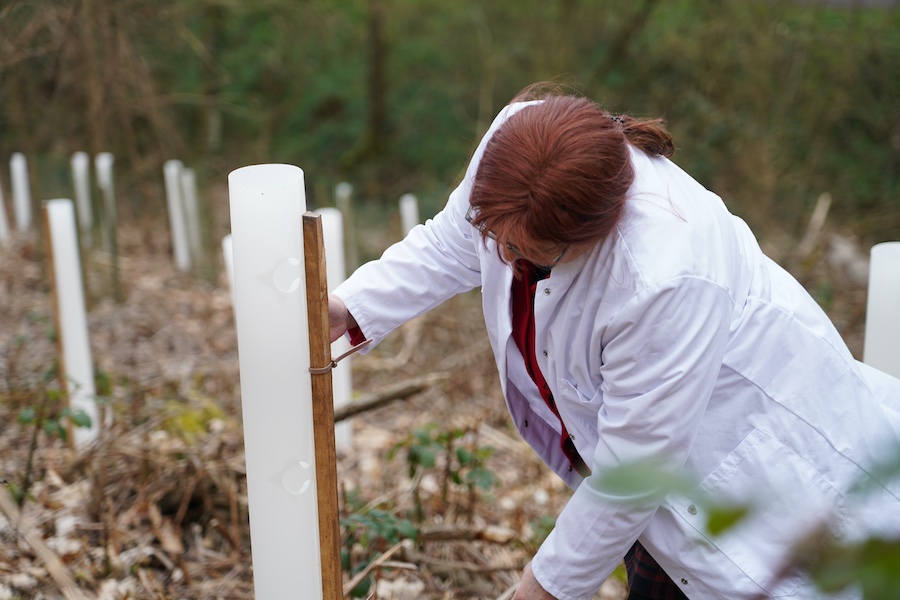
With DIN SPEC 35808 “Tree Shelter for Forestry Applications,” the testing and research service provider Hohenstein, in collaboration with Rottenburg University of Forestry, as well as forestry authorities and industry partners, has established a clear framework for bio-based and fully biodegradable tree shelters. The pre-standard defines requirements and practical testing methods designed to reduce plastic waste in forests and strengthen the long-term protection of soil and the environment.

#Research & Development

Hohenstein publishes 2025 Sustainability Report

The testing and research service provider Hohenstein has published its latest sustainability report, outlining key progress and strategic initiatives. The report focuses on ambitious CO₂ reduction targets, the company’s new mission statement and the systematic expansion of sustainable services for customers worldwide.

#Research & Development

New DIN SPEC assesses environmental impact of textile fragments in soil

Textile products made from synthetic fibres, finished fabrics or dyed materials release fibre fragments into the environment at every stage of their life cycle. With the new DIN SPEC 19296, Hohenstein has developed a standardised testing method to analyse how these fragments behave in soil under natural conditions. Until now, little was known about their environmental behaviour or potential ecological effects once released.

More News on Research & Development

#Research & Development

TCLF: Resilient value chains in times of crises

The textiles, clothing, leather and footwear (TCLF) industry was at the centre of the webinar “Resilient value chains in times of crises”, which took place on 28 April 2026. Global supply chains continue to face increasing pressure, raw material dependencies are growing and economic uncertainties are affecting the entire sector.

#Research & Development

Textile climate control system in workwear – exhibition at the 2026 SME Innovation Day!

Conventional protective workwear often reaches its limits during strenuous physical activity. In particular, the transport of sweat and excess body heat poses a problem. The German Institutes of Textile and Fiber Research (DITF) conducted research on flow-optimized, air-conducting textile structures that enable targeted climate control directly on the body. These structures can be integrated straight into protective work garments. The textile climate control system supports the body’s natural thermoregulation. This contributes to improved workplace safety and comfort.

#Research & Development

Elastic yarns to become more recyclable and environmentally friendly in future

On 29 April 2026, ITA student Tobias Dickmeiß was awarded a sponsorship prize by the Wilhelm Lorch-Stiftung for his innovative approach, to replacing conventional elastane with elastic yarns made from thermoplastic copolyester elastomers (TPC). Thanks to their thermoplastic nature and compatibility with typical polyesters used in the textile industry, elastic TPC yarns offer improved recyclability. Furthermore, the use of the melt-spinning process in yarn production eliminates the need for solvents that are harmful to the environment and human health.

#Research & Development

Walter Reiners Foundation Prize awarded to three ITA graduates

Sabina Dann, Lukas Balon and Annegret Storm from the Institut für Textiltechnik (ITA) of RWTH Aachen University were awarded the Walter Reiners Foundation Prize by the German Engineering Federation (VDMA) for their master’s and bachelor’s theses. Peter Dornier, Chairman of the Walter Reiners Foundation, presented the awards during Techtextil at the VDMA stand in Frankfurt am Main, Germany.

Latest News

#Natural Fibers

European Flax-Linen & Hemp step into advanced manufacturing: Enabling filament winding, 3D printing and high-performance composite processes

The Alliance for European Flax-Linen & Hemp announces a new wave of technological advancements demonstrating how flax-linen and hemp fibres are now being successfully integrated into advanced composite manufacturing processes. These developments mark a transition beyond traditional hand lay-up techniques, positioning natural fibres as credible, scalable solutions for high-performance industrial applications.

#ITM 2026

SETEX turns dyeing and finishing data into daily production control

At ITM 2026, SETEX will show how textile mills can use machine, recipe, quality and energy data for more reliable daily production decisions — not as another reporting layer, but as part of the running dyeing and finishing process. With OrgaTEX X3 MES, E390x/C390x controllers, CamCOUNT and FabricInspector Portable, SETEX connects planning, machine execution and fabric-related quality insight within existing mill structures.

#Technical Textiles

Fifteen years of Autoneum – From spin off to global technology leader

What started as a strategic carve‑out has since become the success story of a global technology leader in acoustic and thermal management solutions for vehicles. Headquartered in Winterthur, Switzerland, Autoneum supplies leading automobile manufacturers worldwide with innovative, lightweight and increasingly sustainable solutions.

#Textile chemistry

The CHT Group GmbH awarded Best Managed Company 2026

The CHT Group GmbH has been honored as Best Managed Company 2026. The seal of approval recognizes excellently managed medium-sized companies and is awarded as part of a program by Deloitte Private, UBS, the Frankfurter Allgemeine Zeitung, and the Federation of German Industries (BDI).

TOP