[pageLogInLogOut]

#Research & Development

Environmentally friendly and sustainable: shopping and production digitally optimized
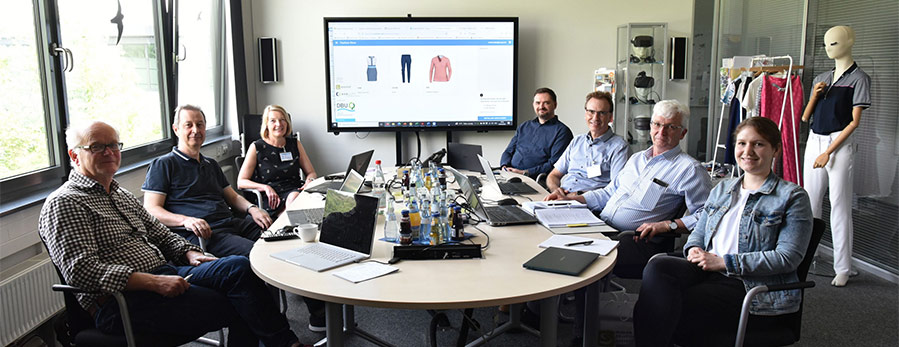
Kick-off event of the project partners at the end of June in Denkendorf (from the left: Alexander Artschwager (DITF), Dr. Jürgen Seibold (DITF), Jeanette Nordmann (Assyst GmbH), Alexander Mirosnicenko (DITF), Dr. Rainer Trieb (Human Solutions), Dr. Martin Lades (Assyst GmbH), Stefanie Hiss (DITF) Photo. DITF
The designer has an idea, the customer, consumer or retailer, checks it out and changes one or two details to suit his or her taste. Then garments are produced in small batches or tailored to the body thanks to modern body measurement. Digital technology ensures that the wishes are met, everything fits and everything looks as expected. Returns? That was yesterday.

Digitized processes not only satisfy the customer, but also protect the environment. That's why the Deutsche Bundesstiftung Umwelt (German Federal Environmental Foundation) is funding the research cooperation between the German Institutes of Textile and Fiber Research Denkendorf (DITF) and Assyst GmbH. The keyword here is the shifting back of value-added processes. Result: no mass-produced goods for the garbage, no child labor, high ecological standards and low transport costs.


"Every body is individual" emphasizes Dr. Martin Lades, Assyst GmbH. The ECO-Shoring project takes this into account. The creation of an avatar, i.e. the model of one's own body, is the basis. There are also serial measurements in different regions of the world. In the project, processes and the database of Avalution GmbH allow that the customer only has to enter a few body parameters to get an accurate fit. With the body height, weight and age, the program can create a true-to-life body double - the trying-on on the computer can begin. The model is primarily suitable for online shopping, but in principle the customer can also be measured and advised directly in the store.

More News from TEXDATA International

#Recycling / Circular Economy

textile.4U publishes special edition “Top 100 Textile Recycling Companies 2025”

With a comprehensive 176-page special edition, textile.4U is dedicating its latest issue entirely to one of the most dynamic and influential topics in today’s textile industry: textile recycling. The new issue, published exclusively in high-quality print, presents the Top 100 textile recycling companies researched and selected by TexData – organizations that already play a key role in the transition to circular textiles or are expected to have a significant impact in the near future.

#Recycling / Circular Economy

Responsible Textile Recovery Act of 2024 signed by Governor

Senator Josh Newman (D-Fullerton) is proud to announce that Senate Bill 707 (SB 707), the Responsible Textile Recovery Act of 2024, has been signed into law by the Governor of California, Gavin Newsom. This groundbreaking legislation establishes the country’s first Extended Producer Responsibility (EPR) textile recycling program, marking a significant step forward in the state’s efforts to combat waste and promote sustainability.

#Textiles & Apparel / Garment

Modtissimo promotes sustainability with 28 coordinates in the Green Circle

Modtissimo is proving more and more to be a textile and clothing show that delivers the latest innovations in the area of sustainability, with the iTechStyle Green Circle being the main showcase for companies' creations. In this 60+4 edition, taking place on 12 and 13 September, 28 coordinates will be exhibited in a section organised by CITEVE and curated by Paulo Gomes.

#Europe

The EU and Egypt team up to mobilise private sector investments at Investment Conference and sign a Memorandum of Understanding underpinning €1 billion in macro-financial assistance for Egypt

At the EU-Egypt Investment Conference, co-organised by the EU and the Government of Egypt on 29-30 June, the EU and Egypt are teaming up to intensify private sector investments in Egypt. They are also signing a Memorandum of Understanding (MoU) for the disbursement to Egypt of up to €1 billion in Macro-Financial Assistance.

More News on Research & Development

#Research & Development

Pellet press enables thermomechanical textile recycling on a pilot scale at ITA

Since the end of 2025, the technical centre of the Institut für Textiltechnik (ITA) of RWTH Aachen University has been equipped with a pellet press from the manufacturer Amandus Kahl GmbH & Co. KG, Reinbek, Germany. This press can efficiently compact shredded synthetic textiles at a throughput of up to 25 kg/h and process them into pellets with a diameter of 4 mm.

#Composites

STFI at JEC

The Sächsisches Textilforschungsinstitut e.V. (STFI) will present composites for aviation made from recycled carbon fibres and natural fibres, as well as printed lightweight elements for surface heating in electric vehicles at JEC World in Paris.

#Research & Development

Fabolose: Fabricating vegan and circular leather alternatives from bio-tech-derived cellulose

Fabulose is an EU funded project coordinated by the German Institutes of Textile and Fiber Research (DITF). Its consortium consists of leading research institutes, biotech innovators, and industry stakeholders who aim to create high-performance, biobased and recyclable leather-like fabrics, using efficient biotech production routes for bacterial cellulose, cyanophycin and bacterial pigments

#Research & Development

New DIN SPEC assesses environmental impact of textile fragments in soil

Textile products made from synthetic fibres, finished fabrics or dyed materials release fibre fragments into the environment at every stage of their life cycle. With the new DIN SPEC 19296, Hohenstein has developed a standardised testing method to analyse how these fragments behave in soil under natural conditions. Until now, little was known about their environmental behaviour or potential ecological effects once released.

Latest News

#Techtextil 2026

Monforts to showcase advanced coating solutions at Techtextil 2026

Over the past few years Monforts has significantly advanced its technologies for coating, with the successive introductions of the MontexCoat, coaTTex and VertiDry systems combining flexibility, precision and energy efficiency for the technical textiles market.

#Composites

JEC World 2026 returns with an unprecedented content program

Recognized worldwide as the leading trade exhibition for composite materials and their applications, JEC World returns on March 10-12, 2026, at Paris Nord Villepinte as the most ambitious edition to date, in line with its motto “Pushing the limits”. As the must-attend event for the composites industry, JEC World will offer an unprecedented program, blending conferences, markets insights, technical sessions, awards, and above all, a unique experience and invaluable connections.

#Raw Materials

Beyond the wardrobe – innovative cotton takes the spotlight

Cotton can do more – a lot more. Cutting-edge textiles and high-tech products made from 100% cotton prove just how powerfully performance and sustainability can come together. That very surge of innovation is front and centre at the 38th Bremen Cotton Conference, taking place March 25–27, 2026, at Bremen’s Parliament on the historic market square – culminating in a bold and dedicated closing session on Friday. In the spotlight: performance upgrades for pure cotton, smart strategies for circular textile waste solutions, and pioneering concepts for demanding technical applications. From natural fibre–reinforced composites to highly effective flame-retardant solutions, cotton steps out of the closet and shows the future potential woven into every fibre.

#Digital Printing

Keeping print inclusive: Empowering women in the print industry

Across all industries, cultivating a diverse and inclusive workplace is increasingly recognised as valuable and essential to long-term success. However, despite the print industry’s significant advancements in technology and innovation, visible representation of women remains limited. As the sector grapples with low recruitment, it’s important to challenge outdated perceptions. Creating real change, however, requires collective effort - no single company can do it alone.

TOP