[pageLogInLogOut]

#Research & Development

Cut-resistant ski undergarment protects against sharp edges

Ski underwear is an important part of the equipment. It can protect against dangerous cuts. Photo: Oleksandr Pyrohov on Pixabay
When we currently see spectacular accidents in alpine competitions, we primarily think of leg and ligament injuries, but there seems also to be an increasing risk of cut injuries from the razor-sharp ski edges. Cut injuries are often severe and can in worst cases even be life threatening. The German Institutes of Textile and Fiber Research Denkendorf (DITF) carry out cutting tests on materials for the textile manufacturers and FIS, the International Ski Federation. Cut-resistant protection undergarment is awarded with a FIS label if the minimum recommended protection level is achieved.

FIS, textile manufacturers and the textile research center together have developed the FIS-DITF recommended minimum standard for the cut resistance of ski protection undergarment. The right undergarment improves the protection of athletes from severe cut injuries. To determine whether the undergarment meets the test specifications, the cut resistance of the material is rated using a 5-star scale.
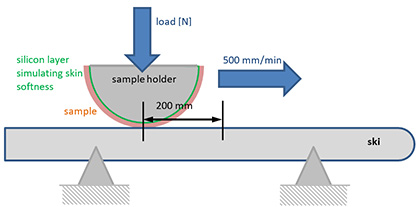
Principle of the cut test with underwear (sample) and the ski. Figure: DITF


The scientists at the DITF check the compressive force at which the ski undergarment is cut through with a freshly and relevant grinded ski edge. The fabric has to withstand a minimum 20 centimeter cutting length at an angle of 0, 45 and 90 degrees. The test simulates a cut on an arm or leg with a compressive force of up to 500 N (50 kilograms).

The cutting speed is also precisely defined. For comparable data, the same type of ski is used for each test, the edges of which are always grinded in exactly the same way. "That was a big challenge in development," emphasizes Thomas Stegmaier, head of the Competence Center for Textile Chemistry, Environment and Energy at the DITF.


The star system, on the other hand, is easy to explain: If the undergarment withstands 100 N (10 kilograms) of pressure, it reaches the minimum level of 1 star. For every additional 100 N an additional level and star is reached. Up to 5 stars / levels are possible.

FIS label for cut-resistant underwear with one star. Photo: FIS


Ski undergarment with the FIS-DITF label not only offers more safety for professional athletes on Olympic slopes, even recreational skiers can benefit from the tested protection garment.
More News from Deutsche Institute für Textil- und Faserforschung Denkendorf

#Research & Development

Panty liners prevent bacterial vaginosis

Worldwide, almost one third of women of childbearing age suffer from bacterial vaginosis. This is when the sensitive microbiome of the vagina becomes unbalanced. Such a disorder of the vaginal flora can cause urogenital infections, abscesses on the ovaries or fallopian tubes or premature births. This significantly increases the risk of infertility in women and of contracting a sexually transmitted disease or HIV.

#Research & Development

DITF send a signal for climate protection

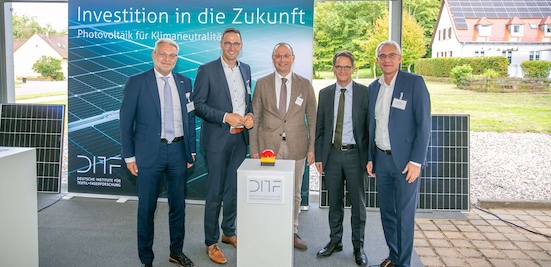
The German Institutes of Textile and Fiber Research Denkendorf (DITF) have successfully implemented extensive investments in photovoltaic systems at their site in Denkendorf. The systems installed on the roofs of the buildings and covered parking lots have a total installed capacity of 840 kilowatt peak (kWp). The DITF invested 1.6 million euros in this with the support of the state of Baden-Württemberg. The system was ceremonially put into operation on September 17, 2025.

#Research & Development

4.2 million Euros for research into textile recycling

Around the world, used textiles are still rarely recycled and pile up into huge mountains of waste. A recent study by the Boston Consulting Group (BCG) drew attention to this problem. However, the low recycling rate is also due to the fact that only a small percentage of used textiles are actually suitable for recycling into high-quality materials and for demanding applications. The German Institutes of Textile and Fiber Research Denkendorf (DITF) are addressing this problem with their research.

#Research & Development

Denkendorf fiber chart revised

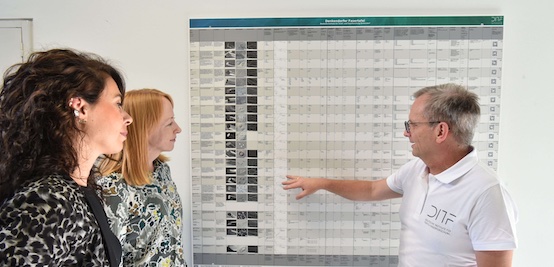
A companion during studies and for practical use in the workplace: generations of textile experts have used the Denkendorf Fiber Chart to keep track of all the important characteristic values of textile raw materials. Following the first two editions in the 1970s and 1980s, Denkendorf scientists have comprehensively revised the Fiber Chart. The third edition is now available in digital form for the first time.

More News on Research & Development

#Research & Development

Fraunhofer CCPE presents the “Monomaterial Design Set” – Innovative solutions for circular product design

Composite materials made from different types of plastic often extend the lifetime of products but make recycling more difficult in the circular economy. That is why Fraunhofer CCPE has developed the “Monomaterial Design Set”. This new approach helps to reduce the variety of plastics used in durable products and offers circular solutions for designers and product developers.

#Research & Development

How innovations drive BASF’s success

“Innovation has always been part of BASF’s DNA. Especially in these volatile times, it is crucial to leverage our innovative strength to develop competitive solutions that differentiate us as a company in our markets and give us a competitive edge,” said Dr. Stephan Kothrade, Member of the Board of Executive Directors of BASF and Chief Technology Officer, at the company’s Research Press Briefing held today. To achieve this, BASF implemented its “Winning Ways” strategy about a year ago with the clear goal of becoming the preferred chemical company to enable its customers’ green transformation.

#Research & Development

Small tolerances, big impact and a recyclable alternative to elastane

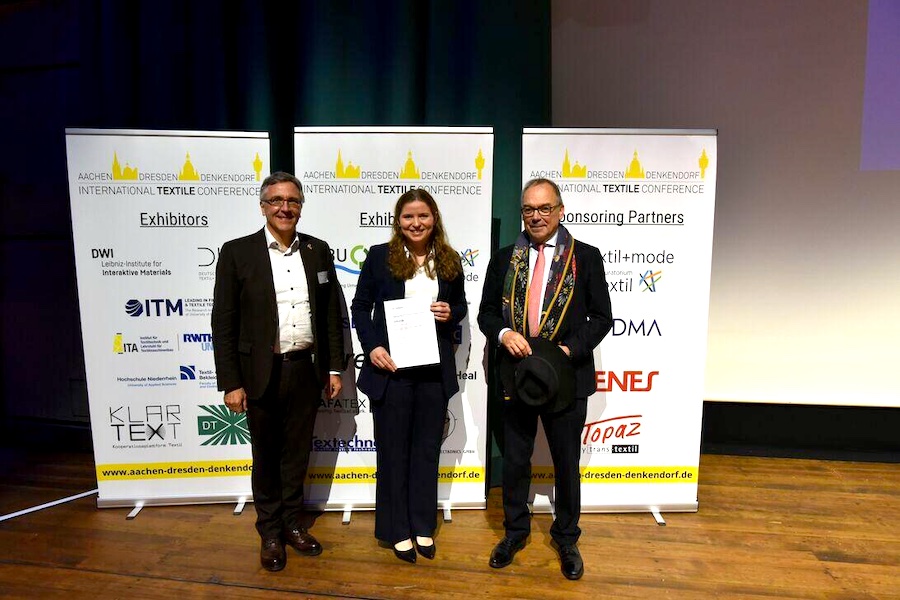
ITA Master's student Janne Warnecke investigated tension differences over the fabric width in the weaving process and thereby contributed to quality assurance; ITA Bachelor's student Jasmin Roos found a basis for the development of recyclable yarns and textiles. For these developments, they were awarded the Walter Reiners Foundation's Promotion and Sustainability Prizes on 27 November. Peter D. Dornier, Chairman of the Walter Reiners Foundation, presented the awards at the Aachen-Dresden-Denkendorf International Textile Conference (ADD-ITC) in Aachen, Germany.

#Associations

Young researchers recognised for cutting-edge work in recycling, fibre technology and textile mechanics

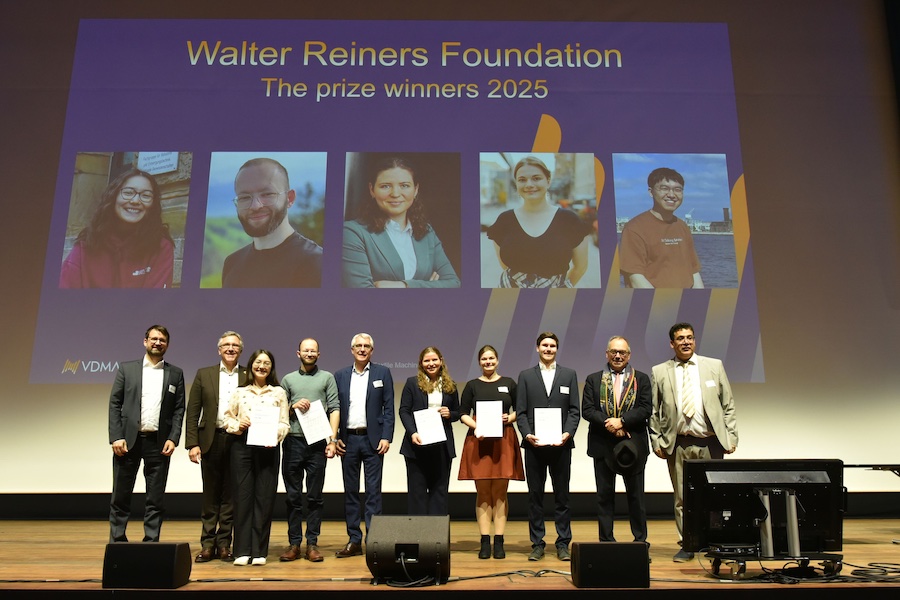
At the Aachen-Dresden-Denkendorf International Textile Conference held in Aachen at the end of November, Peter D. Dornier, Chairman of the Walter Reiners Foundation of the VDMA, honoured five successful young engineers. Promotion and sustainability prizes were awarded in the categories bachelor/project theses and diploma/master theses. Academic theses that develop solutions for resource-saving products and technologies, for example, are eligible for the sustainability awards.

Latest News

#Spinning

First PA66 spinning plant with EvoQuench successfully commissioned

With the successful commissioning of a multi-digit PA66 spinning line for microfiber yarns, Chinese textile company Shandong Nanshan Fashion Technology Co., Ltd. has added yarn production to its textile value chain.

#Knitting & Hosiery

SHIMA SEIKI returns to ShanghaiTex

Leading flat knitting solutions provider SHIMA SEIKI MFG., LTD. of Wakayama, Japan, together with its Hong Kong and Chinese market subsidiary SHIMA SEIKI (HONG KONG) LTD., will exhibit at the ShanghaiTex 2025 exhibition (Booth No.: Hall N3, Booth A20) held in Shanghai, China this month. This marks the return of SHIMA SEIKI to ShanghaiTex after a 14-year hiatus, its last exhibit at the show having been in 2011.

#Man-Made Fibers

arena introduces renewable LYCRA® EcoMade fiber in its latest swimwear collection

Italian swimwear specialist arena has unveiled a new collection that brings sustainability and performance even closer together. Launched on December 4, the line features swimsuits made from recycled nylon and renewable LYCRA® EcoMade fiber — the first time the bio-based spandex has been used commercially in swimwear.

#Spinning

Saurer Technologies Twisting Solutions at ICFE 2026

Saurer Technologies Twisting Solutions, a global leader in textile machinery innovation, will be present at the International Carpet and Flooring Expo ICFE 2026. Join us January 6–9 at the Istanbul Expo Center, Türkiye, as industry leaders, manufacturers, and innovators gather to explore the latest breakthroughs in carpet and flooring technology. Let’s meet at the new established global Center of the Carpet Sector in hall 3, booth 300!

TOP