[pageLogInLogOut]

#Research & Development

International Sustainable Aviation and Energy Society Award awarded to Professor Thomas Gries
© ITA
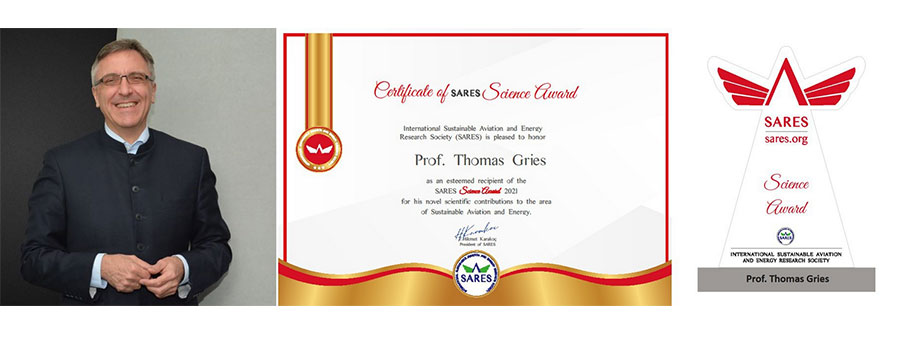
On 27 November 2021, the Scientific Award for International Sustainable Aviation and Energy Society (SARES Award) was awarded to Professor Dr Thomas Gries from the Institut für Textiltechnik of RWTH Aachen University. The award ceremony took place during the closing ceremony of the International Symposium on Sustainable Aviation (ISSA) in a hybrid format online and simultaneously at Kasetsart University, Bangkok, Thailand.

With the award, the committee recognised the ongoing contribution of Pro-fessor Gries and the Institut für Textiltechnik to the digitisation and bio-transformation of the textile sector, as well as the Institute as a place of innovation for sustainable aviation.

Examples of this include the development of 3D braided ceramic matrix composite components for aircraft engines, which were researched together with partners in a Horizon 2020 project (EU project AllOxITD). The ongoing Chrysomallos research project as another example, funded under the national aeronautics research programme in Germany, aims to develop a completely new and sustainable high-performance insulator for aircraft cabins based on aerogels. These have a significantly lower weight than the glass fibre mats used up to now, while providing the same insulation performance, and solve the problem of the previously high manufacturing costs of aerogels. The aim of the project is to develop an insulation material with reduced density (reduction of more than 20 percent). To this end, a new type of insulation material based on aerogel is to be developed. The basis is an aerogel fleece (0.06 W/mK at 28 kg/m³), which has already been developed as part of a dissertation at the Institut für Textiltechnik of RWTH Aachen University (Mroszczok, J.: 2019).


The aviation industry is one of the fastest growing industries in the world. Due to this fact and its importance for society and the global economy, it needs to make special efforts towards sustainability. The ISSA, an international multi-disciplinary symposium, aims to address current issues in aviation such as improving aircraft fuel efficiency, promoting the use of biofuels, minimising environmental impact, mitigating greenhouse gas emissions and reducing engine and aircraft noise.

Through the award, SARES honours scientists and researchers whose work on sustainable aviation issues has made an important contribution at the international level. The selection is based on the scientific publications of the applicant or nominee, the h-index, i.e. the key figure for the worldwide perception of a scientist in professional circles, the project topics and the project results.


More News from Institut für Textiltechnik of RWTH Aachen University (ITA)

#Research & Development

Solid Air Dynamics wins second place at RWTH Innovation Award

On 30 January, RWTH spin-off Solid Air Dynamics was awarded second place in the RWTH Innovation Awards for its research in the field of aerogel fibres. Manufactured from renewable raw materials, aerogel fibres offer outstanding thermal insulation, are extremely lightweight and completely biodegradable, and can consist of over 90 per cent air.

#Research & Development

Award-winning research for sustainable carbon fibre cycles

Sustainable recycling of carbon fibres is possible through targeted electrochemical surface modification, which makes the sizing of carbon fibres resistant to solvolysis. ITA PhD student Sabina Dann was awarded the MSW Award from RWTH Aachen University for her master's thesis on this development. The award ceremony took place on 12 November 2025 in Aachen.

#Research & Development

Kick-off for the Textile Production of the Future: Establishment of a Textile Technology and Development Centre in Mönchengladbach, Germany

The Institut für Textiltechnik (ITA) of RWTH Aachen University, together with its partners, is pleased to announce that it has received approval for its joint initiative, ‘Textile Factory 7.0’. The goal of the project is the establishment of a technology and development centre for the textile industry in Mönchengladbach.

#Research & Development

Exchange data between textile companies openly, securely and cost-effectively without a central platform – ITA makes it possible

The Institut für Textiltechnik (ITA) of RWTH Aachen University has launched a new demonstrator for an open and secure data space in the textile industry at the Digital Innovation Centre Europe (DICE). For the first time, the demonstrator shows directly and clearly how companies can share their data securely with each other without the need for a central platform. Data exchange is based on shared, freely usable technical foundations.

More News on Research & Development

#Research & Development

New DIN SPEC assesses environmental impact of textile fragments in soil

Textile products made from synthetic fibres, finished fabrics or dyed materials release fibre fragments into the environment at every stage of their life cycle. With the new DIN SPEC 19296, Hohenstein has developed a standardised testing method to analyse how these fragments behave in soil under natural conditions. Until now, little was known about their environmental behaviour or potential ecological effects once released.

#Research & Development

Testing and research laboratory ensures safe and more sustainable products worldwide

For 80 years, Hohenstein has stood for independent testing, scientific expertise and practical solutions. Today, the testing and research service provider supports manufacturers and brands worldwide in making textiles, hardlines and medical devices safe, more sustainable and market-ready – thereby building trust among consumers. With an international presence and interdisciplinary expertise, Hohenstein supports its customers from production through to market launch, helping them navigate an environment of growing regulatory and societal demands.

#Research & Development

Bio-based fibers with good flame retardancy

Fibers made from bio-based plastics reduce dependence on fossil raw materials and promote the circular economy. The covalent bonding of flame-retardant additives can open the way for these fibers to enter the mass market.

#Research & Development

Sustainable athletic wear made from bio-based Polyethylene

Conventional sports textiles made from petroleum-based synthetic fibres are to be replaced in the future by sustainable, bio-based, cooling textiles. Polyethylene, previously used mainly in the packaging industry, is thus qualified for use in textiles and, as a bio-based drop-in solution, offers a cost-effective, sustainable alternative for the future.

Latest News

#Sustainability

Ying McGuire becomes new CEO of Cascale

Cascale today announced the appointment of Ying McGuire as Chief Executive Officer, effective June 1, 2026.

#Technical Textiles

Sustainable, lightweight, and sound absorbing: Polyester-based front trunk solution for BEVs

As car manufacturers look to further reduce their carbon footprint, Autoneum has developed an innovative front trunk solution for battery electric vehicles (BEVs), made entirely from polyester-based textile. The Ultra-Silent Frunk offers significant weight reduction, improved acoustic and thermal insulation, and uses up to 70 percent recycled material, supporting sustainable and efficient vehicle design. Autoneum, global technology leader in acoustic and thermal management for vehicles, has already received orders for the new frunk from three major OEMs in Asia and Europe to be built in three BEV models. Series production for two BEVs has been underway in China and Germany since last year.

#Raw Materials

Modern testing methods for raw cotton

The 38th International Cotton Conference Bremen will take place from 25 to 27 March 2026 at the Bremen Parliament. This conference has traditionally stood for in-depth expertise and international exchange. The program will focus on technical innovations, market trends, and regulatory frameworks across the entire value chain – from agriculture to the circular economy. With high-profile speakers, the conference is regarded as the key meeting point for the global cotton industry. Today’s focus: Cotton quality and testing methods.

#Spinning

Rieter responds to higher raw material prices

Global political and economic developments have been leading to rising raw material and energy costs for some time. The textile machinery industry is also affected by this trend. Rieter machines and components consist to a large extent of steel, copper, aluminum and electronics. These materials in particular have seen higher demand and higher prices in recent months.

TOP