[pageLogInLogOut]

#Spinning

TC 30i and IDF 3: Dream Team for direct spinning
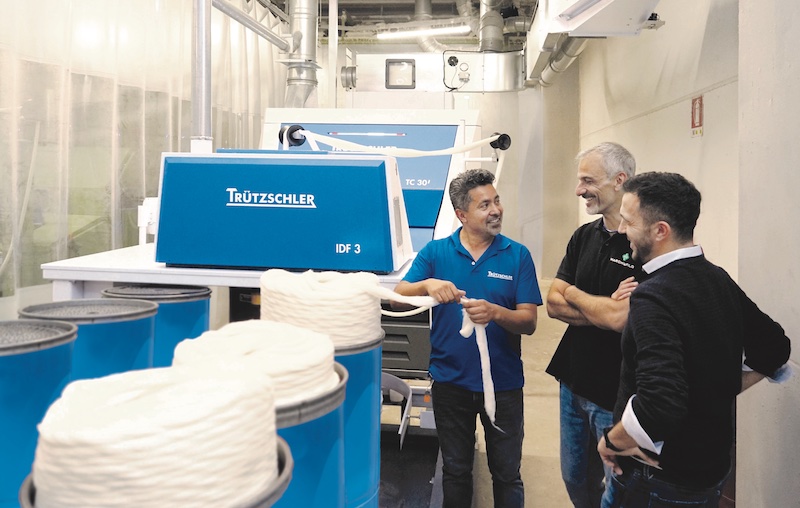
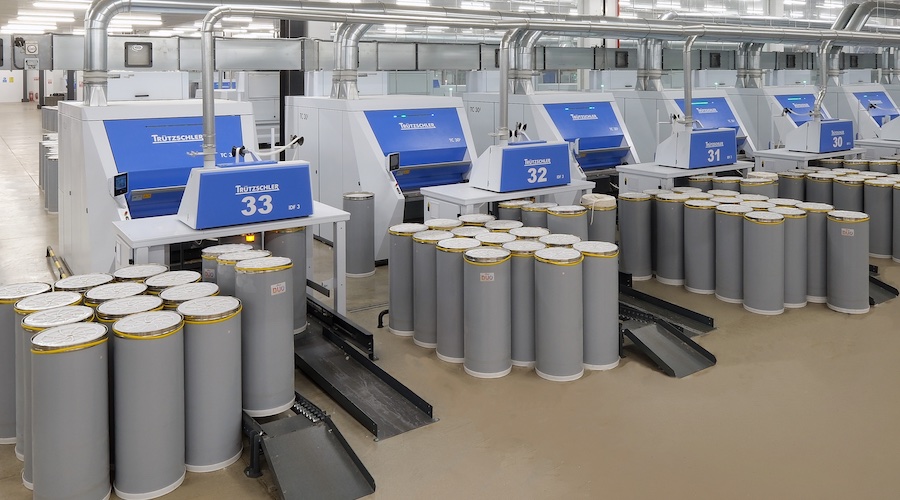
The first installations of the Trützschler Card TC 30i and the Trützschler Integrated Draw Frame IDF 3 are now complete – and the first customers have finished rigorous testing in direct spinning applications. The IDF 3 is achieving strong results in real-world conditions. And customers are very pleased with its easy handling and high-speed spinning.
The DreamTeam for direct spinning © 2024 Trützschler


The Italian company Marchi & Fildi, headquartered in Biella, was one of the first to test the new IDF 3. The company specializes in producing pure and blended yarns made from natural or man-made fibers for flat knitting, circular knitting and weaving. Its products are used for fashion, furnishings and technical applications worldwide. It also places a strong focus on reducing its environmental impact.

Marchi & Fildi is a pioneer in innovative and sustainable yarns made from recycled materials, with deep expertise in mechanical recycling. Guido Marchetto, Production Supervisor, reports with enthusiasm: "We are very pleased with the new IDF 3. It increases our efficiency and provides higher yarn quality. The ease of operation simplifies the production process. We look forward to the benefits that the IDF 3 will bring to our business in the future". Marchi & Fildi’s first trials were carried out with different fiber blends. This included a blend of 70 % soft waste cotton and 30 % polyester as the raw material for rotor direct spinning, with a yarn count in a range of Ne 8 to Ne 12 and Ne 30.
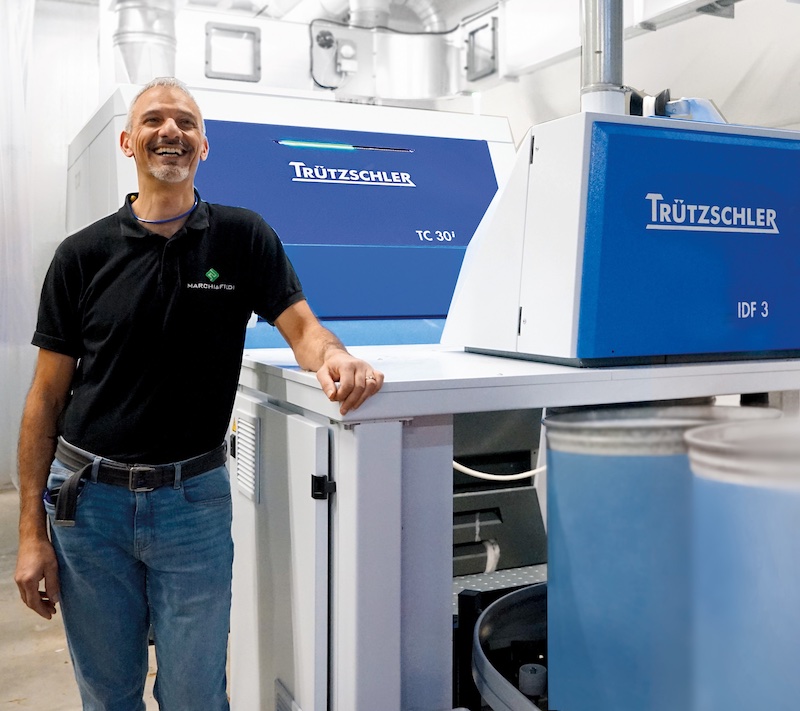
Guido Marchetto from Marchi & Fildi © 2024 Trützschler


Remarkable recycling results

Later tests involved fiber blends of 50 % PET and 50 % recycled cotton from hard textile waste for rotor direct spinning with a yarn count of Ne 30. Experts at Marchi & Fildi stated that this material blend is typically very challenging. Processing secondary fibers made from hard textile waste requires very high competence in yarn production, which Marchi & Fildi impressively demonstrates. It also requires advanced technologies. This is due to technological challenges such as significantly lower fiber length. Trützschler’s IDF technology has a special drafting zone geometry that ensures reliable fiber guidance and controls floating fibers. It generates lower drafts than a conventional draw frame passage and avoids the risk of false drafts and count variations.

Decades of experience with the IDF technology have demonstrated that the higher the short fiber content, the better the result with IDF compared to conventional two draw frame passages. In combination with the TC 30Ri, a variant of TC 30i that has been specifically equipped and configured for processing recycled fibers, the IDF 3 delivers maximum possible quality for the production of sustainable yarns.

Marchi & Fildi confirmed that combining the TC 30Ri and IDF 3 went beyond their expectations due to the unique possibility of optimizing the process parameters. The TC 30Ri delivers the material at a higher speed and the IDF 3 keeps up with this speed to produce very good sliver evenness – even during the can change. Better sliver quality results in very good yarn parameters that exceed the mill standard.

Overall, the company’s results showed a 75 % increase in productivity over the previous card model and a 14 % reduction in energy consumption at higher production rates. Combining the TC 30Ri and IDF 3 also enabled Marchi & Fildi to skip the drawing stage from its process, which boosts quality while saving resources and cutting costs.

“We have collaborated with Trützschler for many years because its machines offer excellent performance for processing recycled yarns,” says Guido Marchetto. “The machines are easy to set up and adapt for our specific needs. And we can always rely on the effective service support from Trützschler too.”

In conclusion, it’s no surprise that Trützschler’s IDF technology is getting more and more popular across markets worldwide. It makes it possible to significantly shorten the spinning preparation process without compromising on quality. In fact, IDF technology helps to improve quality levels when processing raw materials with a high short fiber content. It also enables shortened processes that save resources, energy and production space. When used together, the TC 30i and the IDF 3 help customers reach the full potential of the direct spinning process.
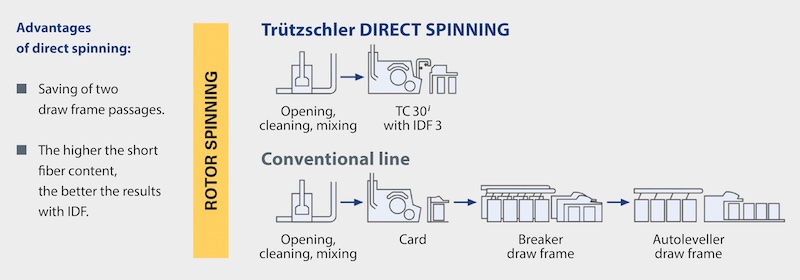
Diagram for Trützschler direct spinning © 2024 Trützschler


Benefits of the IDF 3:

• Higher yarn quality and homogenous slivers through advanced measuring devices.

• Increased efficiency by 3 % through new can changing principle that minimizes can change times.

• Easy accessibility for optimal machine handling.


More News from Truetzschler GmbH & Co. KG

#Spinning

Perfect quality through collaboration: Machinery from Trützschler, Toyota and Murata at Zirve Tekstil

In today’s textile industry, excellence is not achieved by chance – it’s the result of deliberate decisions, technical expertise, and the courage to go beyond conventional paths. The Turkish company Zirve Tekstil has done just that: by combining the best technologies from Trützschler, Toyota and Murata, they’ve created a production setup that delivers outstanding yarn quality – recognized worldwide.

#Spinning

Details matter: How Trützschler cylinder wires boost efficiency in Pakistan’s spinning sector

Pakistan’s textile industry, especially its spinning sector, is the backbone of the national economy and a vibrant hub of innovation. Today’s spinning mills face growing demands for efficiency, quality, and sustainability. From the serene northern valleys to the vibrant port city of Karachi in the south, mills like Suraj Cotton Mills, Liberty, and Nishat Chunian are turning to advanced solutions.

#ITMA Asia + CITME Singapore 2025

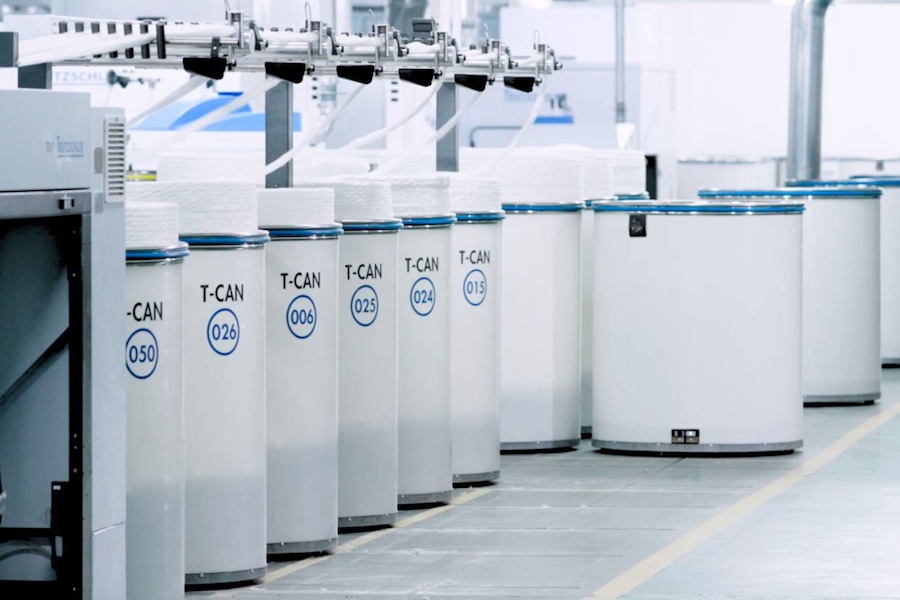
T-CAN – Revolutionizing can transport

In virtually all spinning mills, transporting sliver cans is still done manually. Rising labor costs, lack of operators and increasing quality requirements make this a growing challenge. With T-CAN, Trützschler introduces a practical solution: a fully automated can transport system that will be presented live at ITMA ASIA 2025 in Singapore.

#Spinning

Pre-Cleaner CL-X: The future of cotton cleaning

What if the future of cotton cleaning was already here – setting a new standard for cleaning efficiency, productivity and energy savings? That future has a name: CL-X. Since its market launch in 2022, the Pre-Cleaner CL-X has become a true bestseller, proving its value in several hundred customer applications worldwide. Now, new results from Türkiye demonstrate again how the Pre-Cleaner CL-X outperforms the competition.

More News on Spinning

Latest News

#Knitting & Hosiery

The new RE 6 EL from KARL MAYER shows what it can do

KARL MAYER’s new RE 6 EL from KARL MAYER brings a breath of fresh air to raschel fabric production. The latest samples from the textile product development department of this innovative textile machine manufacturer demonstrate the extensive design possibilities on offer.

#Research & Development

Testing and research laboratory ensures safe and more sustainable products worldwide

For 80 years, Hohenstein has stood for independent testing, scientific expertise and practical solutions. Today, the testing and research service provider supports manufacturers and brands worldwide in making textiles, hardlines and medical devices safe, more sustainable and market-ready – thereby building trust among consumers. With an international presence and interdisciplinary expertise, Hohenstein supports its customers from production through to market launch, helping them navigate an environment of growing regulatory and societal demands.

#Associations

Engineering depth and diversity for composites

Airbond is the latest member of the British Textile Machinery Association (BTMA) to receive recognition for contributions to the composites industry. The engineering firm based in Pontypool, South Wales, has just received the Make UK Energy and Sustainability Award for its Lattice 3D Printing project.

#Research & Development

Award-winning research for sustainable carbon fibre cycles

Sustainable recycling of carbon fibres is possible through targeted electrochemical surface modification, which makes the sizing of carbon fibres resistant to solvolysis. ITA PhD student Sabina Dann was awarded the MSW Award from RWTH Aachen University for her master's thesis on this development. The award ceremony took place on 12 November 2025 in Aachen.

TOP