#Recycling / Circular Economy
Sorting for circularity India toolkit launched: Pioneering partnership sets India on path to next-gen textiles leadership
“The Sorting for Circularity India toolkit is a milestone in our journey towards a waste-free world. We have mapped the textile waste landscape, unpacking the huge potential, as well as the roadblocks and commercial opportunities in India’s textile waste industry. We are excited to move beyond rhetoric with this powerful coalition of partners and translate our findings into a roadmap for concrete actions.” — Katrin Ley, Managing Director, Fashion for Good
THE JOURNEY THUS FAR
In 2021, Fashion for Good launched the Sorting for Circularity India Project to organise the Indian textile waste market in a three-phase approach so as to streamline, strengthen and foster the Indian textile waste market to drive the transition to a more circular economy that recaptures value to its maximum potential.
The project brought together various industry players including Fashion for Good partners adidas, Levi Strauss & Co., PVH Corp., Target, Arvind Limited, Birla Cellulose, and Welspun India, as well as Fashion for Good innovators Reverse Resources, PICVISA, and Matoha; H&M, Primark, and TESCO also joined as external partners. The project is supported through catalytic funding provided by Laudes Foundation and IDH, and knowledge support from Canopy and Circle Economy Foundation.
Drawing upon the invaluable insights gained throughout the project, Fashion for Good unveils a toolkit designed to harness the untapped potential of textile waste in India. Together, these resources provide valuable insights, assessments, and practical guidance to advance recycling in India's textile industry.
This incredibly strategic collaboration between three of our partners will be a game-changer in that it brings together three critical ingredients needed to scale the adoption of next-generation fashion materials globally – textile waste as the feedstock, the market in terms of brand commitments, and sizable investments. All of which India is abundant in, making the region ripe with potential.” — Anita Chester, Managing Director, Laudes India
INDIA’S POST-CONSUMER TEXTILE WASTE LANDSCAPE
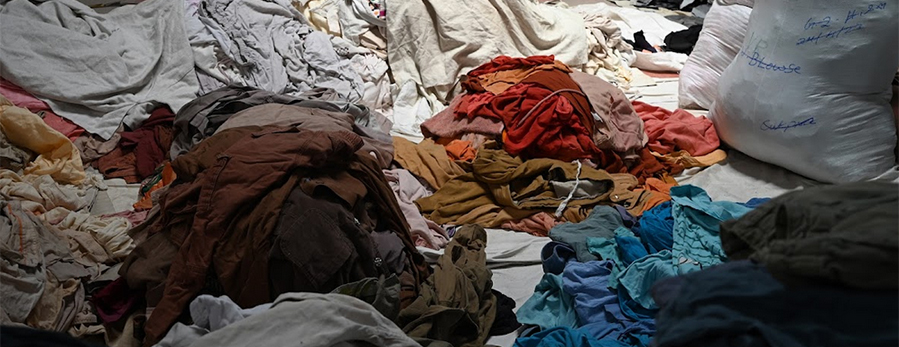
According to Fashion for Good’s Wealth in Waste report, every year, 1,720 KTons of 100% cotton post-consumer domestic (PCD) textile waste remains unvalorised in India due to the lack of proper collection and sorting systems. With the upcoming surge of legislation on textile waste management, the value of post-consumer waste is expected to rise, making it crucial for India to focus on PCD waste and develop the necessary infrastructure for collection, sorting, and pre-processing.
In the context of the Sorting for Circularity India Project Post-consumer Pilot Program, several pilots were carried out with Fashion for Good innovators Matoha, PICVISA, and Reverse Resources, as well as Greenworms, Saahas Zero Waste, Uptext, and Hasiru Dala Innovations as the sorters, and Arvind Ltd., Usha Yarns, Vardhman Textile Ltd., Kakkar Spinning Mills, and Kay Gee Enterprises as the recyclers. In parallel, the commercial viability of sorting hubs using these sorting technologies was assessed by Sattva and Circle Economy Foundation.
The pilot worked with 33 tons of textile waste, exploring innovative sorting technologies, the nuances of post-consumer waste, and the potential for a closed-loop system in India’s textile industry. The business case assessment, on the other hand, explored the infrastructure and investment requirements, the scenarios of financial success and the roadblocks, serving as a framework to enable well-informed decision-making for sorting hubs to implement these technologies.
“IDH is happy to have supported the Sorting for Circularity India project, which aligns with our aspirations to unlock opportunities within India's textile waste landscape. This initiative has provided the foundation for the Re-START Alliance, marking a significant milestone in collaborative endeavours. We recognise the gap between pilots and scaling, and believe that unified strength and pre-competitive collaboration pave the way for scalable solutions.” — Jagjeet Singh Kandal, Country Director, IDH India
A ROADMAP TOWARDS CIRCULARITY
The “Reimagining Textile Waste” conference, which will take place on 1 and 2 December in New Delhi, India, is a significant event that will bring together the key stakeholders of the new textile ecosystem, as well as international innovators who look towards India as a pioneering recycling destination.
The conference will serve to share the toolkit and learnings, as well as formally announce the creation of Re-START Alliance (Recover by Sourcing, Tracing, and Advancing Recycling Technologies), a textile recovery alliance established by Fashion for Good, Laudes Foundation, IDH and Canopy. The alliance aims to take the learnings from the project to scale by developing a formal textile waste supply chain, systems, infrastructure, stronger policy intervention, and industry appetite to enable technology commercialisation. The alliance will officially launch in Q1 2024.
"India is very well positioned to become a global leader in low-carbon Next Gen textile production. Canopy is thrilled to be part of this new collaboration to help India realize that potential," said Canopy Executive Director, Nicole Rycroft "With India’s abundance of textile waste, innovative industry leaders, and the collective buying power of our global network of brands, together we can transform unsustainable supply chains, reduce emissions, and create economic opportunities across India.”