[pageLogInLogOut]

#Recycling / Circular Economy

Borealis showcases a new PP monomaterial pouch that is fully compatible for mechanical recycling of Polypropylene at prse 2023
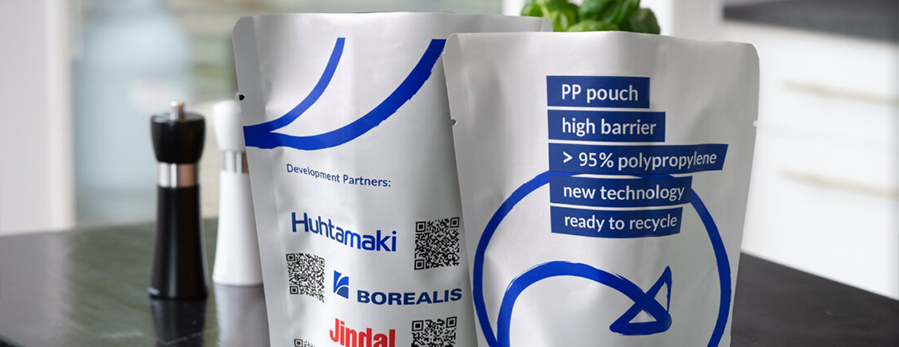
Monomaterial Pouch © Borealis
Borealis announces that it is using the occasion of the Plastics Recycling Show Europe (PRSE) in May to highlight a new monomaterial pouch containing over 95% PP and designed for recycling. Developed in collaboration with value chain partners, this more sustainable high barrier packaging format offers a range of benefits for the blown and cast film extrusion processes as well as for brand owners and end consumers.

As a monomaterial PP packaging format, it can help meet ambitious recycling and waste reduction targets set forth in the EU’s Packaging and Packaging Waste Regulation (PPWR) as well as eco-modulation criteria for Extended Producer Responsibility (EPR) programmes.

Accelerating plastics circularity through value chain co-operation

High barrier packaging is used to preserve and protect foodstuffs that are sensitive to moisture, oxygen, aromas, and light, like dry ingredients and powders, coffee, and snack foods. Producers and consumers benefit from the longer shelf life and reduced food waste made possible by these convenient high barrier pouches. In the extrusion lamination process, laminating PP cast and BOPP (biaxially oriented polypropylene) films yields mono PP laminates with uniquely advantageous properties. These include high barrier and stiffness, and excellent sealing performance.

Using conventional adhesion lamination structures, producers have previously been able to obtain pouch laminate materials containing approximately 90% PP. However, by pooling their respective areas of expertise, Borealis and value chain partners have now been able to boost the share of PP to over 95%. When processed within dedicated mechanical recycling streams for PP, this monomaterial pouch yields greater volumes of high-quality recyclate fit for use in non-food, flexible PP packaging applications. It is thus the ideal format with which to fulfil the principle aims of the PPWR: improve recyclability, grow the market for recycled content, and reduce packaging waste.

While eco-modulated EPR fees based on packaging recyclability credentials and recycled content may differ among EU Member States, the new monomaterial pouch made of over 95% PP meets the CEFLEX (Circular Economy for Flexible Packaging) definition of “fully compatible to mechanical recycling PP.” It is thus a cost-saving alternative to conventional pouch formats composed of a greater number of different materials.


“In re-inventing essentials for sustainable living, our aim is to uphold the integrity and quality of packaging materials while ensuring that these convenient formats are more and more circular,” says Peter Voortmans, Borealis Global Commercial Director Consumer Products. “We are very proud of this value chain collaboration. It equips our partners and customers with yet another viable and more sustainable solution to help manage the updated requirements of the PPWR.”

The high barrier pouch made of over 95% PP demonstrates excellent seal strength and hermetic sealing properties thanks to the material solutions and production expertise contributed by each of the value chain partners involved in this project. Commercially available polyolefins in the Borealis PP extrusion coating and lamination grade portfolio offer stable processability and good laminate bond strength. These were used in tandem with tie layers contributed by the Mitsui Chemical Group, a leading international manufacturer of specialty chemicals, including polyolefin-based tie resins. As a global leader in the development and manufacture of specialty BOPP films, Jindal Filmscontributed to this innovative solution for recyclable packaging. With locations in Europe, America, and China, Profol, known for its innovative cast PP films and lightweight composites, produced the cast films. Based in Finland and operating in 38 countries, Huhtamaki Flexible Packaging provides solutions that enhance wellbeing and convenience for consumers around the world, and contributed innovative laminates to the new monomaterial pouch.

Please visit Borealis at Hall 12, Stand G22 at the PRSE 2023 in Amsterdam from 10–11 May 2023. 



More News from TEXDATA International

#Recycling / Circular Economy

textile.4U publishes special edition “Top 100 Textile Recycling Companies 2025”

With a comprehensive 176-page special edition, textile.4U is dedicating its latest issue entirely to one of the most dynamic and influential topics in today’s textile industry: textile recycling. The new issue, published exclusively in high-quality print, presents the Top 100 textile recycling companies researched and selected by TexData – organizations that already play a key role in the transition to circular textiles or are expected to have a significant impact in the near future.

#Recycling / Circular Economy

Responsible Textile Recovery Act of 2024 signed by Governor

Senator Josh Newman (D-Fullerton) is proud to announce that Senate Bill 707 (SB 707), the Responsible Textile Recovery Act of 2024, has been signed into law by the Governor of California, Gavin Newsom. This groundbreaking legislation establishes the country’s first Extended Producer Responsibility (EPR) textile recycling program, marking a significant step forward in the state’s efforts to combat waste and promote sustainability.

#Textiles & Apparel / Garment

Modtissimo promotes sustainability with 28 coordinates in the Green Circle

Modtissimo is proving more and more to be a textile and clothing show that delivers the latest innovations in the area of sustainability, with the iTechStyle Green Circle being the main showcase for companies' creations. In this 60+4 edition, taking place on 12 and 13 September, 28 coordinates will be exhibited in a section organised by CITEVE and curated by Paulo Gomes.

#Europe

The EU and Egypt team up to mobilise private sector investments at Investment Conference and sign a Memorandum of Understanding underpinning €1 billion in macro-financial assistance for Egypt

At the EU-Egypt Investment Conference, co-organised by the EU and the Government of Egypt on 29-30 June, the EU and Egypt are teaming up to intensify private sector investments in Egypt. They are also signing a Memorandum of Understanding (MoU) for the disbursement to Egypt of up to €1 billion in Macro-Financial Assistance.

More News on Recycling / Circular Economy

Latest News

#Heimtextil 2026

Mimaki demonstrates versatile, simple TRAPIS textile printing at Heimtextil 2026

Mimaki’s textile pigment transfer printing system, TRAPIS, is able to print on a diverse range of fabrics - unlike traditional processes - including natural fibres and synthetic fabrics. The full solution will be shown on Mimaki’s booth (Hall 3.0 Stand A97), as the company returns to Heimtextil to showcase its advancements in sustainable, high quality and efficient textile printing.

#ITM 2026

The Technology Hub for global denim trends: ITM 2026

The ITM 2026 International Textile Machinery Exhibition, to be held at the Tüyap Fair and Congress Center in Istanbul from June 9–13, 2026, brings together groundbreaking technologies in denim production. From smart production systems to eco-friendly raw materials, from digital washing solutions to laser effect technologies, innovations that will shape the future of denim will be showcased for the first time at ITM 2026.

#Natural Fibers

38th International Cotton Conference Bremen: Let´s Talk about Cotton!

The 38th International Cotton Conference Bremen, to be held on 25-27 March 2026 in Bremen’s parliament building on market square, once again sends a powerful signal for professional excellence and international dialogue. The focus is on the latest market trends and technical innovations throughout the entire value chain – from agriculture and quality assurance to processing and the circular economy. With its high-calibre speakers, the conference remains an indispensable forum for anyone involved in shaping the cotton industry scientifically, technically, or economically.

#Research & Development

More safety and comfort for protective clothing thanks to auxetic fabrics

When everyday materials are pulled, they stretch or elongate in the direction of the pull and become narrower in cross-section. We can also observe this property in two-dimensional textiles. Auxetic structures behave differently here. They have the striking property of not changing under tensile stress or even increasing their width or thickness. These properties are advantageous, for example, in protective textiles or textile filter media. The DITF are researching auxetic fabrics for various applications.

TOP