#Recycling / Circular Economy
Half a million tons textile waste readily available for fibre-to-fibre recycling in six European countries
Project Findings Highlight Immense Opportunity To Accelerate Textile Recycling
“As fibre-to-fibre textile recycling commitments and policies increase, as well as the amount of textile waste collected, the infrastructure required to drive the move towards circular systems requires significant investment to scale. To make informed investment decisions, as well as assess the business case for monetisation through recycling, a deeper understanding of the characteristics of today's European post-consumer textiles landscape is needed. This project lays the knowledge foundation that will enable key players to set into motion.” — Katrin Ley, Managing Director at Fashion for Good
The Sorting for Circularity Europe Project was initiated to address this knowledge gap, exploring post-consumer textiles in depth, providing meaningful information on which to base investment decisions, policy developments and next steps towards circularity. Furthermore, the project aims to increase harmonisation between the sorting and recycling industry, stimulating a recycling market for unwanted textiles that can generate new revenue streams for sorters and unlock demand for recyclers and brands. The full report of the project can be read here.
Conducting the analyses across Europe, in Belgium, Germany, the Netherlands, Poland, Spain, and the United Kingdom, the project provides the most comprehensive and representative snapshot of textile waste composition in Europe to date. The results point to promising opportunities for recapturing value while diverting textiles from downcycling and incineration. The results also inform brands of the best circular design practises to adopt, as well as textile collection agencies and organisations to build the necessary infrastructure and better educate and engage consumers on proper sorting and disposal practices.
LEAPING FORWARD THROUGH TECHNOLOGY
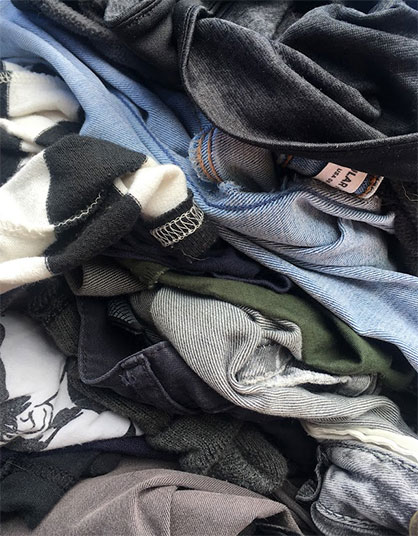
Using innovative Near Infrared (NIR) technology to determine garment composition, traditionally a task performed manually, the project analysed a total of 21 tonnes of post-consumer garments. On-the-ground examinations were performed over two time periods, autumn/winter 2021 and spring/summer 2022, to account for seasonal changes in the types of garments entering sorting facilities.
Cotton was found to be the dominant fibre (42%), followed by a large presence of material blends (32%), almost half of which consisted of polycottons (12%). Based on three characteristics, material composition, presence of disruptors, such as zippers and buttons, and colour, 21% of the materials analysed are deemed suitable as feedstock for mechanical recycling, while 53% are suitable for chemical recycling. This presents a significant opportunity for circularity as currently only 2% of post consumer textiles are diverted to fibre-to-fibre recycling.
BUILDING A ROBUST SORTING AND RECYCLING
INFRASTRUCTURE
In addition to the report, two further industry resources, developed by Circle Economy, have been made available; Recycler’s Database, a database mapping textile recycler's capabilities, illuminating crucial gaps between the sorting and recycling industry, and an open source Sorters Handbook to guide the sorting industry - encouraging and supporting further analyses.
Building off the project, two open digital platforms, Reverse Resources and Refashion Recycle, to match textile waste from sorters with recyclers, have been identified as critical tools to further enable the connections needed to drive greater circularity in the years to come. Following an assessment of suitable digital platforms within and outside of the textile industry, Reverse Resources have 39 active recyclers and 32 active waste handlers/sorters on their platform, while Refashion Recycle have 103 recyclers and 66 sorters onboarded onto their platform. This represents a large portion of the European circularity industry.
PATH TOWARDS A CIRCULAR INDUSTRY
The amount of textile waste collected is likely to increase, due to growing consumption and disposal, and incoming legislation, such as the Waste Framework Directive. Overall, a strong business case for sorting low value textiles is required in order to maintain and increase sorting capacity in Europe. To support this retention and development of sorting capacity, increased investments and policy changes play a key role.
Based on findings and knowledge gathered from the project, Fashion for Good and Circle Economy recommend the following actions in the report:
For all collectors, sorters, and recyclers -
- Use the Sorters Handbook and the Sorting for Circularity Europe Report as guidance to conduct further trials and continue to build an understanding of fibre composition, sorting and recycling processes.
- Provide open-access to trials and data that can support and direct investment into necessary infrastructure.
- Update and utilise the Recyclers Database to build knowledge about mechanical and chemical recycling destinations.
- Funnel further investments into new sorting technologies needed to scale the amount of textiles deemed suitable as feedstock for mechanical and chemical recycling.
- Join digital platforms such as Reverse Resources and Refashion Recycle to unlock and connect supply with demand.
For brands and manufacturers -
- Further commit to adopting circular design practices and incorporating recycled fibres into product portfolios as mandated by the upcoming Ecodesign for Sustainable Products Regulation in the European Union.
For policy makers -
- consider the Sorting for Circularity Europe Report and other relevant studies when developing toolkits, frameworks and legislation such as: the harmonised Extended Producer Responsibility framework, the Digital Product Passports pathway in textiles, and the Ecodesign for Sustainable Products Regulation.
For consumers -
- take into account that purchase and disposal choices have an influence on the end of use of textiles. Consider extending the life of products through repairing, reselling and swapping.
CONSORTIUMS POWER TRANSFORMATION
Launched in early 2021 and initiated by Fashion for Good together with Circle Economy, the Sorting for Circularity Europe project brought together key brands and industry leaders across Europe.
The project brings together the largest industrial textile sorters in the European region; including the Boer Group, I:CO - part of SOEX Group, JMP Wilcox - part of Textile Recycling International, Modare-Cáritas, Wtórpol and TEXAID, placing key industry players firmly at the heart of the project.
Sorting for Circularity Europe is made possible thanks to catalytic funding from Laudes Foundation and is facilitated by Fashion for Good brand partners, adidas, BESTSELLER, Inditex and Zalando, with H&M Group as key project partners. Fashion for Good partners Arvind Limited, Birla Cellulose, Levi Strauss & Co., Otto Group and PVH Corp. participated as part of the wider working group.
Circle Economy, with support from TERRA, led the creation and implementation of the methodology. Refashion facilitated the introduction to TERRA and created the Refashion textile materials library, for the implementation of the methodology. Matoha provided the NIR technology used to assess textile waste composition.
SORTING FOR CIRCULARITY
Sorting for Circularity aims to (re)capture textile waste, expedite the implementation of game changing technologies and drive circularity within the fashion value chain. The framework is based on insights from the Fashion for Good and Aii collaborative report “Unlocking the Trillion Dollar Fashion Decarbonisation Opportunity”, which charts a trajectory for the industry to meet its net-zero ambition by 2050, highlighting the potential and significant impact on carbon emissions in the industry through material efficiency, extended and re- use of waste. Created with scalability in mind, the project was first initiated in Europe, and has now expanded to include Sorting for Circularity India.