[pageLogInLogOut]

#Recycling / Circular Economy

Circle Economy is thrilled to see its partners, the Dutch and Nordic Circular Hotspots, join forces
© 2021 Circle Economy
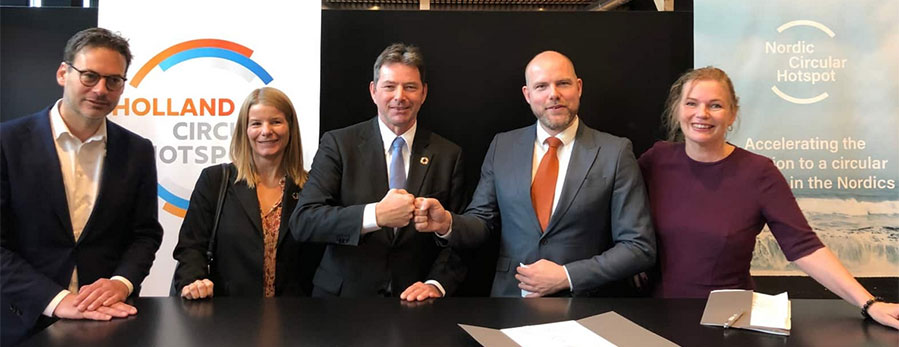
As part of the three-day state visit of the Dutch royal couple to Norway, the Holland Circular Hotspot and Nordic Circular Hotspot formally signed a Partnership Agreement today. The signing ceremony took place in Trondheim in the presence of His Majesty King Willem-Alexander and Her Majesty Queen Máxima as well as His Royal Highness Crown Prince Haakon Magnus and Her Royal Highness Crown Princess Mette-Marit.?

Circle Economy, a partner of both the Dutch and Nordic Circular Hotspots, warmly welcomes this new collaboration, which aims to accelerate the market transition for circular solutions and businesses in and between The Netherlands and the Nordics. Since the Nordic Circular during the World Circular Economy Forum in Helsinki in June 2019, the two Hotspots have worked closely together. The formation of the Nordic Circular Hotspot was inspired by the Holland Circular Hotspot and now the time has come to formalise this partnership.

“Signing a partnership with the Nordic Circular Hotspot comes at a moment that the world realises that it needs circularity more than ever,” said Freek van Eijk, Director, Holland Circular Hotspot, at the signing ceremony. “This is the century for circular entrepreneurs and frontrunners to have the biggest market potential.”

Leapfrogging circular barriers

The Nordic economies combined make up the 12th-largest economy in the world. Accelerating the circular and sustainable transformation in this region has great potential and can have a significant ripple effect. The Netherlands is leading the transition to a circular economy, with a Circularity Metric of 24.5 per cent, according to Circle Economy's Circularity Gap Report for the Netherlands. By comparison, the Norwegian economy is only 2.4 per cent circular according to the Circularity Gap Report Norway. Through this collaboration, the Nordics could leapfrog some of the early barriers The Netherlands has gone through, and utilise innovation, resources and knowledge sharing in order to make the circular economy the new normal. Circle Economy was represented in Trondheim by Marc de Wit, Director Strategic Alliances.

“Circular value creation is key to sustainability in our markets for the time ahead,” said Einar Kleppe Holthe, Managing Partner, Nordic Circular Hotspot. “Nothing is better than formalising the partnership between our two Hotspots, connecting The Netherlands and Nordics in a more close and collaborative way.”

“Together we aim at leaving the wasteful, consumption-based and resource-intensive economy of the previous century,” said Cathrine Barth, Founder and Managing Partner, Nordic Circular Hotspot. “As partners we seek to evolve the circular economy and collaborate in view of establishing a healthier, safer and cleaner economy.”


Kick off with a roundtable with circularity-focused companies

To kick off their collaboration, the two Hotspots will this afternoon host a roundtable on circularity with 15 Norwegian and Dutch companies and organisations from different sectors. The roundtable will be held in collaboration with the Trondheim Centre for Sustainable Development and Nordic Innovation. Its purpose is to find ways to learn from each other, work cross-sectorally and holistically, and to germinate collaborative projects and initiatives.

State visit to Norway

The signing ceremony was part of the state visit, held from November 9-11 and accompanied by Dutch foreign minister Ben Knapen, affirming the outstanding relations between Norway and The Netherlands. Both countries share common values and jointly seek solutions to major international challenges. The main themes of the visit include bilateral and international co-operation, climate change, the energy transition and sustainability, with the circular economy being in the spotlight through the Partnership Agreement.




More News from TEXDATA International

#ITM 2026

ITM 2026: The new geography of textile production

New production hubs are emerging across North Africa and Central Asia, while Türkiye is accelerating its transformation toward higher-value, technology-driven and more sustainable textile manufacturing.

#Research & Development

“Production is a product”

From technical textiles and AI-driven robotics to the limitations of textile circularity: Professor Dr Thomas Gries looks back on more than two decades of development at ITA Aachen. In the interview, he explains why production technology remains a decisive success factor, discusses international collaborations and innovation ecosystems, and shares his views on the transformation of production landscapes and the challenges facing an increasingly regulated industry.

#Knitting & Hosiery

“We need to move away from the price trap and return to a value-driven mindset.”

With its new Textile Innovation Center, KARL MAYER is sending a strong signal for innovation, collaboration, and the future of textile applications. In this interview, Karl Josef Mayer discusses new opportunities in warp knitting, the processing of staple fibres, recycling, the changing role of machinery manufacturers, and why the textile industry must once again focus more strongly on the value of textiles. by Oliver Schmidt

#Associations

“Innovation, resilience and international experience remain the great strengths of the Swiss textile machinery industry”

Geopolitical uncertainty, growing competitive pressure from China, new free trade agreements and the shift towards a circular economy are currently reshaping the global textile industry. In this interview, Cornelia Buchwalder discusses the current mood within the Swiss textile machinery sector, the industry’s distinctive innovative strength, new market opportunities in India and Asia, and the technological trends that could shape the upcoming trade fair cycle leading up to ITMA 2027.

More News on Recycling / Circular Economy

#Recycling / Circular Economy

Managed workwear services are providing a blueprint for the circular textile economy

Managed workwear service providers are demonstrating how commercial success and circularity can go hand in hand by extending garment lifespans through repair, laundering, reuse and recycling, according to “Managed workwear services—a circular textile economy ahead of the game”, a new 14‑page report from the global business information company Textiles Intelligence.

#Recycling / Circular Economy

Eco-design as the foundation of circular textiles

Based on the results of an extensive European analysis, the Erasmus+ project Skills4Circularity is currently developing three practice-based training modules covering recycling technologies, eco-design for the circular economy and sustainable manufacturing. This was preceded by a comprehensive company survey and a joint analysis conducted by the project partners under the leadership of IVGT. The results show that the greatest challenges lie not so much in a lack of technology as in skills gaps.

#Recycled Fibers

Usha Yarns secures growth equity investment from Fullerton Carbon Action Fund

Usha Yarns Limited (“Usha Yarns”), a producer of high-quality recycled yarns with advanced, well established production processes, announced a growth equity investment from the Fullerton Carbon Action Fund (“Fullerton”), a private equity strategy managed by Fullerton Fund Management that backs established mid-market companies across Emerging Asia to accelerate decarbonisation.

#Recycling / Circular Economy

German 'ZOLL' turns end-of-life uniforms into valuable raw materials

Together with CWS Workwear, the German Customs Administration is extending the life cycle of service uniforms through reuse, recycling and material recovery, demonstrating how circular economy principles can be successfully implemented in the public sector while delivering significant savings.

Latest News

#Functional Fabrics

PERFORMANCE DAYS announces new focus topic & forums for October 2026

With its upcoming October 13–14, 2026 edition, PERFORMANCE DAYS is placing the spotlight on one of the textile industry’s most important transformations: “Bio-Based Materials – From Fiber to Fabric”, a two-part Focus Topic exploring the future of bio-based innovation across the textile value chain. Part 1, presented in October 2026, will focus on fibers and next-generation material developments, while Part 2 at the March 2027 edition will shift the perspective toward dyeing, finishing, additives, and processing technologies.

#Nonwoven machines

MENANG rapidly resumes production with new ANDRITZ airlay line after major fire

MENANG, a Malaysian manufacturer of nonwoven automotive components, has resumed production after a major fire severely damaged its airlay line in mid-March 2026. A new airlay line supplied by ANDRITZ enabled production to restart within only four months.

#Exhibitions & Events

Febratex 2026 to be the largest edition of the leading textile trade fair in the Americas with 10 exhibition halls

Febratex 2026 will be the largest edition in the history of the leading textile trade fair in the Americas. Dedicated to the textile and apparel manufacturing industries, the event will take place from August 18–21, 2026, in Blumenau, Santa Catarina, Brazil, with a strong focus on technology, sustainability, and business generation.

#Raw Materials

Cotton Brazil Dialogues field trip brings international stakeholders closer to Brazil’s cotton production chain

How do you build trust across the global textile value chain? By opening the farm gates. This is the principle behind the Cotton Brazil Dialogues. At the end of July, the programme welcomed its first group of international participants for a five-day immersion into Brazilian cotton production, combining field visits with technical workshops to showcase the quality, sustainability, innovation and traceability behind one of the world’s leading cotton origins.

TOP