[pageLogInLogOut]

#Recycling / Circular Economy

Covestro relies on circulating process water
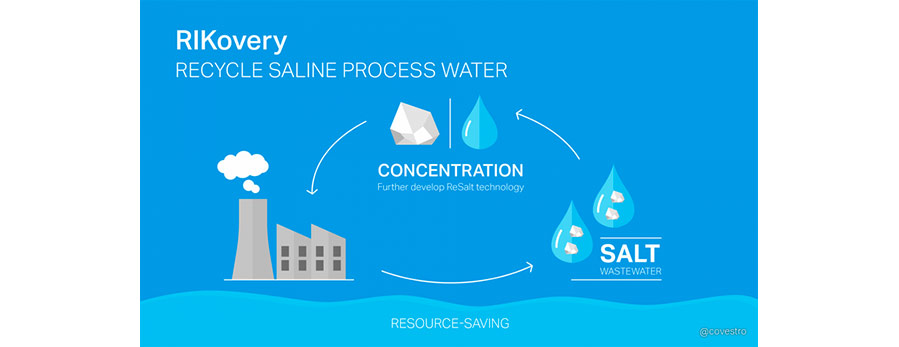
Recycling salt from process waters: Covestro is participating in the RIKovery project. © 2021 Covestro
Covestro intends to increase the circular use of process water in the future. To this end, the company is focusing specifically on research and development and is participating in the new RIKovery research project (funding code 02WV1569). Funded by the German Federal Ministry of Education and Research, the project follows on from the successful work in the ReSalt project (funding code 02WV1408A) and continues research into the treatment of process water.
  • Research project aims to improve use of process water
  • Further development of existing technology targeted
  • Covestro supports UN SDGs with water campaign

Globally, water stress will affect approximately 50 percent of the world's population by 2050. That is why Covestro is already taking action today. At the production sites in Krefeld-Uerdingen and Caojing near Shanghai, industrial saline water recovery plants are already in operation that treat and reuse part of the process water from polycarbonate production. Covestro is thus helping to conserve resources.

With the RIKovery project, Covestro now wants to take the next technological step to be able to reuse even more process water than before. During the three-year runtime, the project consortium wants to explore how salt-containing industrial water streams can be used as fully as possible to relieve natural water resources.?

Further develop existing process technology

"Strengthening cycles is Covestro's declared goal. We are now taking the next step with RIKovery to use process water in a circular way. The further development of our existing technology shows that the direction is right. Now we need to stay on course to use even less water and salt as raw materials for industrial applications in the long term," says Klaus Schäfer, Chief Technology Officer at Covestro.

In addition to Covestro, other project partners from industry, plant engineering and research are working together. They also include the RWTH Aachen and TH Cologne universities, the Water Technology Center, the Analytical Research Institute for Non-Target Screening (AFIN-TS GmbH), BWS Anlagenbau und Service and Evonik Industries. Chris Malkomes of project partner K+S AG says: "We are pursuing the common vision of using saline industrial water streams by treating them. In addition, the aim is to obtain the most highly concentrated permeate possible from the tailings waters of the potash industry, which can be integrated into existing production cycles and utilized there."


"Forward-looking, efficient industrial water management will become a key factor for safe industrial production in the future," says Thomas Track of DECHEMA, which is coordinating the project accompanying the BMBF funding initiative. "Water-efficient sites are a real locational advantage with a view to resource conservation, but also with a view to droughts favored by climate change."

Covestro supports UN SDGs with internal water initiative

Covestro is aware of the special responsibility that the use of the valuable resource of drinking water entails. For this reason, the Leverkusen-based materials manufacturer has additionally launched an internal initiative to creatively develop proposals for sustainable water use. As part of this campaign, the workforce was called upon to submit ideas with business potential based on the United Nations Sustainable Development Goals (SDGs).

Employees from all regions participated in the water initiative. This resulted in dozens of ideas for innovative solutions around the topic of water. A jury selected more than 20 from all the ideas. These are now being tested at the working level.

Among the suggestions from the workforce, many ideas were generated for urban agriculture, but also for cleaning water of microplastics. A major role was also played by the company's own water consumption in production and how this can be improved.

If the ideas prove to be effective and feasible, they will be introduced on a large scale. In this way, Covestro is helping to protect the important resource of drinking water even better in the future.



More News from Covestro AG

#Textile chemistry

Covestro and Heraeus Precious Metals collaborate to enable safer, more sustainable antimicrobial textile coatings

Laboratory tests reveal that AGXX antimicrobial surface technology from Heraeus Precious Metals is fully compatible with Impranil® PU dispersions which are part of the waterborne INSQIN® textile coating technology from Covestro, paving the way for more sustainable antimicrobial textile coatings. This discovery comes at a key moment for the textile coatings industry. As the sharing economy continues to grow, more people are coming into regular contact with high-use surfaces, creating ideal conditions for bacteria, viruses, and other microorganisms to thrive.

#Textile chemistry

Covestro celebrates decade of innovation and sustainable growth

Covestro celebrates its 10-year anniversary today. Since its carve-out from Bayer in 2015, the company has developed into a global leader in high-performance polymer materials and a pioneer in circular economy solutions. With a strong focus on innovation and sustainability, Covestro’s materials are now embedded in countless applications worldwide – from mobility and construction to electronics, healthcare, and consumer goods.

#Textile chemistry

Covestro extends contract with CTO Dr. Thorsten Dreier ahead of schedule until 2031

Dr. Thorsten Dreier will remain Chief Technology Officer of Covestro for a further five years. The Supervisory Board has extended his contract, which runs until June 2026, ahead of schedule from July 1, 2026 to June 30, 2031.

#Textile chemistry

Suiting up Team Sonnenwagen with more sustainable sportswear created through a three-way partnership

Team Sonnenwagen Aachen, a solar racing collective from RWTH Aachen and FH Aachen, Germany, is on a mission to advance sustainable mobility solutions and become world champions. This August, the student team will participate in the 2025 Bridgestone World Solar Challenge, a biannual 3,000-kilometer race across the Australian outback. During the five-day event, 50 student teams from around the world will compete with solar vehicles that they must design, assemble, and drive themselves.

More News on Recycling / Circular Economy

#Europe

New EU rules to stop the destruction of unsold clothes and shoes

The European Commission today (Feb 9) adopted new measures under the Ecodesign for Sustainable Products Regulation (ESPR) to prevent the destruction of unsold apparel, clothing, accessories and footwear.

#Recycling / Circular Economy

Sahil Kaushik appointed CEO of Infinited Fiber as the company advances a phased path to commercial scale

Infinited Fiber has appointed Sahil Kaushik as Chief Executive Officer. Kaushik has served as Acting CEO alongside his role as Chief Operating Officer and will continue to oversee operations until a new COO is appointed.

#Recycling / Circular Economy

trinamiX with new management

BASF is examining strategic options for its subsidiary trinamiX GmbH. trinamiX specializes in biometric imaging and mobile material analysis. These activities are not part of BASF’s core business, on which the company is focusing as part of the implementation of its new strategy.

#Recycling / Circular Economy

Reju announces site selection for first U.S. industrial sized facility regeneration hub in Rochester, New York

Reju, the textile-to-textile regeneration company, today announced it has selected the site for its first U.S.-based industrial facility marking a significant milestone in its efforts to scale globally. This future Regeneration Hub will be in Rochester, New York, reinforcing Reju’s commitment to the adoption of circular textile system across key regions worldwide.

Latest News

#Sustainability

Ying McGuire becomes new CEO of Cascale

Cascale today announced the appointment of Ying McGuire as Chief Executive Officer, effective June 1, 2026.

#Technical Textiles

Sustainable, lightweight, and sound absorbing: Polyester-based front trunk solution for BEVs

As car manufacturers look to further reduce their carbon footprint, Autoneum has developed an innovative front trunk solution for battery electric vehicles (BEVs), made entirely from polyester-based textile. The Ultra-Silent Frunk offers significant weight reduction, improved acoustic and thermal insulation, and uses up to 70 percent recycled material, supporting sustainable and efficient vehicle design. Autoneum, global technology leader in acoustic and thermal management for vehicles, has already received orders for the new frunk from three major OEMs in Asia and Europe to be built in three BEV models. Series production for two BEVs has been underway in China and Germany since last year.

#Raw Materials

Modern testing methods for raw cotton

The 38th International Cotton Conference Bremen will take place from 25 to 27 March 2026 at the Bremen Parliament. This conference has traditionally stood for in-depth expertise and international exchange. The program will focus on technical innovations, market trends, and regulatory frameworks across the entire value chain – from agriculture to the circular economy. With high-profile speakers, the conference is regarded as the key meeting point for the global cotton industry. Today’s focus: Cotton quality and testing methods.

#Spinning

Rieter responds to higher raw material prices

Global political and economic developments have been leading to rising raw material and energy costs for some time. The textile machinery industry is also affected by this trend. Rieter machines and components consist to a large extent of steel, copper, aluminum and electronics. These materials in particular have seen higher demand and higher prices in recent months.

TOP