[pageLogInLogOut]

#Recycling / Circular Economy

Recycling system ’Looop’ helps H&M transform unwanted garments into new fashion favourites
© 2020 H&M
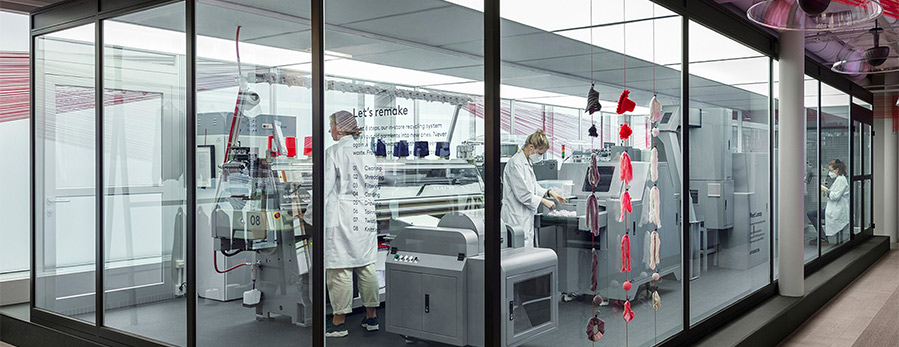
H&M is thrilled to soon offer customers in Sweden the possibility to transform unwanted garments into new fashion favourites with the help from its new garment-to-garment recycling system ‘Looop’. H&M is committed to closing the loop on fashion and this machine visualizes to customers that old textiles hold a value and should never go to waste.

Looop opens to the public in one of H&M's Drottninggatan stores in Stockholm on October 12. This is the first time this garment-to-garment recycling system is shown in store by a fashion retailer and H&M is proud to soon offer customers the opportunity to watch this container-sized machine recycle their old textiles into something new. This is part of a bigger plan - H&M's ambition is to become fully circular and climate positive and the retailer is working with many exciting projects to reach this goal. We must innovate materials and processes while inspiring customers to keep their garments in use for as long as possible.

“We are constantly exploring new technology and innovations to help transform the fashion industry as we are working to reduce the dependency on virgin resources. Getting customers on board is key to achieve real change and we are so excited to see what Looop will inspire” 

Pascal Brun, Head of Sustainability at H&M


Looop uses a technique that dissembles and assembles old garments into new ones. The garments are cleaned, shredded into fibres and spun into new yarn which is then knitted into new fashion finds. Some sustainably sourced virgin materials need to be added during the process, and H&M of course work to make this share as small as possible. The system uses no water and no chemicals, thus having a significantly lower environmental impact than when producing garments from scratch.

H&M wants to lead the change towards a sustainable fashion industry. In 2013 H&M became the first fashion retailer with a global garment collecting program. Now, H&M is taking the next step with its garment-to-garment recycling system Looop. For 100 Swedish kronor, members of H&M's loyalty club can use Looop to transform their old garment into a new favourite. For non-members the fee is 150 Swedish kronor. All proceeds go to projects related to research on materials. By 2030 H&M aims for all its materials to be either recycled or sourced in a more sustainable way, a figure that for 2019 was at 57%.

Looop is created by the non-profit H&M Foundation, together with research partner HKRITA (The Hong Kong Research Institute of Textiles and Apparel) and Hong Kong-based yarn spinner Novetex Textiles.

More News from TEXDATA International

#ITM 2026

ITM 2026: The new geography of textile production

New production hubs are emerging across North Africa and Central Asia, while Türkiye is accelerating its transformation toward higher-value, technology-driven and more sustainable textile manufacturing.

#Research & Development

“Production is a product”

From technical textiles and AI-driven robotics to the limitations of textile circularity: Professor Dr Thomas Gries looks back on more than two decades of development at ITA Aachen. In the interview, he explains why production technology remains a decisive success factor, discusses international collaborations and innovation ecosystems, and shares his views on the transformation of production landscapes and the challenges facing an increasingly regulated industry.

#Knitting & Hosiery

“We need to move away from the price trap and return to a value-driven mindset.”

With its new Textile Innovation Center, KARL MAYER is sending a strong signal for innovation, collaboration, and the future of textile applications. In this interview, Karl Josef Mayer discusses new opportunities in warp knitting, the processing of staple fibres, recycling, the changing role of machinery manufacturers, and why the textile industry must once again focus more strongly on the value of textiles. by Oliver Schmidt

#Associations

“Innovation, resilience and international experience remain the great strengths of the Swiss textile machinery industry”

Geopolitical uncertainty, growing competitive pressure from China, new free trade agreements and the shift towards a circular economy are currently reshaping the global textile industry. In this interview, Cornelia Buchwalder discusses the current mood within the Swiss textile machinery sector, the industry’s distinctive innovative strength, new market opportunities in India and Asia, and the technological trends that could shape the upcoming trade fair cycle leading up to ITMA 2027.

More News on Recycling / Circular Economy

#Recycling / Circular Economy

Mesdan to showcase laboratory-scale textile recycling solutions at Textiles Recycling Expo 2026

At Stand 2235 during the Textiles Recycling Expo 2026 in Brussels, Mesdan will present laboratory solutions designed to support the development and evaluation of textile-to-textile recycling processes.

#Recycled Fibers

Carbios and Wankai postpone startup of China’s first PET biorecycling plant to 2028

The industrial deployment of enzymatic PET recycling in Asia is progressing, but at a slower pace than initially planned. French recycling technology company Carbios and its Chinese partner Wankai New Materials have announced that the commissioning of their planned PET biorecycling facility in Haining, Zhejiang Province, has been postponed and is now expected in the first half of 2028.

#Sustainability

Closing the Footwear Loop reveals challenges and opportunities for circular footwear

The footwear industry faces one of the most complex circularity challenges in the fashion sector. A new Phase 1 report from the Fashion for Good initiative Closing the Footwear Loop, developed together with Circle Economy, provides new insights into the composition, condition and recycling potential of post-consumer footwear waste.

#Recycling / Circular Economy

Textiles Recycling Expo 2026 to spotlight the companies turning textile circularity into industrial reality

As the textile industry faces mounting pressure to scale circular solutions, improve recycling infrastructure, and respond to evolving regulation, Textiles Recycling Expo 2026 will bring together the organisations leading that transformation in practice.

Latest News

TOP