[pageLogInLogOut]

#Recycling / Circular Economy

BASF working toward circularity in recycling of mattresses
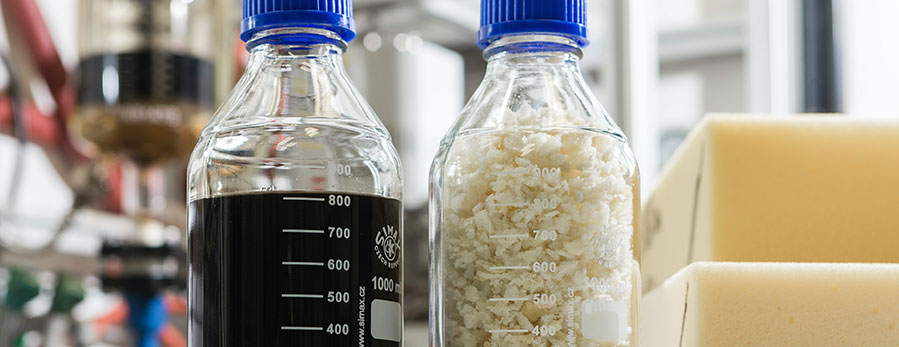
BASF’s innovative recycling process for used mattresses breaks down the flexible polyurethane and delivers the initially used polyol. (c) 2020 BASF
BASF has developed a chemical recycling process for used mattresses and is starting pilot tests at the Schwarzheide site in Brandenburg, Germany. The materials from old mattresses are to be recycled in such a way that they can be used for the production of new mattresses. “The target is to recover the raw materials with a quality comparable to that of non-recycled/virgin raw materials”, says Shankara Keelapandal, Business Management Isocyanates Europe.

In doing so, BASF is breaking new ground and responding to the raised expectations regarding sustainability of the foam and mattress industry as well as those of consumers. It is an important step to possibly re-enter post-consumer waste back into product lifecycles.

  • Old mattresses are to provide raw materials for new ones
  • The first pilot tests are up and running

BASF’s process breaks down the flexible polyurethane and delivers the initially used polyol. From there BASF can produce new foam with a significantly lower carbon footprint, because fewer fossil resources are used. “It makes projects of that nature quite attractive because, while mattresses are easy to collect and to sort out, at the end of their lifecycle they currently end up being either incinerated or in a landfill, explains technical project manager Arno Volkmann. First volumes of the recycled material will be delivered to project partners later this year to develop pilot projects together. “The project is technically complex, but the potential to reduce waste volumes and save resources makes it all worth it” comments Keelapandal.


With the new process, BASF steps up its efforts to increase sustainability and takes one step further toward a circular economy. Aiming to decouple economic growth from the use of finite resources, BASF accelerates the adoption of the circular economy principle into its day-to-day operations. “This is why we develop a solution to closing the loop for soft polyurethane foam with the chemical recycling of mattresses,” adds Keelapandal.

To learn more on the PU recycling project please go to:

https://www.basf.com/global/en/who-we-are/sustainability/we-drive-sustainable-solutions/circular-economy/mass-balance-approach/circularity-recycling-of-mattresses.html

More News from BASF Aktiengesellschaft
Performance Chemicals for Textiles Europe

#Recycling / Circular Economy

trinamiX with new management

BASF is examining strategic options for its subsidiary trinamiX GmbH. trinamiX specializes in biometric imaging and mobile material analysis. These activities are not part of BASF’s core business, on which the company is focusing as part of the implementation of its new strategy.

#Research & Development

How innovations drive BASF’s success

“Innovation has always been part of BASF’s DNA. Especially in these volatile times, it is crucial to leverage our innovative strength to develop competitive solutions that differentiate us as a company in our markets and give us a competitive edge,” said Dr. Stephan Kothrade, Member of the Board of Executive Directors of BASF and Chief Technology Officer, at the company’s Research Press Briefing held today. To achieve this, BASF implemented its “Winning Ways” strategy about a year ago with the clear goal of becoming the preferred chemical company to enable its customers’ green transformation.

#Nonwovens

Turning diaper waste into new value: BASF, Essity and TU Wien pioneer circular solutions

BASF, one of the world’s leading chemical companies and manufacturer of superabsorbent polymers (SAP), and Essity, a global leading hygiene and health company, joined forces together with the Technical University of Wien to revolutionize recycling of absorbent hygiene products (AHP).

#Textiles & Apparel / Garment

BASF at SIMAC 2025: Recycling meets Performance – PU solutions for the future of footwear

BASF is presenting new materials, concepts and recycling methods for polyurethanes in footwear at SIMAC Tanning Tech. The leading international trade fair will take place from September 23-25 in Milan, Italy. We will showcase our unique and integrated toolbox of Elastopan® (PU) and thermoplastic polyurethanes Elastollan® and Infinergy®. Together with our partners and customers we bring innovative products to the market offering utmost lightness paired with mechanical performance and automated processing.

More News on Recycling / Circular Economy

#Recycled_Fibers

Reju announces site selection for French Regeneration Hub in Lacq advancing Europe’s circular textile infrastructure

Reju, the textile-to-textile regeneration company based in France, announces the site selection for an industrial sized Regeneration Hub, in Lacq, in the Pyrénées-Atlantiques, on the Induslacq platform. Reju, a Technip Energies owned company, is deepening its roots in France through the development of this new Regeneration Hub.

#Technical Textiles

Covestro showcases monomaterial concept in autonomous SUE People Mover

UE | STUDIOS has unveiled the fully autonomous electric minibus “Self-driving Urban E-Shuttle” (SUE), placing strong emphasis on sustainable material design. Developed within a project funded by the Federal Ministry for Economic Affairs and Energy (BMWE) and the European Union, the vehicle will begin public road testing this year. At the core of the concept is the consistent use of recyclable monomaterials to improve circularity at end of life.

#Recycled_Fibers

Circ announces New Fiber Club partners to accelerate commercial adoption of recycled textiles

Circ®, a global leader in textile‑to‑textile recycling, announced the scaling of its Fiber Club initiative. Building on the success of the inaugural program, Circ is bringing together a new group of brand partners: the lifestyle brand Madewell (under J.Crew Group), sustainable fashion brand Reformation, and European retailer C&A, alongside supply chain partners Lenzing and Linz Textil.

#Recycling / Circular Economy

Circulose restarts commercial-scale production at Ortviken plant in Sundsvall

Circulose today announced the restart of its commercial-scale production plant at Ortviken in Sundsvall, Sweden, marking a significant step in scaling next-generation materials for the global fashion industry. The company plans to resume production of CIRCULOSE®, a recycled pulp made entirely from discarded cotton textiles, in the fourth quarter of 2026.

Latest News

#Raw Materials

Esquel Group adds two new extra-long staple cotton varieties approved

Esquel Group’s Xinjiang Research & Development Center has successfully developed two new Sea Island cotton (Extra-Long-Staple cotton, ELS cotton) varieties named “Yuan Loong 37” and “Yuan Loong 42,” which have been officially approved and granted registration numbers. Both varieties have also obtained Plant Variety Rights certificates, marking another significant breakthrough for the Group in cotton breeding and commercial application.

#Weaving

Itema America acquires Palmetto Loom Reed, strengthening local manufacturing and service in the U.S.

Itema America, the U.S. subsidiary of Italy-based Itema Group, has acquired – through an Assets Purchase Agreement – Palmetto Loom Reed, a Greenville, South Carolina-based manufacturer of weaving reeds and one of the last remaining domestic producers of these precision components in the United States.

#Functional Fabrics

lululemon introduces Unrestricted Power™ — A new sensation for strength training

lululemon (NASDAQ: LULU) has unveiled Unrestricted Power™, a new innovation platform engineered for heavy lifts and demanding gym sessions. The assortment, which launches in North America, is backed by thousands of hours of research and development, providing secure support without compromising comfort and mobility, enabling a distraction-free fit built to match every move.

#Raw Materials

Aid by Trade Foundation reaches new milestones in supply chain transparency

The Aid by Trade Foundation (AbTF) is reaching new milestones as it leads the way towards greater physical traceability for Cotton made in Africa® (CmiA) cotton. With around 700 suppliers and producers in a total of 25 countries, the Aid by Trade Foundation has reached a new record number of partners who can trace CmiA cotton from the product back to its origin. This is more than double the previous year’s figure.

TOP