[pageLogInLogOut]

#Recycling / Circular Economy

Waste, plants, CO2 – the resources of the future
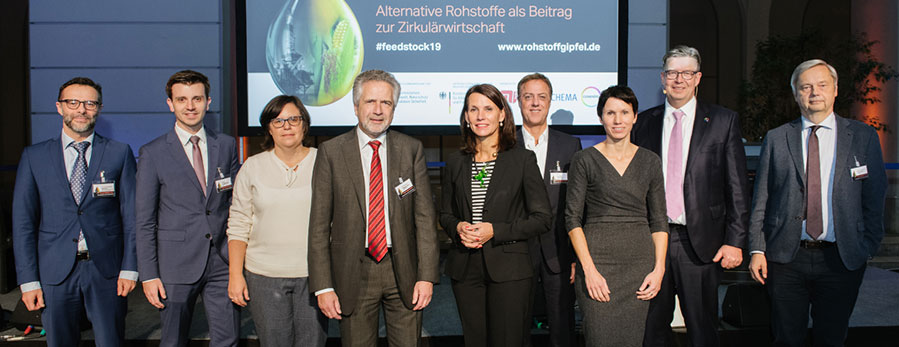
How to get to a Circular Economy was the subject at Raw Materials Summit 2019 in Berlin with representatives from business, politics, media and science. From left: Dr. Frank-Andreas Hatzack, Copenhague Institute for Futures Studies; Philipp Engelkamp, Managing Director Ineratec GmbH; Dr. Adriana Neligan, Senior Economist, German Economic Institute; Professor Kurt Wagemann, Managing Director Dechema; Rita Schwarzelühr-Sutter, State Secretary at the German Federal Ministry for the Environment; Dr. Jürgen Stebani, CEO Polymaterials AG; Judith Skudelny, National parliamentary group FDP; Dr. Klaus Schäfer, Member of the Board of Management Covestro AG; Professor Christian Thomsen, President Technical University of Berlin (c) 2019 Covestro
With sustainable raw materials from waste, plants and CO2, the chemical industry can support the transition to a circular economy. At the Raw Materials Summit 2019, which took place on Monday at the Technical University of Berlin, Germany representatives from business, politics and science called for the increased use of such sources instead of crude oil. Accordingly, non-fossil resources help to close the carbon loop and can contribute to climate protection. At the summit the “Resource Innovator” start-up prize was awarded to the young company Ineratec from Southern Germany.
  • Raw Materials Summit 2019 points way out of the throwaway society  
  • Start-up company wins “Resource Innovator” prize

“The chemical industry is actively pushing ahead with the transformation to a circular economy,” said Dr. Klaus Schäfer, Member of the Board of Management for Production and Technology at Covestro. The materials manufacturer organized the summit again joinly with the Technical University of Berlin and the Dechema Society for Chemical Engineering and Biotechnology.

Waste as a valuable resource

According to Schäfer, it is particularly important to see plastic waste as a resource: “After their use, products must no longer end up uncontrolled in the environment, but must be recycled in an ecologically efficient manner, for example through chemical recycling”, stated Schäfer with a view to politics.

The German government was represented by Rita Schwarzelühr-Sutter, State Secretary at the Federal Ministry for the Environment, Nature Conservation and Nuclear Safety (BMU), who delivered the opening speach. The BMU as well as the Federal Ministry of Education and Research acted as patrons of the event.


Professor Christian Thomsen, President of the Technical University of Berlin, stressed that the academic sector could provide important impetus for research and development into new recycling processes and alternative raw materials. Thomsen: “The interaction of application-oriented basic research and science-based industry is the key to success”.

Promoting a start-up culture

Professor Kurt Wagemann, Managing Director of Dechema, emphasized the importance of a vibrant start-up scene for the realization of new ideas for sustainable production processes and products: “The start-up culture in Germany needs to be more pronounced so that Germany can keep up with international competition”.

Wagemann also selected the “Resource Innovator 2919”. This year's prize at the Raw Materials Summit went to Karlsruhe-based Ineratec GmbH, which was founded in 2016. The company has succeeded in downsizing large chemical plants to miniature size. With these decentralized reactors, high-quality raw materials for the chemical industry can be produced from exhaust gases such as CO2.


More News from Covestro AG

#Textile chemistry

Covestro and Heraeus Precious Metals collaborate to enable safer, more sustainable antimicrobial textile coatings

Laboratory tests reveal that AGXX antimicrobial surface technology from Heraeus Precious Metals is fully compatible with Impranil® PU dispersions which are part of the waterborne INSQIN® textile coating technology from Covestro, paving the way for more sustainable antimicrobial textile coatings. This discovery comes at a key moment for the textile coatings industry. As the sharing economy continues to grow, more people are coming into regular contact with high-use surfaces, creating ideal conditions for bacteria, viruses, and other microorganisms to thrive.

#Textile chemistry

Covestro celebrates decade of innovation and sustainable growth

Covestro celebrates its 10-year anniversary today. Since its carve-out from Bayer in 2015, the company has developed into a global leader in high-performance polymer materials and a pioneer in circular economy solutions. With a strong focus on innovation and sustainability, Covestro’s materials are now embedded in countless applications worldwide – from mobility and construction to electronics, healthcare, and consumer goods.

#Textile chemistry

Covestro extends contract with CTO Dr. Thorsten Dreier ahead of schedule until 2031

Dr. Thorsten Dreier will remain Chief Technology Officer of Covestro for a further five years. The Supervisory Board has extended his contract, which runs until June 2026, ahead of schedule from July 1, 2026 to June 30, 2031.

#Textile chemistry

Suiting up Team Sonnenwagen with more sustainable sportswear created through a three-way partnership

Team Sonnenwagen Aachen, a solar racing collective from RWTH Aachen and FH Aachen, Germany, is on a mission to advance sustainable mobility solutions and become world champions. This August, the student team will participate in the 2025 Bridgestone World Solar Challenge, a biannual 3,000-kilometer race across the Australian outback. During the five-day event, 50 student teams from around the world will compete with solar vehicles that they must design, assemble, and drive themselves.

More News on Recycling / Circular Economy

#Research & Development

Innovation center for textile circular economy inaugurated

Just over eight months after the foundation stone was laid, the new Innovation Center for Textile Circular Economy was officially inaugurated today at TITK Rudolstadt. Thuringia's Minister President Mario Voigt, TITK Director Benjamin Redlingshöfer, and other guests of honor cut the ribbon to the modern building complex and viewed the premises, which are now ready for occupancy. The “DICE – Demonstration and Innovation Center for Textile Circular Economy” is TITK's largest single investment to date. The Free State of Thuringia supported the total cost of €11.5 million with €8 million in GRW and FTI funding.

#Associations

Waste2Fashion: FTTH Committed to advancing Circular Fashion in the Mediterranean

As an official partner of the Waste2Fashion project, the Tunisian Federation of Textile and Apparel (FTTH) participated in the Kick-off Meeting held on 10–11 December in Spain. The event brought together project partners from across the Mediterranean, including Spain, Italy, Egypt, Lebanon, and Tunisia, to align on a shared vision and initiate the first implementation steps.

#Recycled_Fibers

Leading fashion brands step up to unlock the next chapter of Circulose

Since 2024, under new ownership and leadership, Circulose has set a renewed strategic direction focused on securing long-term commitments with partner brands to bring CIRCULOSE® back to market at scale. This strategy has proven successful.

#Recycled_Fibers

Recycling mixed-fibre garments becomes a reality: RadiciGroup, The LYCRA Company and Triumph take circular fashion a step forward

The process, which is both economically and environmentally sustainable, has enabled the production of an underwear set made from 100% recycled nylon and LYCRA® fibre in a closed-loop system.

Latest News

#Research & Development

Sustainable design of Geosynthetics and roof underlayments made from recyclates

Is it possible to recover plastic recyclates from previously unused waste streams in order to produce high-quality fibers and films? How can bio-based polymer fibers be manufactured so as to allow adjustable biodegradability? These are the questions being addressed by researchers from the Fraunhofer Cluster of Excellence Circular Plastics Economy CCPE in the Zirk-Tex project.

#Associations

AATCC announces 2025 Herman & Myrtle Goldstein Graduate Student Paper Competition winners

The American Association of Textile Chemists and Colorists (AATCC) recognized the winners of the 2025 Herman & Myrtle Goldstein Graduate Student Paper Competition. Founded in 1982 to give student members the chance to conduct and present original research, the competition was renamed in 1994 in honor of Herman and Myrtle Goldstein, following their US$60,000 endowment. Their gift is a lasting remembrance of their dedication to young people in the textile industry.

#Nonwoven machines

Yanpai expands nonwovens capacity with two new ANDRITZ needlepunch lines

Zhejiang Yanpai Filter Technology Co., Ltd. (hereinafter referred to as “Yanpai”) has placed an order with international technology group ANDRITZ for two high-performance needlepunch lines. The equipment will be installed at Yanpai’s headquarters facility in Tiantai County, China. Commissioning is scheduled for the third quarter of 2026.

#Natural Fibers

Dr. Jane Dever inducted into the 2025 Cotton Research and Promotion Hall of Fame

Dr. Jane K. Dever, a recognized leader in cotton breeding and fiber quality research, was inducted into the 2025 Cotton Research and Promotion Hall of Fame during the joint Cotton Incorporated/Cotton Board Annual Meeting held on December 9 in New Orleans, LA.

TOP