#Recycling / Circular Economy
Eton’s role in automating the reuse market
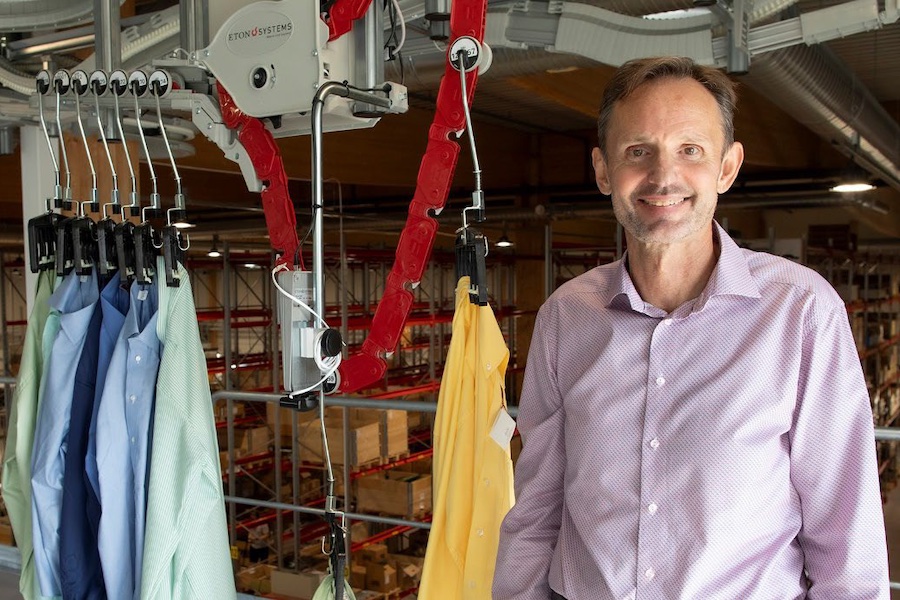
Eton is contributing its well-proven transport system for material handling to the project, which also involves specialists at the Swedish School of Textiles in Borås, the Automation Region innovation cluster at Mälardalen University and the national collaboration platform iHubs Sweden.
High volumes
According to ThredUp’s 2025 Resale Report, the value of the global second-hand apparel market is already worth an annual $256 billion this year and growing at 10% annually to reach a value of $367 bullion by 2029.
Additionally, the online resale segment alone is forecast to double over the next five years to around $40, billion reflecting higher growth of 17%.
“The volumes are now so large that handling must be automated for it to work,” says Jan Molin, CEO of Eton Systems. “The new EU regulations requiring separate collection of textiles are having an impact, but we are also seeing an increasingly positive attitude towards reuse and greater awareness of the textile industry’s environmental impact.”
AI categorisation
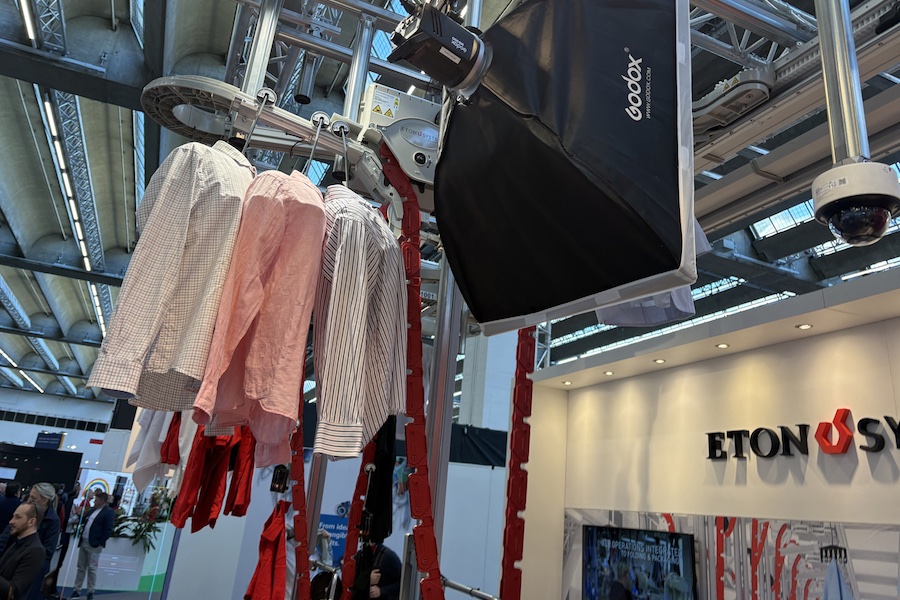
As part of the project, a test facility is being established at Science Park Borås involving garments being placed on custom product carriers within an Eton Systems conveyor system and transported through a series of stations.
The garments are inspected using a vision system, after which AI is employed to categorise them based on parameters such as manufacturer, model and size. Any damage is analysed and the system also provides recommendations for possible repairs.
“The collected information is fed into a calculation model that, based on market data, makes suggestions for a sales price,” Molin explains. “Finally, the garment is photographed for marketing and then transported to a warehouse awaiting sale.”
Historic automation
Eton’s material handling system was developed as early as the 1960s for the company’s own shirt production in Gånghester outside Borås. At the time, material handling was estimated to account for up to 80% of the manufacturing time.
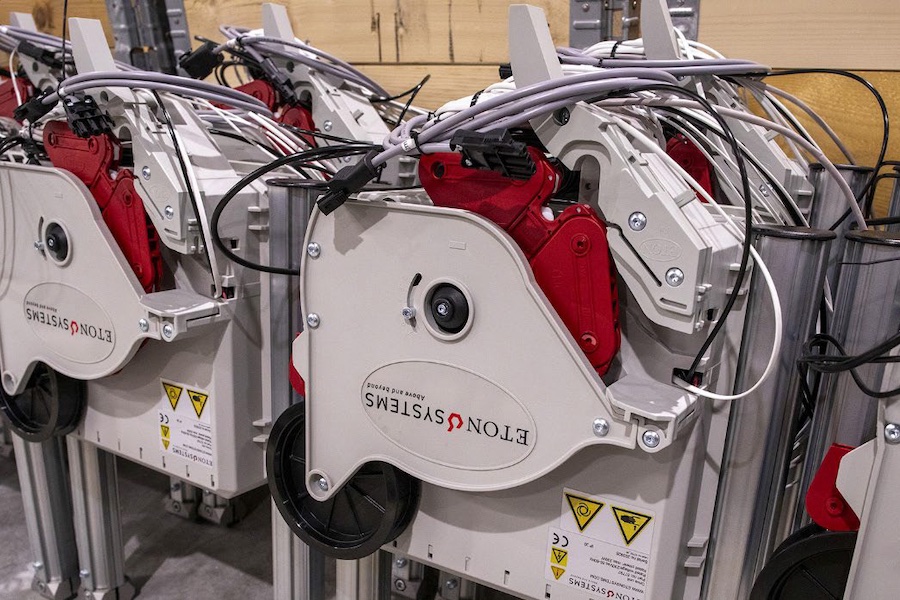
The company’s Unit Production System (UPS) was developed as an automated ceiling-mounted conveyor system that moved the shirts one by one through the various work steps, the company was able to move from mass production to one-off production.
“It provided many benefits, including shorter lead times, greatly reduced material handling time and better ergonomics for operators,” says Molin. “Quality defect costs were also reduced because defects could be detected on individual products instead of at the batch level.”
The UPS concept was very successful and in 1967 was spun off into the stand-alone automation company Eton Systems, which now runs its operations in a modern production facility in Nordskogen in Borås. Its customers are global with an emphasis on clothing production, home textiles and furniture manufacturing, but the system is also used in, for example, the transport and handling of plastic parts for the automotive industry.
Opportunities for Swedish industry
The textile industry has a major environmental impact, not least through extensive overproduction. Clothing companies often order large volumes from the manufacturers and what does not sell is sold out or destroyed.
The Microfactories System Innovation project builds on previous projects that have mainly focused on developing small-scale, local and needs-based production. Now the focus is on the growing market for reuse.
“We see enormous potential in second hand,” says Molin. “It is an area that is growing rapidly and where there is room for innovation and new business models. There is also the opportunity to move technology from other industries.”
Work on the project started in 2024 and will continue for four years. For Eton Systems, participation means both a chance to test new applications for its technology and to strengthen the company’s ability to innovate.
“Collaboration with universities and innovation environments helps us to be at the forefront,” says Molin. “We can participate in freer and more visionary development, without having to take on all the work ourselves. But above all, it is about contributing to a more circular industry, where materials can be used for longer and in a smarter way.”
Accelerating circular systems
“It’s very encouraging to note this growing willingness by many consumers to embrace the second-hand market as an important component of the drive towards accelerating circular systems,” adds TMAS General Secretary Therese Premler-Andersson. “Automation and digitalization as developed by Swedish companies like Eton are increasingly innovating ways in which this market – and more generally textile manufacturing and retailing – can be sustained and made ever more efficient in the general fight against textile waste.”
The Microfactories System Innovation project is funded by the European Regional Development Fund, the Swedish Agency for Economic and Regional Growth, Region Västra Götaland and Region Västmanland.