[pageLogInLogOut]

#Recycling / Circular Economy

Nanollose creates the world’s first wearable fashion garment made from liquid waste

Nanollose garment created from the company’s Tree-Free Rayon fibre © 2025 Nanollose
Australian-based biomaterial technology company Nanollose Ltd (ASX: NC6) has created the world’s first wearable garment using the company’s eco-friendly Tree-Free Rayon fibre (NullarborTM), sourced from sustainable coconut waste.

The sweater is the first of its kind and marks a breakthrough for an industry that is urgently seeking sustainable alternatives to clothing made from traditional rayon and cotton, both of which cause significant environmental issues.

Nanollose Executive Chairman Wayne Best said; “We have successfully taken waste and created clothing, and we have done it following industrial protocol. Our fibre was spun into yarn and made into fabric, then manufactured into this garment using existing industrial equipment. It validates our entire process.”

150 million trees are cut down each year, then chipped and treated with hazardous chemicals to extract the raw material used to make Viscose Rayon fibres for clothing. By contrast, Nanollose’s Nullarbor fibre is made without harming a single tree.

“We didn’t have to cut down any trees to create this sweater, and we have now demonstrated that our Tree-Free Rayon fibre can be used in the same way as other commonly-used fibres to make clothing and textiles, without the hefty environmental footprint.” Mr Best said

Nanollose’s innovative biomaterial technology process begins in a facility where microbes naturally ferment liquid waste products from food industries into cellulose, a cotton-like a raw material that then is transformed into their Nullarbor fibre.

Their process to produce cellulose requires very little land, water or energy and a production cycle is just 18 days, compared to the eight months seen in the cotton industry.

“We believe that we are the only company producing Tree-Free Rayon fibres from waste, and we have now reached a point where our technology is moving out of the laboratory and into the factory. Once we achieve this increased scale, manufactures will have an alternative eco-friendly option available to them.” said Mr Best.
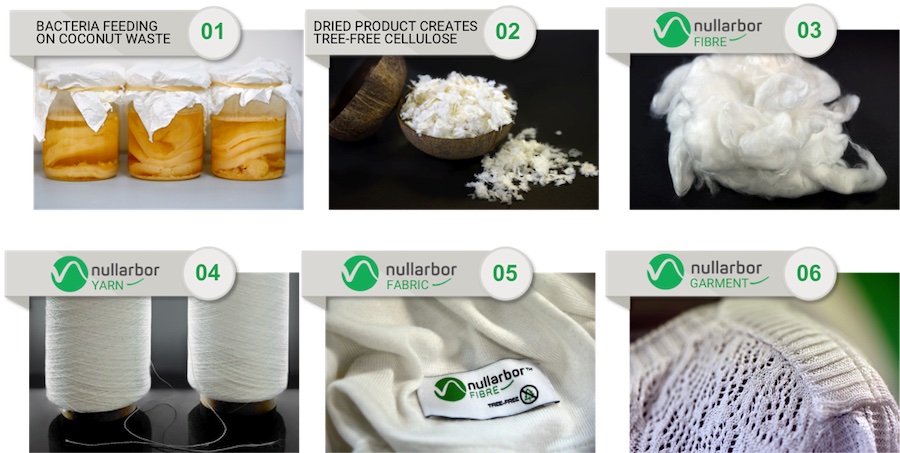
The six steps from taking waste and creating an item of clothing © 2025 Nanollose

As more and more headlines revealing the environmental impact of the textile industry emerge, there is an increasing urgency among consumers, brands, retailers and manufacturers to seek and cultivate alternative fibre resources.

“Progressive brands and companies are starting to facilitate this new shift by involving themselves deeper in the supply chain and searching for feasible, sustainable long-term alternatives. This is evident in the increasing number of enquires we have received over the past six months.” Mr Best said.

This urgency for cleaner alternatives saw retail juggernaut H&M release a sustainability report in April 2017, highlighting their commitment to use 100% sustainably sourced materials by 2030. Similarly, Zara joined the movement with the launch of their new sustainable line ‘Join Life’ modelled by Sasha Pivovrova.

To ensure Nanollose can supply future partners with commercial qualities of fibre, the company is developing a supply chain within an ecosystem around waste from the Indonesian coconut industry (along with waste streams from other industries), and aims to significantly increase fibre production over the next 3-6 months.

“We are a technology company, that has also become a steward in facilitating a new raw material supply chain. The goal is to work with key partners who will simply take waste (instead of trees), produce our Nularbor fibre, and seamlessly integrate them into their clothing supply chain with no retrofitting to existing machinery or processes required”




More News from Nanollose Ltd.

More News on Recycling / Circular Economy

#Recycling / Circular Economy

Advanced Recycling Conference 2025 fuels innovation across key waste streams

The Advanced Recycling Conference (ARC) 2025 brought together nearly 220 experts from 28 countries to spotlight pioneering advancements and foster industry collaboration in recycling across diverse waste streams including plastics, textiles, automotive and other materials.

#Recycling / Circular Economy

ADVANSA launches ADVA®tex: A new step toward textile-to-textile recycling

ADVANSA has introduced ADVA®tex, a new filling fibre made entirely from recycled pre-consumer textile waste, positioning the material as a significant step forward in textile-to-textile (T2T) recycling. The fibre is designed for use in duvets, pillows, mattresses, and furniture applications and is available in three versions.

#Recycling / Circular Economy

European research project addresses textile waste through integrated recycling technologies

A major European research initiative coordinated by Fraunhofer UMSICHT has been launched to develop integrated solutions for textile waste recycling. The AUTOLOOP project aims to create a comprehensive system that could process 1.24 million tonnes of textile waste annually by 2050, whilst potentially creating over 130,000 green jobs across the EU. This project aims to develop, test and integrate automated sorting, tracing, and closed-loop recycling technologies for polyester-based textiles (NRT), addressing the pressing challenge of textile waste management.

Latest News

#Dyeing, Drying, Finishing

Navis TubeTex announces U.S. partnership with Icomatex

Navis TubeTex, a global leader in advanced dyeing and finishing machinery solutions, is pleased to announce a new partnership with Icomatex (www.icomatex.com), a respected European manufacturer of high-quality stenters and textile finishing equipment. Under this agreement, Navis TubeTex will exclusively represent the Icomatex stenter line in the United States.

#Knitting & Hosiery

KARL MAYER celebrates 35 years of EL pattern drive

KARL MAYER is celebrating an anniversary this year: on 30 November 1990, the first warp knitting machine with electronic guide bar control, the KS 4 EL, was delivered – another milestone for patterning. As early as 1980, the SU gearbox with the MRS42SU had initiated the transition from mechanical chains to digital data.

#Research & Development

The region of renewable raw materials: Central German Alliance for Bioplastics

The development of sustainable plastic solutions is rapidly gaining importance in light of global environ- mental pollution, dwindling fossil resources and ambitious climate protection targets. As part of the re- gional alliance RUBIO, which brings together 18 partners from central Germany and the Berlin-Branden- burg area, the bio-based and biodegradable plastic polybutylene succinate (PBS) was comprehensively investigated, starting with the raw material, through the manufacturing process, to industrial application.

#Textile processing

YKK receives ISPO Textrends Awards for circular innovations

YKK Corporation (Headquarters: Chiyoda-ku, Tokyo; President: Koichi Matsushima; hereafter, YKK) is pleased to announce that the ISPO Textrends judges have selected YKK's 3D Composite Puller as the Best Product in the Accessories category. They also selected YKK’s NATULON Plus® Fiber Sourced™ zipper with Recycled PET Open Parts as a Top 5 item in the same category. The competition, held twice a year in conjunction with the ISPO trade show, recognizes the most innovative performance textiles, components, and apparel.

TOP