[pageLogInLogOut]

#Recycling / Circular Economy

14 brands unite with Fashion For Good for ambitious push into footwear circularity
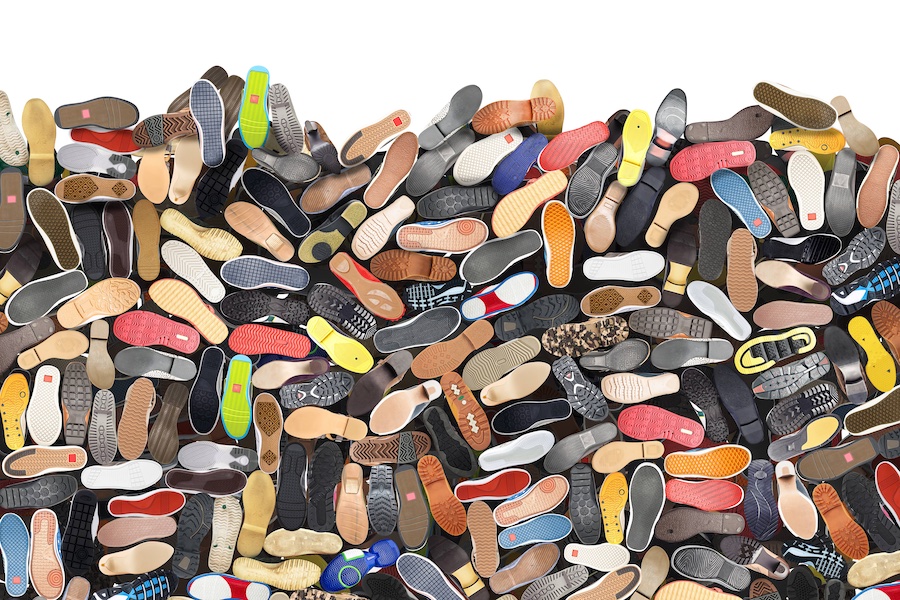
Fashion for Good today announced "Closing the Footwear Loop," a major initiative bringing together 14 leading fashion and footwear brands and their existing circularity programmes to tackle the industry's complex circularity challenges. This collaborative project aims to enable the transformation of footwear's current linear "take-make-dispose" model into a circular one, driving innovation across the value chain.
Fashion for Good and partners are going to close the footwear loop © 2025 Fashion for Good


Participating brands include: adidas, DEICHMANN, Dr. Martens, Footwear Innovation Foundation (affi liated with FDRA), Inditex, lululemon, ON, Otto Group, Puma, Reformation, Target, Tommy Hilfi ger, Vivobarefoot, and Zalando.

Footwear: A complex challenge

The global footwear industry churns out an astonishing 23.8 billion pairs of shoes(1) annually, a figure that highlights both its scale and its environmental footprint. Each shoe is composed on average of more than 60 different components(2), ranging from fabrics and plastics to rubber and adhesives, intricately assembled to meet performance, aesthetic, and cost demands. This complexity, however, hinders the adoption of circular practices, leaving the sector lagging behind in circular innovation compared to other areas of fashion.

While consumers and the industry alike are increasingly calling for more circular solutions, the reality is stark: the most recent studies conclude that approximately 90% of footwear ends up in landfills(3), contributing to an ever-growing mountain of waste. Unlike other areas of fashion where innovation has been more readily integrated, footwear's multi-material construction and complex design complicate efforts to sort, disassemble, or recycle effectively.

This challenge is exacerbated by a lack of reverse logistics infrastructure and the absence of design principles that prioritise circularity. Current practices largely focus on linear production models — manufacture, use, and discard — failing to address the lifecycle of products. The sector's lag in scaled innovation compared to apparel underscores the urgency for systemic change, as the environmental consequences of inaction continue to mount.

While this complexity presents a signifi cant hurdle, brands are already exploring innovative solutions, including material science advancements and take-back programs, to address these challenges and pave the way for more circular footwear. These individual efforts complement the collaborative work within “Closing the Footwear Loop”, creating a synergistic approach to driving industry-wide change.

We are working with ecosystem partners The Footwear Collective, Global Footwear Future Coalition (GFFC), and Global Fashion Agenda to drive a collaborative approach across the industry.

Closing the Footwear Loop was born out of Pioneering the Future of Footwear and addresses multiple key intervention points: lack of end-of-life infrastructure, complex multi-material designs, and a need for unifi ed circularity approaches. This project will deliver:

? Detailed mapping of European footwear waste streams (in collaboration with Circle Economy), providing crucial data on volumes, materials, rewearability, and recyclability. (Report & business case assessment due 2025)

? A roadmap towards circular footwear design, developed with Fashion for Good Alumni circular.fashion, outlining principles for material selection, durability, recyclability, repairability, and responsible chemical management. (Guidelines due 2025)

? Validation of end-of-use innovations, including trials and impact assessments, to overcome current bottlenecks and drive industry-wide adoption. (Recycled material outputs due 2026)

“The footwear industry stands at a critical turning point. With billions of shoes produced annually and 90% ending up in landfi lls, 'Closing the Footwear Loop' represents our most ambitious effort yet to reimagine how we design, use, and dispose of shoes. By bringing together 14 leading brands, we're not just addressing a challenge—we're creating a blueprint for systemic change.” Katrin Ley, Managing Director of Fashion for Good.

You can fi nd more information on the project here:

https://www.fashionforgood.com/case-study/closing-the-footwear-loop/

1 World Footwear. (2023). The World Footwear Yearbook 2023. Available here.

2 Cheah, L., Duque, C. N., Olivetti, E., Matsumura, S., Forterre, D., Roth, R., & Kirchain, R. (2013). Manufacturing-focused emissions reductions in footwear production. Journal of Cleaner Production.

3 Vivobarefoot. 22 billion pairs of shoes are dumped into landfi ll each year. It’s time for change. 


More News from Fashion for Good

#Recycling / Circular Economy

Fashion for Good releases open-source blueprint for near-net-zero textile manufacturing

Fashion for Good launches the first open-source blueprint for near-net-zero textile manufacturing, tackling one of fashion’s biggest emissions hotspots. Developed under the Future Forward Factory project, the blueprint offers Tier 2 manufacturers in India five practical, financially viable pathways to reduce carbon emissions by up to 93%.

#New Materials

From premiums to parity: How Fashion for Good is rewriting the economics of new materials

Fashion for Good launches Price Parity Toolkit: developed with support from Laudes Foundation, Canopy and Finance Earth, the framework introduces an innovative financing approach (premium decoupling) to remove price premiums from the supply chain and unlock faster adoption of lower-impact materials across the industry.

#Natural Fibers

Fashion For Good launches “Beyond50 Denim” to address hemp integration barriers in global denim production

Fashion for Good, together with leading global brands BESTSELLER, C&A, PDS Limited, Reformation, and Target, launched Beyond50 Denim: Combining Cottonised Hemp and Green Chemistry, a project accelerating the use of hemp as an alternative to conventional cotton in denim. By combining two pioneering innovations (SEFF’s Nano-Pulse™ cottonised hemp fibres and FIBRE52™’s proprietary chemistry formulations with soft handfeel), the project seeks to demonstrate that hemp-based denim can match or even surpass cotton in both performance and appeal.

#Sustainability

Fashion For Good unveils “The Next Stride”, a new footwear project to replace fossil fuel mate-rial with bio-based sole innovation

Fashion for Good today announced the launch of The Next Stride: Bio-Based Materials for Footwear Soles, a 12-month project to transform the $400 billion footwear industry¹ by reimagining one of its most impactful components: the sole. In partnership with adidas, Target, and Zalando, alongside leading material innovators Algenesis Labs, Balena, Evoco, KUORI, and Yulex, the initiative will test and validate bio-based polymers as high-performance alternatives to the fossil fuel–derived materials that dominate footwear production. By focusing on the sole (the foundation of every shoe), The Next Stride aims to accelerate the industry’s shift toward scalable, circular solutions.

More News on Recycling / Circular Economy

Latest News

#People

Happy Holidays!

Dear reader, the year 2025 is drawing to a close. We are entering what we hope will be a peaceful holiday season, spending time with our families and taking a moment to pause and reflect. We hope we have been able to support you once again this year with relevant news and articles, and we look forward to surprising you with many innovations in the coming year. Enjoy the festive season, stay healthy, and we wish you a happy and joyful holiday season.

#Weaving

Lindauer Dornier announces leadership transition in weaving machine business

After more than ten successful years at Lindauer DORNIER GmbH, Mr Wolfgang Schöffl will leave the family-owned company at the end of the year to enter well-deserved retirement.

#Heimtextil 2026

Texpertise Focus AI: Messe Frankfurt puts Artificial Intelligence centre stage at its international textile and apparel trade fairs

Under the banner 'Texpertise Focus AI, Messe Frankfurt will place a strong emphasis on Artificial Intelligence (AI) across its international textile and apparel trade fairs from 2026 onwards, setting a future-shaping signal for the industry. The initiative highlights the responsible use of AI along the entire textile value chain, from fibre production to the point of sale. The programme will launch at Heimtextil in Frankfurt in January 2026.

#Technical Textiles

Autoneum and Polestar set new benchmarks for passenger experience and sustainability

As the global market leader in sustainable acoustic and thermal management, Autoneum is a key supplier of interior and exterior components for the highly anticipated Polestar 5 model. The successful collaboration between Autoneum and Polestar marks a significant milestone in sustainable automotive engineering: the electric grand tourer sports car features several innovations in lightweight, fully recyclable polyester-based components that ensure a superior driving experience. Polestar 5 was revealed at the IAA Mobility 2025 in Munich and is available in 24 markets.

TOP