#Recycling / Circular Economy
The Renewable Materials Conference hits the mark again
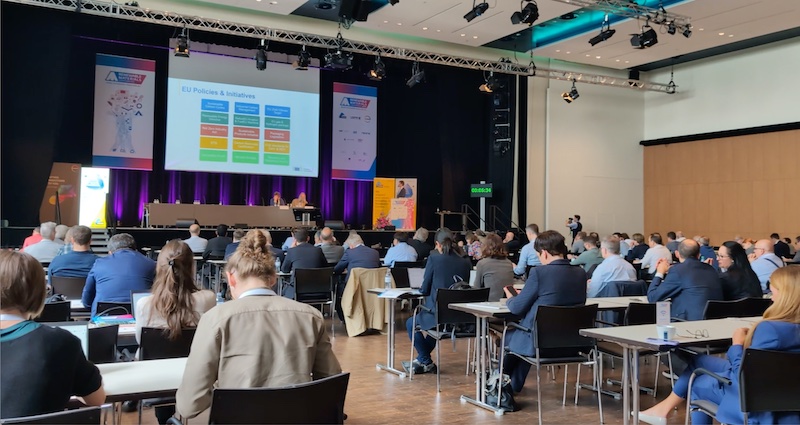
Over three days, 440 participants from 26 countries met, representing leading brand manufacturers, chemical and material companies, as well as the European Commission – DG Grow, Clima, Environment and RTD – and the Dutch and German governments. As in previous years, participants were extremely satisfied: High-quality, cutting-edge content in the 80 presentations, in-depth discussions in ten workshops, an exhibition, the election of the "Renewable Material of the Year 2024", extensive networking opportunities during the conference and the three evening events, an overall professional and enjoyable atmosphere (“special spirit”) – right down to a traditional carnival dance show from the region as a big surprise at the evening buffet.
The event's platinum sponsor was UPM of Finland, which operates Europe's first new biorefinery in Leuna, Germany.
Messages from the conference
Speakers highlighted the importance of moving to sustainable and renewable materials and the need to tackle Scope 3 emissions. The momentum for LCA and carbon footprints is now: "Measure what you treasure" (Ivana Krkljus, BASF).
Industry is on the verge of a major transformation, and the different corporate strategies are united by a clear commitment to bio- and CO2-based solutions, combined with recycling, to keep carbon in the cycle and remove all fossil carbon from the ground in the long term. The future industrial production will have to be completely redesigned to meet new challenges: "Biodiversity equals robustness equals resilience – resilience and adaptability will become more important than efficiency" (Lars Börger, industry insider).
The conference showcased a wide range of new products and facilities, many of which were only made possible through collaboration along the value chain. On the one hand, the conference focused on typical petrochemical building blocks such as naphtha or ethylene, which are now also produced using biomass, CO2, pyrolysis or gasification. On the other hand, there are completely new solutions such as fillers from lignin, glucopolymers or polyoil and PUR from rapeseed oil. There are many new renewable routes, especially for fine chemicals, personal care, coatings and adhesives or new premium quality snack packaging that contains 50 % recycled plastic and meets stringent food contact requirements.
A recurring theme in the presentations was that, unlike the US or China, Europe currently lacks an appropriate policy framework to support the transition to renewable carbon in the chemicals and materials sector. Two workshops discussed what instruments the EU should have at its disposal to transform the chemical industry while maintaining its competitiveness. Many ideas and impulses now need to be further developed.
Although biodegradation is not a major issue in Europe, unlike China or other Asian countries, key methods for understanding biodegradation are now established. For the first time, the fate of carbon in a biodegradable polymer can be tracked very precisely using isotope-labelled polymers to show that the carbon ends up as CO2 and in microbial biomass. A new technique using fluorescently labelled materials can also prove once and for all that certified compostable materials leave no microplastics behind. These advances in the scientific understanding of biodegradation will be used to prepare future regulations to implement the obligation to use biodegradable materials in relevant applications that end up in the environment.
Innovation Award “Renewable Material of the Year 2024”
For the fourth time, the innovation award “Renewable Material of the Year” was granted for the development of new technologies and applications, which combines all renewable material solutions in one competition – from biomass and CO2 utilisation to recycling. Six innovations were nominated by a panel of experts from 38 submissions. After 10-minute presentations by the nominees, the participants chose the winner. The innovation award was organised by the nova-Institute and sponsored by Covestro (Germany). The three winners in detail:
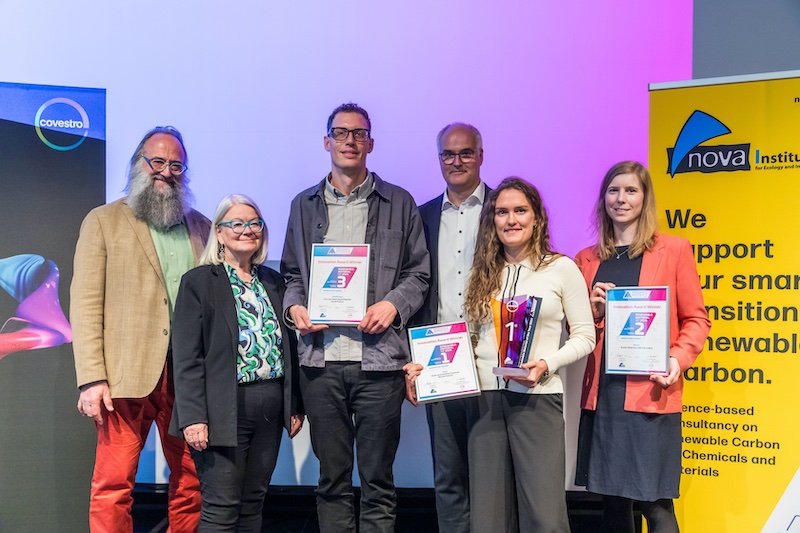
First Place
Again (Denmark): Acetic Acid and Other Chemicals Derived from CO2
By combining millennia-old bacteria with cutting-edge biotechnology, Again ferments waste CO2 emissions directly from flue gas into CO2-derived base chemicals such as acetic acid. Its novel biomanufacturing process captures unavoidable carbon emissions from industry and reuses them to produce valuable base chemicals for which there are currently few or no green alternatives, helping to defossilise some of the world’s most challenging value chains. This biomanufacturing process represents a paradigm shift, eliminating the need for energy and cost-intensive CO2 capture and purification. More information: https://again.bio
Ida Rask Kongsgaard, Again: ”We are honoured to be awarded ‘Renewable Material of the Year 2024’ amongst an inspiring line-up of nominees at this year’s Renewable Materials Conference. A big thanks to our off taker HELM (Germany), who have been a pivotal support in our commercialization journey. We are excited to bring our products to the market together and to start defining the new normal for a greener chemical industry.”
Second Place
Reselo (Sweden): Rubber Made from 100 % Birch Bark
Reselo addresses the need for alternative fossil-free rubber polymers driven by external and internal pressures across the rubber industry. Reducing the climate impact of materials is a priority, but so far there has been little innovation in more sustainable solutions, especially in the rubber segment. Reselo Rubber is therefore very attractive as it is 100 % made from birch bark, a waste stream from the forest industry. The polymer can be processed in existing equipment and is compatible with current vulcanisation systems, elastomers and additives. Reselo Rubber is currently being used in a number of applications in collaboration with global companies to bring more sustainable products to the market. More information: https://reselo.se/
Josefin Larsson, Reselo: “Being recognized as the top three ‘Renewable Materials of the Year 2024’ by industry peers is an achievement we are very proud of and encourage us on our journey. More importantly, it is a testament to the need of welcoming new categories of materials from different bio-based resources to ultimately defossilise the rubber and plastic industry.“
Third Place
VAUDE Sport (Germany): First?ever Wood?based Polyester Textile Product
Until now, recycled PET has been favoured for textiles, but criticism is growing over quality concerns. With this first milestone, VAUDE, in cooperation with UPM (Finland), demonstrates the feasibility of tapping new European bio-based sources. The MEG in this demonstrator is made from wood residues and is intended as a drop-in solution without compromising on quality. The goal for the commercial version is a 100 % bio-based solution, which contains, besides bio-based MEG, fully bio-based purified terephthalic acid (PTA). VAUDE is demonstrating a scalable commercial approach to renewable PET and shows what such a solution could entail. More information: https://vaude.com
René Bethmann, VAUDE Sport: “We are thrilled to have won third prize. This achievement once again underscores the importance of collaboration along the entire value chain and highlights that we can only achieve a sustainable transformation together.“