[pageLogInLogOut]

#Recycling / Circular Economy

NILIT goes circular with SENSIL® Flow
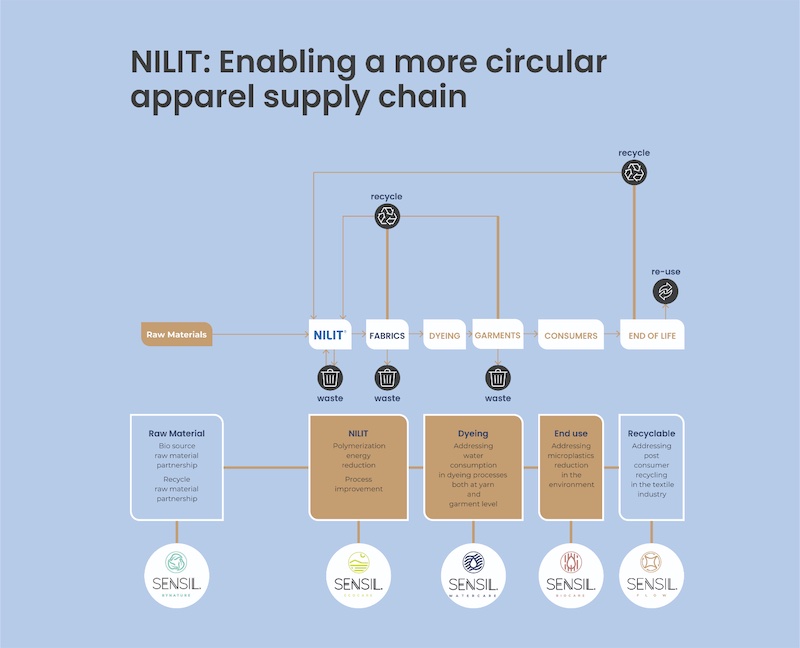
NILIT, the global market leader, and a producer of high quality Nylon 6.6 for apparel and owner of the SENSIL® brand, introduces SENSIL® Flow, a new approach to Nylon 6.6 circularity that enables yarn, fabric, and, ultimately, apparel recycling to eliminate waste and further reduce apparel’s environmental impact. SENSIL® Flow is more than just a sustainable performance product. It is an innovative approach that engages the entire supply chain to truly attain circularity through product design and partnership.
NILITs new SENSIL Flow approach engages the entire textile supply chain to reduce waste throughout, increase the use of recycled content, and ultimately enable apparel recycling with long-lasting garments thoughtfully designed using new mono-component premium SENSIL Flow Nylon 6.6. (Graphic: Business Wire)


“Our mission to create a more sustainable textile industry requires a shift in mindset throughout the value chain,” says Ilan Melamed, NILIT General Manager. “SENSIL® Flow represents an out-of-the-box approach that directly enables yarn and fabric recycling and lays the groundwork for apparel recycling and is part of a broader circularity mission for NILIT. Such a significant industry transformation can only be attained through deep partnerships that create innovative products and processes, visionary designs, and a collaborative reconfiguration of the value chain itself.”

“According to industry experts, more than 90 million tons of apparel end up in landfills each year,” says Michelle Lea, NILIT’s Chief Marketing and Sustainability Officer. “Only about a fifth of discarded clothing is reused or recycled. The SENSIL® Flow approach eliminates waste throughout the production chain and enables brands to design apparel that lasts longer and, at the end of an extensive life, can be more easily recycled.”

Today, apparel recycling is constrained by the complexity of sorting and separating materials before they can be recycled back to their original components, Garments made with blended fibers and fabrics are especially difficult to recycle.

The SENSIL® Flow approach addresses these obstacles on multiple fronts. First, SENSIL® Flow is a yarn that delivers a mono-component fabric with comfort stretch that can be considered as an alternative to elastane in certain end uses. Engineered to provide inherent elasticity and recovery properties, SENSIL® Flow creates comfortable, stretchable performance fabrics for the casual and lifestyle segments. These beautiful fabrics have excellent color absorption and exquisite 3D effects while at the same time making post-consumer recycling possible. Pure premium Nylon 6.6 yarns, fabrics, and garments are easily recycled using a process that requires no additional chemicals and generates minimal CO2 emissions.

Additionally, NILIT partners with recycling experts to facilitate the efficient recovery and recycling of fabric waste and post-consumer fabrics and clothing that would otherwise end up in a landfill or incinerator. These partners are expected to create high quality recycled Nylon chips that can be reintroduced into NILIT’s Nylon fiber spinning process, resulting in high quality outputs, as well as other engineering plastics. Certificates will validate circularity and provide transparency and accountability for partners committed to building a circular textile economy.

Celebrating 50 years of excellence, NILIT offers a comprehensive collection of premium Nylons designed to empower the apparel industry’s shift to a more sustainable position. NILIT launched industry-first SENSIL® ByNature made using bio-gas from reclaimed landfill waste. SENSIL® BioCare is enhanced with a special technology proven to help lessen the persistence of textile waste in sea water and in landfills. SENSIL® EcoCare, crafted with recycled Nylon, improves circularity and LCA. SENSIL® WaterCare with embedded color saves up to 100% of the water used in the traditional wet dyeing process. Plus, the complete SENSIL® portfolio of products is manufactured according to NILIT’s Total Product Sustainability criteria. These responsible yarns give designers the beautiful, environmentally considerate performance fabrics they need to create apparel collections that respond to consumer demands.




More News from NILIT

#Recycling / Circular Economy

Samsara Eco and NILIT team up to build world-first Nylon 6,6 recycling facility

Samsara Eco, the enviro-tech innovator and NILIT, the world’s leader in the production of nylon 6,6 for apparel, have announced plans to explore investment and construction of a nylon 6,6 textile-to-textile recycled polymer production site in South East Asia to help close the loop on nylon 6,6.

#Yarn & Fiber

NILIT announces strategic expansions, including a joint venture with Shenma in China

NILIT, the global leader in high-performance Nylon 6.6 fibers for the apparel industry and leader in sustainability, that owns the broadest line of sustainable Nylon 6.6 products, is announcing a new joint venture with Shenma Industry Co., Ltd. (hereinafter referred to as Shenma), a subsidiary of China Pingmei Shenma Group, a global leader in the industrial Nylon 6.6 market and a leading supplier to the automotive industry around the world.

#Yarn & Fiber

NILIT scores for sustainability with award winning partnerships

Experience Game Changing SENSIL® Premium Nylon 6.6 at ISPO Munich Stand A1.444

#Yarn & Fiber

NILIT raises the sustainability bar with durable SENSIL® Toughtex

NILIT introduces SENSIL® Toughtex, the innovative premium Nylon 6.6 yarn for protective apparel that is substantially more resilient and abrasion resistant than conventional nylon with less environmental impact, too. SENSIL® Toughtex is manufactured according to NILIT’s Total Product Sustainability Program and can be enhanced with other SENSIL® technologies such as WaterCare color-embedded Nylon 6.6 for water savings, EcoCare recycled Nylon 6.6, and ByNature for lower CO2 emissions.

More News on Recycling / Circular Economy

#Recycled_Fibers

Reju announces site selection for French Regeneration Hub in Lacq advancing Europe’s circular textile infrastructure

Reju, the textile-to-textile regeneration company based in France, announces the site selection for an industrial sized Regeneration Hub, in Lacq, in the Pyrénées-Atlantiques, on the Induslacq platform. Reju, a Technip Energies owned company, is deepening its roots in France through the development of this new Regeneration Hub.

#Technical Textiles

Covestro showcases monomaterial concept in autonomous SUE People Mover

UE | STUDIOS has unveiled the fully autonomous electric minibus “Self-driving Urban E-Shuttle” (SUE), placing strong emphasis on sustainable material design. Developed within a project funded by the Federal Ministry for Economic Affairs and Energy (BMWE) and the European Union, the vehicle will begin public road testing this year. At the core of the concept is the consistent use of recyclable monomaterials to improve circularity at end of life.

#Recycled_Fibers

Circ announces New Fiber Club partners to accelerate commercial adoption of recycled textiles

Circ®, a global leader in textile‑to‑textile recycling, announced the scaling of its Fiber Club initiative. Building on the success of the inaugural program, Circ is bringing together a new group of brand partners: the lifestyle brand Madewell (under J.Crew Group), sustainable fashion brand Reformation, and European retailer C&A, alongside supply chain partners Lenzing and Linz Textil.

#Recycling / Circular Economy

Circulose restarts commercial-scale production at Ortviken plant in Sundsvall

Circulose today announced the restart of its commercial-scale production plant at Ortviken in Sundsvall, Sweden, marking a significant step in scaling next-generation materials for the global fashion industry. The company plans to resume production of CIRCULOSE®, a recycled pulp made entirely from discarded cotton textiles, in the fourth quarter of 2026.

Latest News

#Raw Materials

Esquel Group adds two new extra-long staple cotton varieties approved

Esquel Group’s Xinjiang Research & Development Center has successfully developed two new Sea Island cotton (Extra-Long-Staple cotton, ELS cotton) varieties named “Yuan Loong 37” and “Yuan Loong 42,” which have been officially approved and granted registration numbers. Both varieties have also obtained Plant Variety Rights certificates, marking another significant breakthrough for the Group in cotton breeding and commercial application.

#Weaving

Itema America acquires Palmetto Loom Reed, strengthening local manufacturing and service in the U.S.

Itema America, the U.S. subsidiary of Italy-based Itema Group, has acquired – through an Assets Purchase Agreement – Palmetto Loom Reed, a Greenville, South Carolina-based manufacturer of weaving reeds and one of the last remaining domestic producers of these precision components in the United States.

#Functional Fabrics

lululemon introduces Unrestricted Power™ — A new sensation for strength training

lululemon (NASDAQ: LULU) has unveiled Unrestricted Power™, a new innovation platform engineered for heavy lifts and demanding gym sessions. The assortment, which launches in North America, is backed by thousands of hours of research and development, providing secure support without compromising comfort and mobility, enabling a distraction-free fit built to match every move.

#Raw Materials

Aid by Trade Foundation reaches new milestones in supply chain transparency

The Aid by Trade Foundation (AbTF) is reaching new milestones as it leads the way towards greater physical traceability for Cotton made in Africa® (CmiA) cotton. With around 700 suppliers and producers in a total of 25 countries, the Aid by Trade Foundation has reached a new record number of partners who can trace CmiA cotton from the product back to its origin. This is more than double the previous year’s figure.

TOP