[pageLogInLogOut]

#Natural Fibers

Better Cotton partners with Planboo to reduce emissions using cotton crop waste
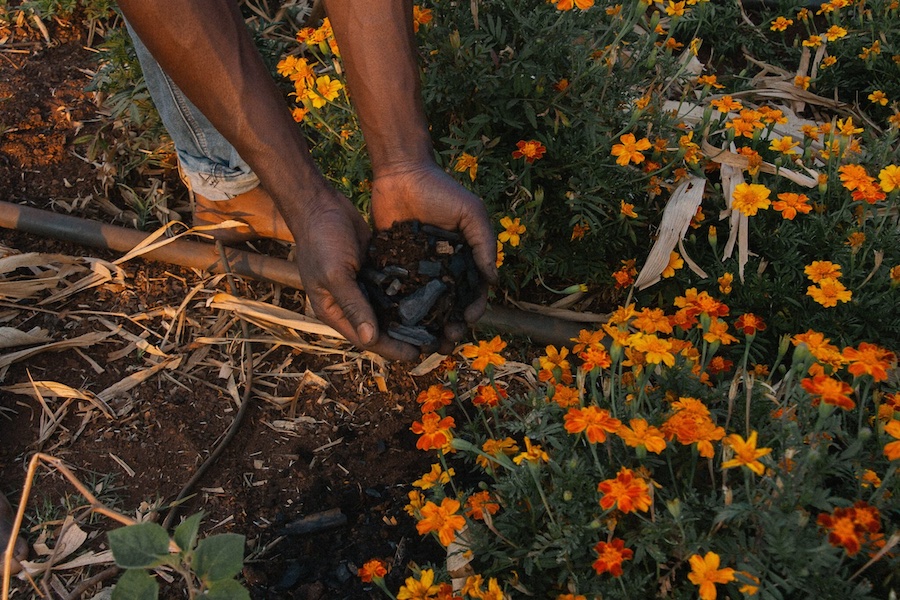
Better Cotton, the world’s largest cotton sustainability initiative, has teamed up with climate technology startup Planboo to help cotton farmers reduce greenhouse gas (GHG) emissions – and earn carbon credits for it.
Farmer holds biochar produced using crop waste © 2025 Planboo.


The partnership will involve biochar, a charcoal-like substance made from agricultural waste and other waste products that, when applied to soils, can improve their health, while helping them store carbon for more than a century.

Biochar is known to improve the structure of soil and enhance its ability to retain water and nutrients, while limiting chemical fertiliser use. In collaboration with Planboo, Better Cotton will support licensed farmers to produce this topical solution from farm waste and later apply it on the ground – providing environmental benefits in both phases.

Lars van Doremalen, Director of Impact at Better Cotton, said: “Planboo has championed biochar for over half a decade, and it is easy to see why. This age-old practice creates value from waste and boosts the climate resilience of land. Add to that the scope for farmers to be financially rewarded for their sustainability efforts, and this is an incredibly exciting proposition.”

Better Cotton will leverage Planboo’s digital Measurement, Reporting, and Verification (MRVin) system throughout this work, capturing data points from the production of biochar to the calculation of carbon reductions and removals.

This end-to-end software synchronises data to accurately calculate waste inputs, biochar volumes, carbon removals, and subsequent carbon allocation. As such, it unlocks new income streams for communities committed to reducing carbon emissions and improving their soil health.

Retailers and brands can also benefit, as their support to scale these efforts within the value chain would help mitigate Scope 3 emissions, which account for the vast majority of greenhouse gas release by the fashion and textile industries.

Freddie Catlow, Co-founder & CEO said: “From our very first days, Better Cotton stood out as the partner to deliver impact within fashion value chains. After seeing a 60% yield increase in cotton crops from our Solidaridad project in Zambia, it became clear this model was well-suited for cotton farming regions.

“With Better Cotton’s global reach and Planboo’s digital MRVin, we’re excited to embed carbon removal and soil health into the fabric of cotton farming, rooted in regeneration, and scaled by software.”

Better Cotton and Planboo will soon provide details of the scope of their first project, targeting smallholder cotton farming communities in India.


More News from Better Cotton

#Raw Materials

Better Cotton Initiative marks certification anniversary with progress update and accreditation

One year since becoming a certification scheme, the Better Cotton Initiative (BCI) has announced that more than 3,000 supply chain actors have been certified. At farm level, more than 30% of farms and producer units supplying BCI Cotton have received a positive audit outcome.

#Raw Materials

Better Cotton Initiative opens enrollment in the US with promising opportunities for producers

Producer enrollment for the US Program of the Better Cotton Initiative (BCI) is open until May 15 for the 2026-2027 season. With over 2,600 members spanning the cotton supply chain and more than 11,000 users of its Better Cotton Platform (BCP) as of 2025, BCI’s standard is implemented in 15 countries and covers one fifth of global cotton production.

#Natural Fibers

Better Cotton Initiative partners with Uzbek government agency to offset certification costs

The Better Cotton Initiative (BCI) has today announced a strategic agreement with Uzbekistan’s Light Industry Agency to increase financial support for cotton farming clusters adopting sustainable agricultural practices.

#Natural Fibers

Better Cotton Initiative surpasses 50% traceable BCI Cotton milestone

Two years since the launch of its traceability solution, the Better Cotton Initiative (BCI) has announced that over 50% of BCI Cotton volumes entering global fashion and textile supply chains are now traceable, deriving from 15 countries.

More News on Natural Fibers

#Man-Made Fibers

Lenzing AG to become majority owner of TreeToTextile AB and accelerates industrialization of new fibers

The Lenzing Group is taking another strategic milestone by acquiring a controlling majority in the Swedish innovation company TreeToTextile AB. This step strengthens Lenzing’s position as a leading provider of sustainable, wood‑based specialty fibers and expands its innovation pipeline with a highly scalable, patent‑protected technology platform. The transaction is executed through the issuance of new shares.

#Raw Materials

Cotton Incorporated appoints Bev Sylvester as Chief Marketing Officer

Cotton Incorporated announces the appointment of Bev Sylvester as chief marketing officer. In this newly created role, Sylvester will oversee Cotton Incorporated’s marketing strategy, brand positioning, consumer engagement and global outreach to increase demand for cotton and strengthen its relevance in the marketplace.

#Composites

Alliance for European Flax-Linen & Hemp expands bio-materials presence at JEC World 2026

The Alliance for European Flax-Linen & Hemp is pleased to announce its participation at JEC World 2026, featuring a significantly expanded presence and an enhanced offering for the global composites industry.

#Europe

ICAC to support European Commission on pending PEF legislation

The International Cotton Advisory Committee (ICAC) is proud to announce that it has been included as a member of the European Commission’s Technical Advisory Board (TAB) on the Product Environmental Footprint methodology. The Commission developed the Product Environmental Footprint (PEF) to assess and communicate the life cycle environmental performance of products and organizations.

Latest News

#Functional Fabrics

“Action helps us change what we do!”

DAY 0 takes place deliberately before PERFORMANCE DAYS begins. It is conceived as a space for reflection, dialogue and active engagement — a moment to pause before the fair, rethink established systems and address sustainability not as a trend, but as a fundamental transformation challenge. Under the guiding metaphor “Turn the Tap Off”, DAY 0 focuses on root causes rather than symptoms, systemic change rather than isolated solutions, and collective responsibility rather than individual silos.

#Textiles & Apparel / Garment

Pets in fashion: functional and sustainable textiles find new market at Intertextile Apparel

China’s pet economy is booming, especially amongst younger generations, and pet apparel – from designer outfits to functional garments – was a RMB 3.5 billion (over USD 500 million) market in 2024, growing more than 20% annually¹. To help exhibitors harness this trend, Intertextile Shanghai Apparel Fabrics – Spring Edition 2026 will launch the Pet Boutique, presenting a range of innovative, sustainable materials that prioritise both functionality and comfort for pets.

#Sustainability

VAUDE eliminates PFAS from all products

PFAS (per- and polyfluoroalkyl substances) are now detectable worldwide – in drinking water, soil and the human body. These so-called “forever chemicals” are considered hazardous to health and potentially carcinogenic, as they do not break down and remain in the environment permanently. Despite these risks, PFAS are still used in a wide range of products. More than 15 years ago, VAUDE made a strategic decision to gradually eliminate PFAS from all product categories.

#Europe

FITA, ABIT and EURATEX underline strategic importance of Mercosur – EU Partnership Agreement for the textile and apparel industry

The Argentine Textile Industry Federation (FITA), the Brazilian Textile and Apparel Industry Association (ABIT), and the European Apparel and Textile Confederation (EURATEX) continue to monitor the process of internalizing the Mercosur-European Union Partnership Agreement. This agreement is essential for the competitiveness of our industries, on both sides of the Atlantic.

TOP