[pageLogInLogOut]

#Raw Materials

The effects of solar panels on sheep grazing

Solar panels are being promoted as one of the best methods to produce green energy. As a result, in addition to wind energy facilities, solar panels are starting to take up space no open pasture across the world. How will affect the grazing patterns of livestock – in particular, sheep? International Wool Textile Organisation (IWTO) offers a sneak peek at research conducted by Emma Kampherbeek, MSc., Dr. Zachary McFarlane, Dr. Laura Webb, and Dr. Seeta Sistla, which sets out to answer this question.

How Sheep Respond To Solar Panels On Their Grazing Lands

The research project undertaken by Kampherbeek, McFarlane and Sistla aimed to “investigate the effects of solar panels on sheep grazing behaviour…” Two types of grazing management strategy are proposed – intensive rotational grazing or rotational grazing. The research was also intended to determine which of the two would be most suitable.

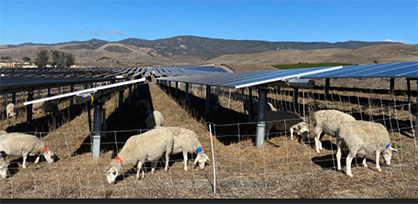
Working on the Gold Tree Solar Farm in San Luis Obispo County, California, the researchers observed the grazing behaviour of sheep on and around the solar facility. Four groups of sheep were selected and tagged – two solar groups and two control groups. The control groups were sent out to graze on native rangelands. While the solar group were confined to the land on which the solar facility had been set up. However, since the solar farm had little available forage, it had to be supplemented with alfalfa hay. The overall result of the study was that sheep on the solar farm preferred to graze underneath the solar panels, rather than in the alleys between them. It was also conclusively observed that sheep on the solar farm spent more time grazing than those on the rangelands.

It was also found that sheep in 4-day rotations grazed more than sheep in 1-day rotations. The conclusion is that animals that rotate less often can spend more time browsing or selecting preferred plant species. This indicates that sheep can provide excellent vegetation management on solar farms. Depending on forage conditions, a mix of rotational and continuous grazing can be employed.


The IWTO Wool Round Table 2023

Emma Kampherbeek is one of the speakers at this year’s Wool Round Table, to be held in Montréal from 3-6 December.

To register for this exciting and informative event, visit:

https://iwto.org/wool-round-table-2023/
© 2023 IWTO
© 2023 IWTO


More News from TEXDATA International

#ITM 2026

ITM 2026: The new geography of textile production

New production hubs are emerging across North Africa and Central Asia, while Türkiye is accelerating its transformation toward higher-value, technology-driven and more sustainable textile manufacturing.

#Research & Development

“Production is a product”

From technical textiles and AI-driven robotics to the limitations of textile circularity: Professor Dr Thomas Gries looks back on more than two decades of development at ITA Aachen. In the interview, he explains why production technology remains a decisive success factor, discusses international collaborations and innovation ecosystems, and shares his views on the transformation of production landscapes and the challenges facing an increasingly regulated industry.

#Knitting & Hosiery

“We need to move away from the price trap and return to a value-driven mindset.”

With its new Textile Innovation Center, KARL MAYER is sending a strong signal for innovation, collaboration, and the future of textile applications. In this interview, Karl Josef Mayer discusses new opportunities in warp knitting, the processing of staple fibres, recycling, the changing role of machinery manufacturers, and why the textile industry must once again focus more strongly on the value of textiles. by Oliver Schmidt

#Associations

“Innovation, resilience and international experience remain the great strengths of the Swiss textile machinery industry”

Geopolitical uncertainty, growing competitive pressure from China, new free trade agreements and the shift towards a circular economy are currently reshaping the global textile industry. In this interview, Cornelia Buchwalder discusses the current mood within the Swiss textile machinery sector, the industry’s distinctive innovative strength, new market opportunities in India and Asia, and the technological trends that could shape the upcoming trade fair cycle leading up to ITMA 2027.

More News on Raw Materials

Latest News

#Associations

Mario Jorge Machado re-elected President of EURATEX

The EURATEX General Assembly has re-elected Mario Jorge Machado as President of EURATEX, renewing its confidence in his leadership at a crucial moment for the European textile and clothing industry. The sector is facing rising costs, global competitive pressure and an increasingly challenging transition towards sustainability and digitalisation.

#ITM 2026

ITM 2026 makes happy participants with its international and qualified visitor profile

ITM 2026 International Textile Machinery Exhibition, one of the most prestigious meeting points of the textile machinery sector, attracted attention in its first three days, particularly with its diverse international visitor numbers. Industry professionals from all over the world had the opportunity to closely examine the latest technology machines and solutions displayed in operation. Thousands of visitors from approximately 100 countries, primarily Egypt, Pakistan, India, Uzbekistan, Syria, Turkmenistan, Tajikistan, Morocco, Algeria, and Tunisia, met at the Tüyap Fair and Congress Center for new investment and cooperation opportunities.

#ITM 2026

KARL MAYER presents a textile TEXTRONIC® innovation at ITM 2026

With highly efficient machines and continuous textile innovations, KARL MAYER underscores its role as a reliable partner for discerning top-tier customers. Just in time for ITM 2026 in Istanbul, the industry leader is introducing a true innovation: an eyelash lace with its characteristic fringed look – combined with a previously unattainable 4-way stretch. While the established fabric could until now only be produced as rigid version or with one-dimensional stretch, the new elasticity in both dimensions expands the possibilities for cross-band panel fabrics.

#Man-Made Fibers

DYNEEMA® and NP Aerospace advance personal protection for military servicewomen

Dyneema®, owned by Avient Corporation, an innovator of materials solutions, is supplying its high-performance unidirectional (UD) materials to world-leading armor manufacturer NP Aerospace, enabling the production of armor systems designed specifically to fit the female body. With 2,000 new armor systems, including 4,000 plates, made in the United Kingdom (UK) and delivered in June 2026, this collaboration addresses a long-standing lack of high-quality personal protection specially built for female defense and security personnel.

TOP